






















Service Hotline
News

News

Front and rear TBOX and OBD interact with CAN bus
2021-12-28
1124
T-BOX is a front-mounted Telematic BOX, that is, there is a networked controller in the car before it is put on the market. A corresponding mobile APP will be released on the whole car, and the following functions can be realized through the mobile APP formally:
Remote control of vehicles: door unlocking, window control, sunroof control, air conditioning control, vehicle starting and other functions;
Obtain vehicle information: door status, window status, car light status, tire pressure status, vehicle fault information, vehicle positioning and other functions;
Security services: alarm if the car is towed away, remote alarm and location tracking after the vehicle is stolen;
Remote diagnosis and refresh: Most cars do not support this for the time being and will be slowly developed in the future;
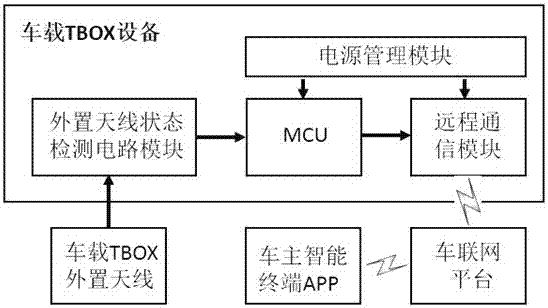
T-Box generally refers to the smart vehicle terminal in the Internet of Vehicles system. It communicates directly with the car CAN bus to obtain body status and vehicle condition information, and uploads these parameters to the TSP background. It can also receive instructions issued by the background and return the execution results. Based on this, the remote control function can be extended to mobile apps, smart keys, etc.
Of course, it is also possible to connect various external audio and video entertainment systems. T-Box can integrate OBD modules, and I thought it could replace OBD equipment as a rear-mounted module. However, based on the working principle and form of T-Box, as well as safety considerations, front-mounted modules would be better.
When we mentioned front-end equipment, we naturally also mentioned the OBD that was relatively popular five or six years ago (On Board Diagnostics)application.
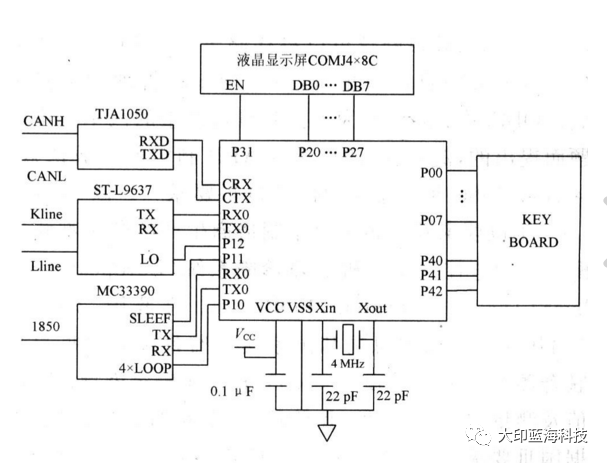
Common OBD circuit diagram
The OBD box is an after-installed product. An additional small box is inserted into the vehicle's OBD port to realize networking with the cloud and read a small amount of vehicle information. Generally, there is little vehicle control, and there are no other functions of TBOX. OBD refers to an OBD device that can be connected to the car's OBD diagnostic interface. It can collect vehicle bus data, conduct fault diagnosis, and integrate GPS chips, acceleration sensors, etc., and can obtain driving data. Combined with the mobile phone App, it can play a certain security role in vibration, displacement, and ignition alarms. Of course, some other vehicle-mounted devices will also choose to occupy the OBD interface, such as car navigation HUD, etc. Since the communication with the car uses the CAN bus that is commonly used in cars, it is also called CAN BOX in some applications, and they are all after-installed supporting products.
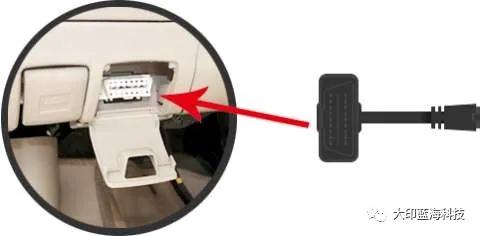
Installation of obd vehicle intelligent terminal hardware
The following is the market situation of OBD in 2017-2018:
Because a certain number of cars on the market did not have Internet functions before, we temporarily made this product to provide UBI insurance fleet management and other services. This is a transitional product. When T-BOX becomes popular in the future, its existing value will be very small.
T-Box can integrate OBD modules, and I thought it could replace OBD equipment as a rear-mounted module. However, based on the working principle and form of T-Box, as well as safety considerations, front-mounted modules would be better. Generally refers to the intelligent vehicle-mounted terminal in the Internet of Vehicles system, which directly communicates with the car CAN bus to obtain body status and vehicle condition information, and uploads these parameters to the TSP background. It can also receive instructions issued by the background and return the execution results. Based on this, the remote control function can be extended to mobile apps, smart keys, etc. Of course, it is also possible to connect various external audio and video entertainment systems.
The above two types of vehicle-mounted terminals, depending on the degree of cracking of the original factory agreement, can remotely control operations such as window raising, whistle, ignition, and air conditioning, and even more advanced functions. Since they need to be adapted separately for different brands, models, and models, the coverage of remote control functions is relatively limited.
About the interaction between TBOX and CAN bus
Due to the maturity and reliability of CAN bus technology, the in-car bus network of basically all cars is currently CAN. The figure below is the bus network of a general vehicle.
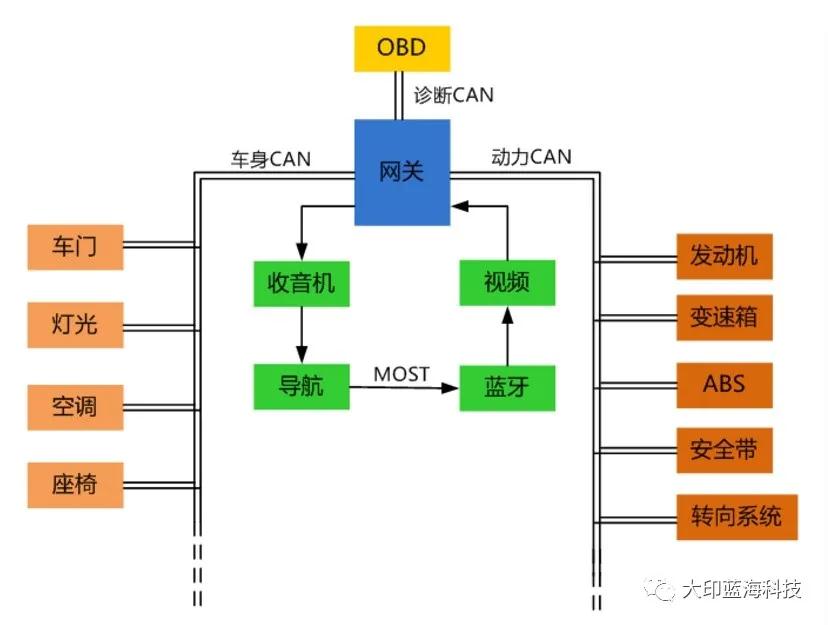
This is just a schematic diagram showing the general logical connection method. The bus architectures of each company are different, but they basically include high-speed and low-speed CAN networks (low-speed has a tendency to be eliminated). MOST is mainly used in entertainment systems that require relatively large amounts of data, and is not standard for all vehicles.
In order for TBOX to control some functions of the vehicle, it is inseparable from the operation of the CAN bus. There are generally three methods in the industry. OBD is not the practice of responsible OEMs and will not be mentioned in this answer.
1. Choose to connect directly to CAN and use TBOX as a node. (The column did not mention this in detail)
If you only need to implement the control function of a certain CAN in TBOX (usually body CAN, which has network management functions, the implementation is relatively simple), you can directly add TBOX to this network as a node, and use the same CAN transceiver to process mobile network signals, Bluetooth, WIFI and other signals into CAN signals. The advantage is of course that it is simple and direct. You only need to prepare the sleep wake-up mechanism and secure access of the TBOX node. The network management strategies of other nodes do not need to be modified again. The disadvantage is that the function is limited (of course, the TBOX signal can also be forwarded to the power CAN through the gateway, which is more troublesome, so there is method 2).
2. Integrate TBOX function with gateway
CAN interactions at different rates require a gateway to forward signals. If the TBOX function is integrated in the gateway, direct interaction with all CAN networks can be achieved, similar to the figure below. Such a connection method only requires adding network management to the nodes in the power CAN that support the TBOX function. The advantage is that information transmission is direct and effective, and implementation is simple. The disadvantage is that the security requirements are relatively high.
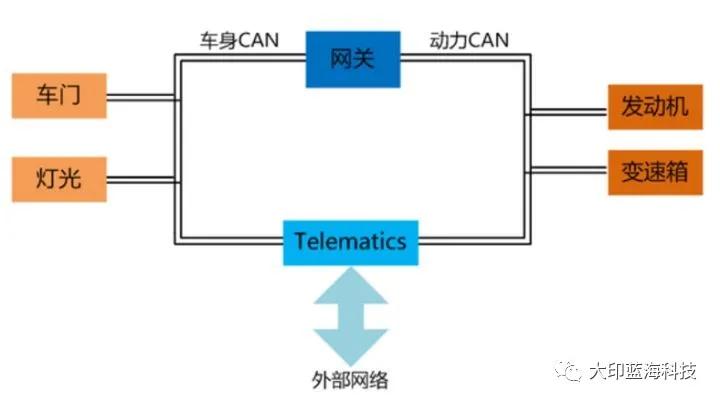
3. TBOX is connected to the CAN external network
Integrated in the MOST (or other) non-CAN network responsible for the entertainment system, relying on the gateway to forward messages. This structure is not used much in the industry now. Its advantages are: the external network is highly integrated with the entertainment system, making it easy to realize the entertainment and social attributes of the Internet of Vehicles; information needs to be forwarded through the MOST gateway, which is highly secure. Disadvantages: MOST bus cost is high and MOST gateway development is difficult.
The interaction principle is actually very simple, that is, TBOX can connect to the CAN network and send CAN messages, and the corresponding controlled node can be awakened and receive CAN messages from TBOX, nothing else. The implementation function is roughly the same, and I hope more consideration will be given to reliability and security. In fact, with the current development of automotive electronics, the limitations of the CAN bus are increasing, and the industry has slowly been looking for alternatives.
Flexray (CAN FD) and Ethernet are slowly emerging with corresponding standards and devices. If Ethernet is used in the car, it will basically take off for TBOX.
summary:Through comparison, it is found that the control principles implemented by OBD boxes and TBOX are basically similar. At present, the main "battlefield" of OBD boxes is the aftermarket. It is developed by auto parts suppliers and then sold to car owners. The OEMs are less involved because it involves the analysis and cracking of relevant protocols and related encryption. Algorithm certification has fewer functions that can be realized, mainly passive monitoring functions; TBOX's main "battlefield" is the pre-installation market, which is usually developed by vehicle manufacturers. It can better integrate with various car controllers and realize remote control of vehicle-mounted equipment. TBOX is usually assembled before the car is sold.
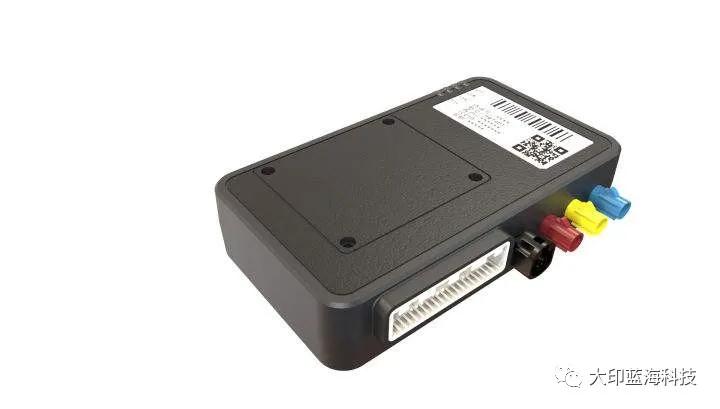
Common car TBOX
This article is reprinted from "Dayin Blue Ocean Technology", which supports the protection of intellectual property rights. Please indicate the original source and author when reprinting. If there is any infringement, please contact us to delete it.
Related Recommendations