






















Service Hotline
News

News

The battle of TWS main control chips, the balance between delay, noise reduction and stability
2021-12-28
922
Electronic Enthusiast Network reported (Text/Zhou Kaiyang) Among the many wireless connection technologies, Bluetooth has once again triggered a wave of market craze with the help of true wireless headphones (TWS). Bluetooth headsets are no longer a new technological product, but the emergence of TWS has solved most people's pain points with this product. Nowadays, major mobile phone and headset manufacturers have begun to launch new TWS headset products, and use powerful main control chips to achieve additional functions such as noise reduction and voice control. All of this also benefits from the low-power protocol BLE added from Bluetooth 4.0.
According to ABI Research, the number of BLE devices will reach 1.6 billion in 2023, achieving a compound annual growth rate of 27% from 2018 to 2023. With the continuous popularity of BLE technology in smart home, Internet of Things and other applications, this technology has been growing steadily since its emergence in 2010, and has become a hot spot in the Bluetooth market due to the surge in BLE audio applications. With the launch of Bluetooth 5.2, BLE has developed LE Audio high-quality audio transmission.
As the core of TWS, its main control chip fundamentally determines the performance and features of different Bluetooth headsets. According to Strategy Analytics, Apple accounted for 50% of the TWS market share in 2019 with the help of the Airpods series. Apart from Apple, what are the competitive TWS terminal products on the market and what are their main control chips?
Broadcom
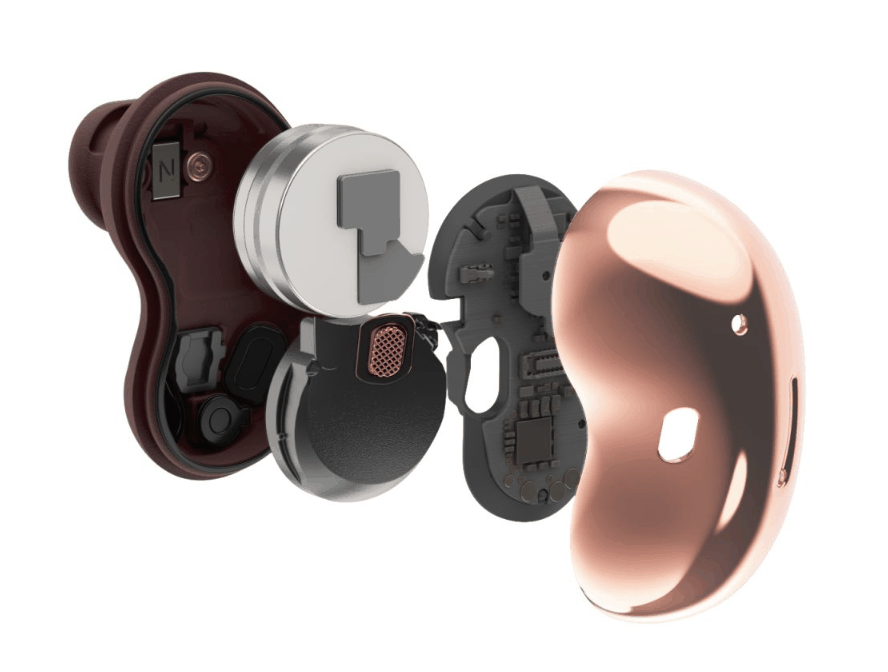
Galaxy Buds Live / 三星
The Galaxy Buds released by Samsung last year became the best TWS headset in 2019 rated by the American Consumer Reports. The headset was not only adjusted by AKG, but also used Broadcom's BCM43014 main control chip. Broadcom pointed out that the chip combines years of semiconductor expertise and wireless audio engineering technology. While supporting the Bluetooth 5 protocol, it uses seamlessly integrated advanced acoustic algorithms to reduce background noise.
In order to expand the market for active noise reduction TWS headphones, Samsung released two new products this year. The Galaxy Buds Plus released at the beginning of the year and the Galaxy Buds Live released this month both use Broadcom’s new main control chip BCM43015. The chip uses ARM Cortex-M4 as the MCU and ARM Cortex-M0+ as the sensor central processor. The BCM43015 also supports Low Power Shadow Technology (LPST) and Extended Synchronous Connection (eSCO), and uses Adaptive Frequency Hopping Technology (AFH) to reduce radio frequency interference. In addition, the chip also has built-in Cadence's Xtensa Hifi-3 DSP core as the audio subsystem, using a dual-channel 12-bit ADC to monitor the battery voltage.
Qualcomm
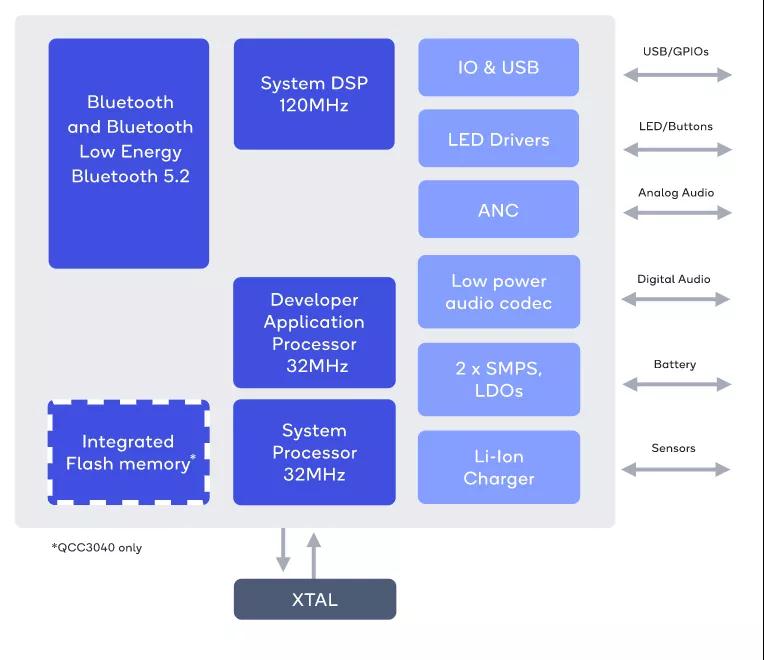
QCC3040 structure diagram / Qualcomm
Since Qualcomm acquired CSR, Bluetooth chips with the help of CSR have occupied most of the market, and now TWS will naturally not let go of the market opportunity. In addition to the QCC514x high-end Bluetooth chip released this year, Qualcomm also launched the QCC304x series for the entry-level and mid-range markets. Take the QCC3040 chip, for example. This chip uses two 32-bit processors (the highest frequency is 32MHz) and a 120MHz configurable DSP core, which reduces energy consumption by 70% compared with the previous generation QCC300x series. QCC3040 has built-in digital noise reduction technology with extremely low power consumption and supports the latest Bluetooth 5.2 protocol.
In addition to excellent performance, the biggest advantage of Qualcomm's Bluetooth chip is its support for audio codec protocols. Qualcomm's aptX can be said to be the most adaptable protocol among TWS headsets currently. It includes aptX Adaptive that focuses on stability, aptX HD that focuses on sound quality, and aptX LL (Low Latency) that targets low latency.
Apple
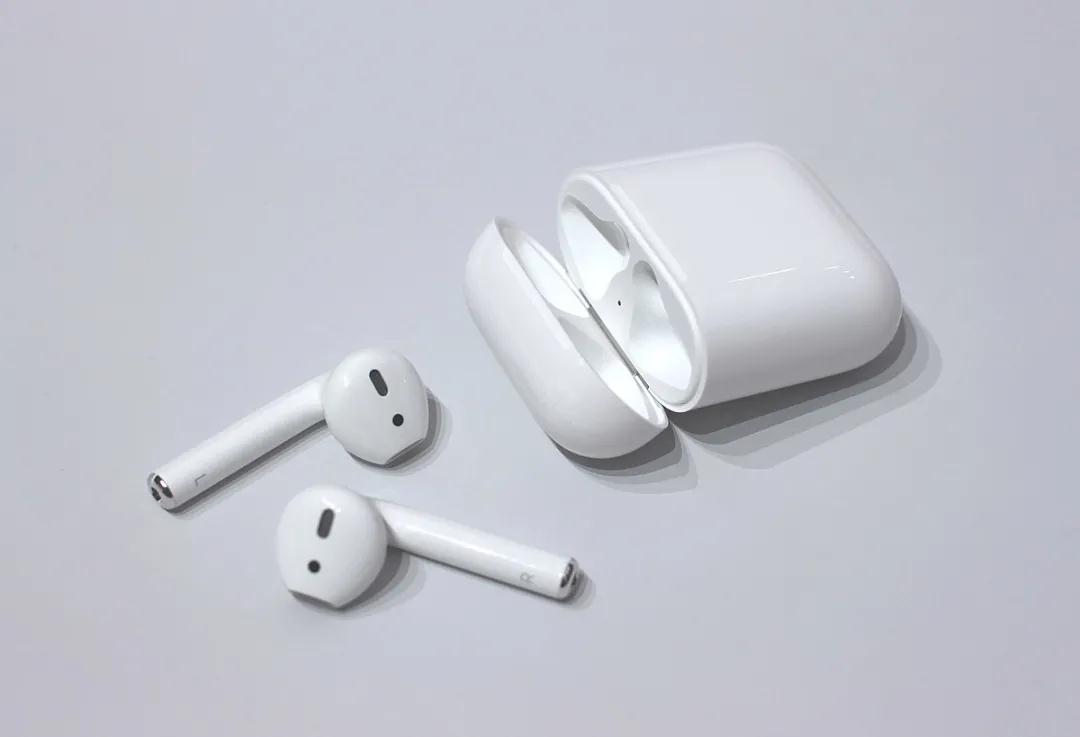
AirPods 1st generation / Apple
As the Airpods that made TWS popular in one fell swoop, its first-generation product used Apple’s self-developed W1 chip. However, in the second-generation products and Airpods Pro that were subsequently launched, Apple used the new H1 chip.
The new chip not only upgrades the Bluetooth 4.2 protocol to 5.0, but also increases the call life by 50%. Apple claims that the H1 chip allows the subsequent Airpods Pro to achieve 1.5 times the connection speed, while improving the stability, speed and distance of the Bluetooth signal, reducing latency by 30%, and adding new voice control functions.
Huawei
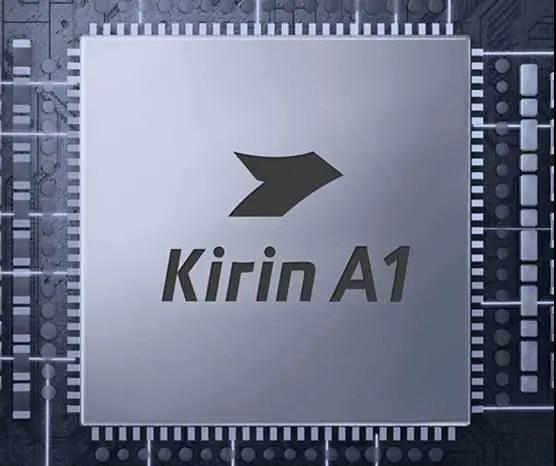
Kirin A1 chip / Huawei
Dual-channel synchronous transmission technology / Huawei
Huawei uses the Kirin A1 chip in FreeBuds 3, which is also the world's first SoC to pass BT/BLE dual-mode Bluetooth 5.1 certification. The chip uses a Cortex-M7 processor with a maximum frequency of 200MHz and a maximum power consumption of 10 uA/MHz, which is far lower than the industry’s 30uA/MHz power consumption standard. The chip is also equipped with a new dual-channel synchronous transmission technology and a 356MHz high-rate audio processing unit, which not only provides a stable and fast Bluetooth connection, but also reduces the delay in audio and video synchronization. Kirin A1 uses real-time 3A call noise reduction algorithm and adaptive noise reduction (ANR) to provide 15dB environmental noise reduction effect, and uses echo cancellation (AEC) to prevent the echo from the other party on the call.
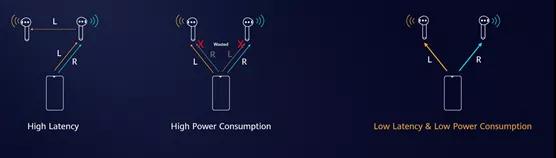
Huawei solves the problems of delay and power consumption through its self-developed dual-channel synchronous transmission technology. Traditional TWS headsets transmit the left and right channels to the main headset at the same time, and then forward it to the secondary headset. This causes problems of low forwarding efficiency, high delay, disconnection, and high power consumption. In addition, since Bluetooth and 2.4GHz Wi-Fi use the same frequency band, they can easily interfere with each other. This technology allows two headsets to receive communication from the left and right channels respectively, reducing power consumption by 50%, similar to the LE synchronization channel in Bluetooth 5.2.
Hengxuan Technology
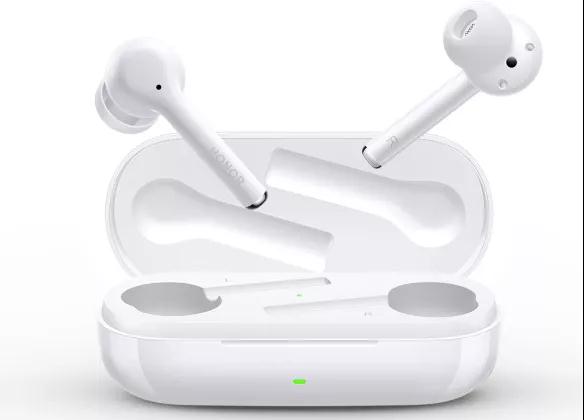
Honor Flypods 3 / Huawei
Before FreeBuds 3, Huawei’s TWS products mainly used Hengxuan Technology’s main control chip. For example, Huawei Freebuds 2 Pro and Honor FlyPods 3 both have built-in Hengxuan Technology’s BES2300 chip. BES2300 uses a 28 nm HKMG CMOS process, integrates a Cortex-M4F core, and supports ANC active noise reduction, with an average noise reduction effect of 25dB. In addition to Huawei, many domestic brands of headphones use Hengxuan Technology’s Bluetooth chips, such as Xiaomi’s Air2s and Oppo Enco W51.
In order to solve the propagation problem of traditional TWS solutions, Hengxuan Technology has also launched its own solution-LBRT low-frequency forwarding technology. This technology allows the forwarding of the main and secondary headphones to be maintained in the low frequency band (10-15MHz), thereby achieving low power consumption and low latency, while achieving a high bit rate music transmission of 3Mbps.
Realtek
RTL8773C芯片 / Realtek
Realtek released the dual-mode Bluetooth 5.0 chip solution RTL8763B for TWS in 2018. The chip consists of a 32-bit ARM Cortex-M4F processor and an ultra-low-power DSP core. Its baseband frequency is 40MHz, has a ROM size of 768KB, and uses an enhanced Tensilica Hi-Fi-mini 24-bit DSP core.
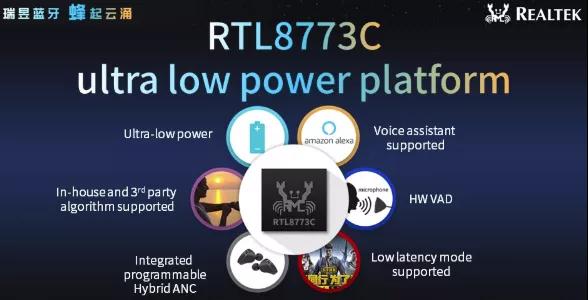
Last year, Realtek announced a new noise reduction chip solution, the RTL8773 series. This chipset supports environmental noise reduction (ENC) and hybrid active noise reduction (ANC). Realtek mentioned that the chip not only supports its own active noise reduction algorithm, but also supports third-party algorithms, with a noise reduction effect of up to 40dB. The RTL8763BFP in this series focuses on low-latency applications and can achieve latencies of 100ms or even lower. This has a great advantage compared with other main control chips, such as Huawei Freebuds 3 (Kirin A1: 190ms) vivo TWS Earphone (QCC5126: 180ms) and Airpods Pro (H1: 144ms).
Airoha
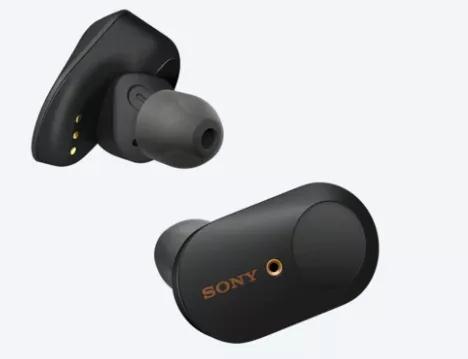
WF-1000XM3 headphones / Sony
Luofa Technology became a member of MediaTek Group in 2017 and is also the main chip supplier of Sony TWS products. Sony’s latest noise-cancelling TWS headphones, WF-1000XM3, use Luofa’s AB1552A chip (MediaTek model MT2811SP). Sony has also added its own noise-cancelling processor QN1e to the headphones. In 2019, Luofa launched the hybrid active noise reduction main control chip solution AB155x. This series of chips has a built-in ARM Cortex-M4 processor with a maximum frequency of 156MHz, and a Tensilica HiFi mini DSP core with a maximum frequency of 312MHz. In addition, AB155x uses self-developed MCSync (Multicast Synchronization) technology. TWS headsets supported by MCSync technology can achieve a more stable connection, reduce intermittent audio and reduce latency, and support Hi-Res audio decoding.
summary
Compared with traditional Bluetooth headsets or traditional noise-cancelling Bluetooth headsets, TWS headsets have certain degradation in battery life, noise reduction effect and sound quality. But considering the limitations on size and power consumption, it is natural to make such a compromise. However, with the further improvement of Bluetooth chip process technology, Bluetooth chips will make breakthroughs in performance in the future.
In order to reduce delay and interference, many chip manufacturers have provided their own solutions. However, as Bluetooth 5.2 expands its market share, LE synchronization channels may be uniformly used in the future. Judging from the product certification page of the Bluetooth Technology Alliance, many terminal, chip and IP manufacturers are beginning to prepare the next generation of Bluetooth 5.2 products. From this point of view, the era of TWS headsets occupying the entire Bluetooth headset may soon come.
This article is reproduced from "Electronic Enthusiast Network", support the protection of intellectual property rights, please indicate the original source and author when reprinting. If there is any infringement, please contact us to delete it.
Related Recommendations