























Service Hotline
Nieuws

Nieuws

Uitdagingen en tegenmaatregelen bij de grootschalige uitrol van 5G
2021-12-28
908
samenvatting:Met de ontwikkeling van de commerciële 5G-licentie van mijn landHet inrichten en uitrollen van netwerken is cruciaal geworden. Dit artikel analyseert in detail het potentieel voor 5G-uitrol op grote schaal vanuit verschillende perspectieven.het juiste moment, evenals de problemen en uitdagingen die zich in 6 aspecten kunnen voordoen, en ten slotte de focus op de belangrijkste uitdagingen.Corresponding measures will be taken.
voorwoord
Op 6 december 2018 heeft het Ministerie van Industrie en Informatietechnologie testlicenties voor midden- en lage frequentiebanden van 5G-systemen verstrekt aan de drie grootste telecomaanbieders. China Telecom en China Unicom ontvingen testlicenties voor de 3500 MHz-band, terwijl China Mobile testlicenties ontving voor de 2600 MHz- en 4900 MHz-banden. Frequentiebronnen vormen de kern van de strategische infrastructuur van mobiele communicatienetwerken. De verstrekking van deze testlicenties voor 5G-systemen in China garandeert telecomaanbieders dat ze de grootschalige aanleg van 5G-testnetwerken volledig kunnen uitvoeren en bevordert de verdere ontwikkeling van de 5G-industrie in China.
De drie grote operators zijn ook actief bezig met de aanleg van 5G-proefnetwerken in het hele land. China Mobile bouwde in 2018 een grootschalig proefnetwerk in vijf steden: Shanghai, Suzhou, Hangzhou, Guangzhou en Wuhan, en breidde dit in 2019 uit naar 40 steden. China Telecom heeft een provincie- en domeinoverschrijdend grootschalig proefnetwerk gebouwd met SA als belangrijkste component en een hybride SA/NSA-netwerk, en heeft demonstratieprojecten voor 5G-innovatie gelanceerd in 17 steden, waaronder Beijing, Shanghai, Guangzhou en Shenzhen. China Unicom heeft de uitrol van een "7+33+n" 5G-proefnetwerk bevorderd, dat de kerngebieden van zeven steden bestrijkt, waaronder Beijing, Shanghai, Guangzhou, Shenzhen, Nanjing, Hangzhou en Xiongan, hotspotdekking realiseert in 33 steden en 5G-netwerken op maat aanbiedt in n steden.
Op 6 juni 2019 heeft het Ministerie van Industrie en Informatietechnologie commerciële 5G-licenties verleend aan China Telecom, China Mobile, China Unicom en China Radio en Televisie. Mijn land is daarmee officieel het eerste jaar van de commerciële uitrol van 5G ingegaan. De grootschalige uitrol van 5G-netwerken is de belangrijkste taak voor telecomoperators. Dit artikel analyseert de mogelijke problemen en uitdagingen bij de grootschalige uitrol van 5G vanuit verschillende perspectieven, zoals standaarden, apparatuur, basisresources en toepassingen in verticale sectoren.
Timing van de grootschalige uitrol van 5G
De vroege uitgifte van commerciële 5G-licenties in mijn land betekent niet dat de voorwaarden voor grootschalige uitrol onmiddellijk vervuld zullen zijn.Als we het commerciële proces van 4G vergelijken, werd de eerste versie van de R8-standaard in 2009 gepubliceerd en begonnen buitenlandse operators in datzelfde jaar met de commerciële uitrol. Nadat de ITU in 2012 LTE-Advanced officieel had goedgekeurd als de officiële 4G-standaard, gaf mijn land in december 2013 officieel 4G-licenties af. Omdat er vol成熟e standaarden, apparatuur en grootschalige bouwervaring in het buitenland beschikbaar waren, konden binnenlandse operators direct overgaan tot de grootschalige uitrol van netwerken.De volledige standaard voor 5G (R16) zal pas in 2020 worden gepubliceerd. Momenteel zijn de standaarden, chips, apparatuur en toepassingen nog niet klaar voor volledige implementatie.The timing of large-scale 5G deployment depends on several important factors.
1.1 Standard process
The two version standards of R15 (Option3 and Option2) were promulgated in December 2017 and June 2018 respectively, and the late drop version standard (Option4/7) was promulgated in June 2019. The R16 standard that truly realizes all the functions of 5G will be promulgated in March 2020 and frozen in June. From the standard process, the current network can only support eMBB and basic URLLC services.
1.2 Chips en apparatuur zijn volwassen
In January 2019, the IMT-2020 (5G) Promotion Group announced at the 5G technology research and development test phase 3 summary meeting held in Beijing that the 5G phase 3 test was basically completed. Both 5G base stations and core network equipment can support non-independent networking and independent networking modes. The main functions are in line with expectations and have reached pre-commercial levels.
On May 21, 2019, the Ministry of Industry and Information Technology stated at the State Council’s regular policy briefing held by the State Council Information Office that my country’s 5G products are becoming increasingly mature, and systems, chips, terminals and other links have basically reached commercial levels, and are ready for commercial deployment.
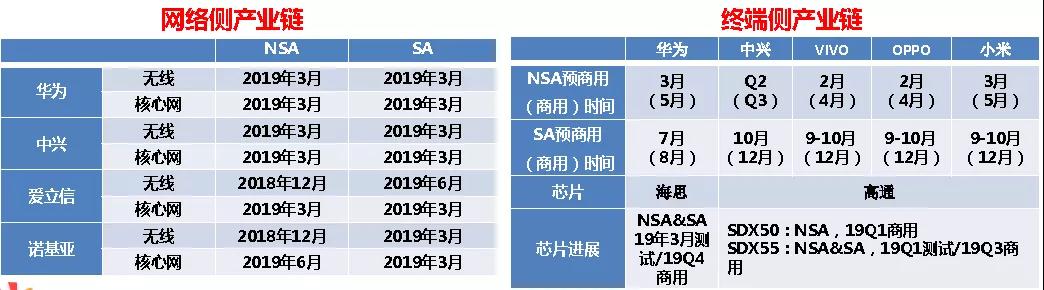
The supply process of main 5G network side and terminal side products is shown in Table 1 and Table 2.
1.3 Basic resource reserves
Compared with 4G networks, 5G has undergone revolutionary changes from network structure to equipment form, and has higher and stricter requirements for various basic resources. CU/DU/AAU reconstruction and new business requirements have triggered the adjustment of the 5G access network network structure, with the addition of fronthaul bearing, CU/DU aggregation (C-RAN networking), UPF/MEC sinking and other major changes. The demand for access-side transmission resources (optical switches, pipes, optical cables) and aggregation equipment rooms, two basic physical resources, needs to be adjusted, optimized and added as much as possible before large-scale base station deployment.
The existing towers and floor resources already carry 2/3/4G network equipment of various standards and frequency bands from the three major telecom operators. The degree of co-construction and sharing is very high. It is very difficult to add 5G AAUs, especially to meet the simultaneous deployment of multiple operators. Before large-scale deployment, the existing towers and systems need to be detailed, integrated and optimized to improve the availability and value of the existing sites.
1.4 Application maturity
The design goal of 5G is to fully meet the needs of the three major scenarios (eMBB/uRLLC/mMTC), evolving from to C as the main player to to C and to B flying together. From a certain perspective, the mission of 5G is to fully enable various vertical industries and drive the informatization and intelligent upgrading of all walks of life in society through integration with vertical industries. At present, the integrated application of 5G and vertical industries is still in the preliminary exploration stage (as shown in Figure 1). Telecom operators demonstrate network capabilities and application prospects through various 5G+ application demonstrations, set up platforms, build circles, and form groups to achieve mutual penetration and mutual influence, driving the true commercial maturity of 5G applications, which in turn promotes more complete network construction.
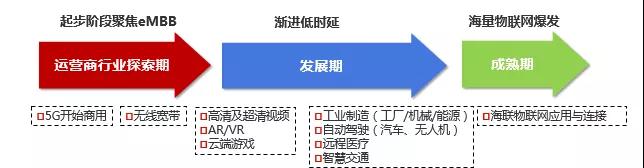
Figure 1 5G application development stages and typical applications
1.5 Steun van de lokale overheid
Op basis van de volwassenheid van standaarden en technologieën hebben lokale overheden beleid geïntroduceerd ter ondersteuning van de ontwikkeling van 5G-gerelateerde infrastructuur en industrieën, en duidelijke actieplannen en ontwikkelingsdoelen geformuleerd. Neem bijvoorbeeld de "Implementatierichtlijnen van de provinciale overheid van Zhejiang voor het versnellen van de ontwikkeling van de 5G-industrie". Deze richtlijnen bevatten gedetailleerde plannen voor twee tijdsknooppunten (2020 en 2022). Op basis van de voltooide bouwtaken en netwerkdekkingsdoelen kan 5G tegen 2022 breed worden ingezet en diepgaand worden geïntegreerd in diverse economische en maatschappelijke sectoren, een internationaal toonaangevend niveau bereiken, een uitstekend 5G-industrieel ecosysteem opbouwen en een nationaal pioniersgebied voor de aanleg van 5G-netwerken, een internationaal invloedrijk clustergebied voor de ontwikkeling van de 5G-industrie en een demonstratiegebied voor innovatieve 5G-toepassingen worden.
1.6 Het juiste moment voor grootschalige implementatie
Op basis van bovenstaande factoren wordt aanbevolen dat het tempo van de binnenlandse uitrol van 5G-netwerken als volgt verloopt: In 2019 zal de uitrol beginnen in hotspots in belangrijke steden en gebieden met een hoge vraag, waarna de ontwikkeling en uitbreiding verder zal worden voortgezet; in 2020 zal de eerste grootschalige uitrol plaatsvinden na de officiële lancering van de R16-standaard, en zullen netwerkgestuurde diensten verder worden ontwikkeld. Van 2012 tot 2022 zal de omvang en diepte van de netwerkuitrol verder worden uitgebreid, en zullen de netwerkuitrolstrategie en -capaciteit worden verfijnd op basis van dekkings- en bedrijfsscenario's om de geïntegreerde ontwikkeling van diverse industrieën en 5G effectief te ondersteunen.
Uitdagingen
Naarmate de standaarden en apparatuur zich verder ontwikkelen, zal de grootschalige uitrol van 5G-netwerken nog steeds te maken krijgen met diverse moeilijkheden en uitdagingen op het gebied van netwerkplanning, basisvoorzieningen en technische implementatie. Deze kunnen als volgt worden samengevat.
2.1 Choice of network NSA/SA deployment
In the early stage, 5G mainly uses large-bandwidth access capabilities to support large-traffic services, such as VR, AR, 4K/8K high-definition live broadcast backhaul, etc. In order to quickly commercialize 5G, NSA (Option 3 solution) based on 4G core network EPC can be deployed in the early stage. With the maturity of standards, equipment and industries, and the demand for more low-latency and large-connection services, it has become a must to build an SA (5GC+NR, Option 2 solution) network that fully supports 5G new business requirements and related functions.
Vanuit het perspectief van het benutten van marktkansen is het noodzakelijk om snel een 5G-netwerk op basis van NSA uit te rollen en dit vervolgens te transformeren en te upgraden naar een SA-netwerk. Uit een uitgebreide kostenanalyse (TCO) blijkt dat de kosten voor het eerst bouwen van een NSA-netwerk hoger liggen dan de kosten voor het direct uitrollen van een SA-netwerk wanneer dat nodig is.
2.2 What are the changes and impacts of gNB after CU/DU reconstruction?
The 5G base station gNB after CU/DU reconstruction is divided into three parts of logical functions CU+DU+AAU, which raises the following questions: whether the physical entities of CU/DU are jointly installed or separated, what method is used for fronthaul bearer between AAU and DU, the impact of the form (volume, weight, power consumption) of AAU, and whether the wireless access network architecture needs to be adjusted. Among these issues, the form and deployment of CU and DU are the most critical. Currently, the equipment form provided by the industry is a combination of CU/DU, which is similar to the 4G BBU. It can be deployed centrally or decentrally. The transmission bearer is divided into fronthaul + backhaul. Based on business needs in the later stage, CU and DU are independent physical entities, forming a three-level architecture (CU-DU-AAU). The CU deployment location can be high or low. Based on business needs, DU can be aggregated or dispersed. The transmission bearer is divided into fronthaul + midhaul + backhaul.
2.3 Is there any adjustment to the 5G NR access network architecture?
Sinds de opkomst van gedistribueerde basisstations (BBU+RRU) kennen draadloze toegangsnetwerken twee bouwmodi: DRAN en C-RAN. De C-RAN-modus maakt gebruik van BBU's om de resources in de computerruimte centraal te beheren. Samenwerking tussen basisbandbronnen verbetert de efficiëntie en verlaagt de kosten voor de aanleg op afstand, maar verhoogt tegelijkertijd de transmissieresources en de onderhoudsdruk. In het 5G-tijdperk is C-RAN van grotere waarde. Gezien de diverse en flexibele zakelijke scenario's, moet de architectuur van het draadloze toegangsnetwerk flexibeler en robuuster zijn en moet het netwerk toegang tot diensten op aanvraag ondersteunen. Scheiding van CU/DU en aggregatie van DU's bevorderen de introductie van SDN/NFV, waardoor flexibele resource-orkestratie/slicing en automatisch netwerkonderhoud mogelijk worden. Verticale industrie-integratie vereist decentralisatie van netwerkfuncties, de inzet van MEC en de decentralisatie van het media-oppervlak. Het 5G NR-toegangsnetwerk op basis van C-RAN kan telecomoperators effectief ondersteunen bij het optimaliseren van verbindingsdiensten, het versterken van verbindingsapplicaties en het opbouwen van een concurrentievoordeel ten opzichte van internetbedrijven. Uiteraard staat het ook onder enorme druk wat betreft de bouw en het onderhoud van essentiële voorzieningen zoals computerruimtes, pijpleidingen en optische schakelaars.
2.4 Voldoening van de beschikbare resources op macro-/microstationslocaties onder de 6GHz-band
Three domestic telecom operators have all obtained 5G frequency bands below Sub 6GHz. In terms of coverage capabilities, China Mobile's 2.6GHz capability is the strongest. From an analysis of industry maturity, China Telecom and China Unicom have obtained 3.5GHz. At present, the three major telecom operators have very rich 2/3/4G network site resources, but the site property properties are very diverse, including owned by the operator, owned by the tower company, owned by a third-party company, and public properties (all kinds of light poles, floor resources, etc.).
The availability of existing site sites involves many factors. From a coverage perspective, it includes the coverage capabilities of 5G base stations (2.6/3.5GHz), the satisfaction of existing site sites, the acquisition of new site sites, and the acquisition of pole resources for small and micro base stations; from the transformation of existing resources, it includes equipment room facilities and sky towers From the perspective of network structure, it includes basic resource system issues under C-RAN networking and how to anchor 4G base stations; from the perspective of meeting business needs, the analysis includes different value areas, special business scenarios, and different network deployment and site requirements for 2B services.
2.5 5G gNB equipment requirements for supporting transformation
The new 5G gNB base station has much higher requirements for computer room facilities and antenna facilities than the previous 2/3/4G base stations. The main reason is that the new AAU equipment has increased in size, weight and power consumption. Table 3 is the current parameter table of typical equipment.
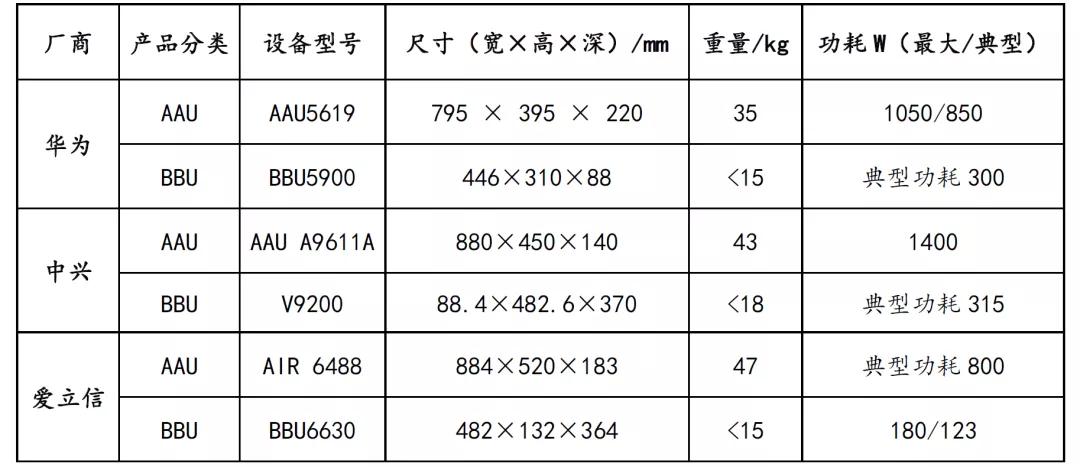
Tabel 3 Fysieke parameters van 5G gNB-apparatuur van grote fabrikanten
The new AAU product form and physical parameters bring four factors.
a) The sky space is tight. Under the background of co-construction and sharing, multi-operators and multiple systems are deployed on the same tower, which leads to the shortage of antenna resources and the difficulty of adding 5G AAU equipment.
b) The load-bearing requirements are higher. 5G AAU is usually large in size (more than 35L), heavy (more than 40kg), and has a large windward surface (more than 0.5m2). The process modification requirements for the sky tower mast are significantly higher than those of 4G.
c) Landschapsverfraaiing is beperkt. De bestaande verfraaide antenne heeft beperkte interne installatieruimte en voldoet niet aan de eisen voor installatieruimte en warmteafvoer van de 5G AAU.
d) Transformatie van het AC/DC-voedingssysteem. De toevoeging van een 5G-systeem zal de AC- en DC-voedingssystemen van bestaande basisstations zwaarder belasten. Vooral in scenario's waar meerdere locaties worden gedeeld, vormen onvoldoende AC-netcapaciteit en de noodzaak tot transformatie belangrijke beperkende factoren voor grootschalige 5G-implementatie. Het voedingssysteem is weergegeven in figuur 2.
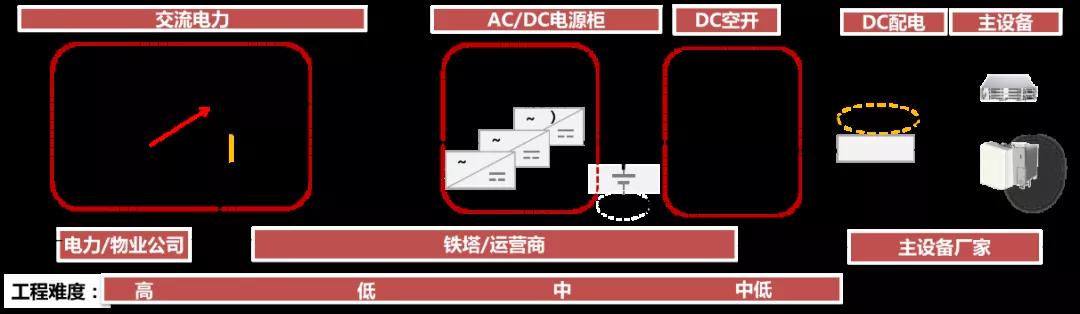
Figure 2 5G base station AC and DC power supply system diagram
2.6 Bespreking van het constructiemodel voor 5G-distributie binnenshuis
Binnenruimtes zijn een gebied met een hoge incidentie van datadiensten en veel scenario's zijn ook zeer waardevolle toepassingsgebieden voor 5G-diensten. De aanleg van 5G-distributie binnenshuis moet echter rekening houden met de volgende problemen.
a) Diversity.
(a) Diversity of existing network indoor coverage construction modes, including DAS, small panels, leaky cables, leather stations, etc.
(b) 5G moet diverse zakelijke ondersteuningsmogelijkheden bieden.
(c) Het probleem aanpakken van hoe diverse soorten dekkingsscènes te construeren.
b) Complexiteit.
(a) Traditionele DAS is een passief ruimtesysteem dat niet kan worden bewaakt en beheerd. Het is moeilijk om storingen te verhelpen en nieuwe verbindingen tot stand te brengen.
(b) Het aandeel van de uitrol van digitale ruimtedistributie is niet hoog en kan geen verfijnde beoordeling en voorspelling van netwerkbronnen ondersteunen.
(c) How to transform and maintain requires huge investment in manpower and material resources.
c) Waarde.
(a) Typische zakelijke scenario's voor 5G binnenshuis zijn onder andere VR/AR, slimme productie, slimme energie, draadloze medische toepassingen, enz.
(b) Customized indoor coverage system solutions are required for different value scenarios.
d) Economisch.
(a) The demand is huge and there are many sites, so most of the existing rooms need to be upgraded.
(b) Operators have introduced digital room distribution solutions on a large scale in the middle and late stages of 4G networks. Facing 5G, the usage of digital room distribution will increase significantly and the cost will be effectively reduced.
(c) Different scenarios require construction methods to achieve optimal cost performance.
tegenmaatregelen
3.1 Overall response ideas
a) Begin with the end in mind and bury your capabilities in advance. In-depth exploration of existing site sites, computer rooms, transmission and other resources, with the goal of comprehensive 5G SA network coverage, combined with 5G NR wireless access network network structure adjustment, and in accordance with the C-RAN overall plan, resource planning and capacity reservation are carried out in advance to form complete basic resources (site sites, computer rooms, pipelines, optical cables) for large-scale commercial use.
b) De apparatuur staat stand-by en de ondersteunende apparatuur is eerst beschikbaar. Gezien de mogelijkheden voor het upgraden en leveren van de eerste 5G-hoofdapparatuur, is er geen haast met de volledige uitrol. Op basis van het locatiegedeelte van het alomvattende 5G-uitrolplan zullen locaties, antennes, apparatuurruimtes en andere faciliteiten die gerenoveerd of nieuw gebouwd moeten worden, indien nodig, van tevoren worden gerenoveerd om te voldoen aan de eisen van een snelle en grootschalige uitrol van 5G.
c) Speciale projecten opzetten en samen vooruitgang boeken. Voor de grootschalige uitrol van 5G-netwerken worden een speciaal 5G-engineeringimplementatiecentrum en een multidisciplinair promotiemodel opgezet, inclusief draadloze communicatie, transmissie, computerruimte en volledige dienstverlening, om communicatie- en coördinatieproblemen te verminderen en de voortgang en kwaliteit van de projectuitvoering te verbeteren.
d) Voordeel van de eerste mover en vastgelegde resources. Profiteer van het voordeel van China Mobile als eerste 5G-aanbieder op het gebied van schaalvergroting en combineer locatiekenmerken om hoogwaardige locatie-, antenne- en computerruimteresources vooraf vast te leggen bij torenbedrijven.
3.2 Use C-RAN as the basic architecture to form basic resource capability reserves
Before large-scale deployment of 5G, it is necessary to reserve the capacity of basic resources. From the aspects of reducing investment and operation and maintenance costs and future-oriented technology development and business deployment, C-RAN is used as the infrastructure of the 5G NR wireless access network. C-RAN planning and construction relies on the construction of comprehensive service areas. The overall network planning and corresponding basic resource capacity reserves can be completed in the order of surface (integrated service area) to point (C-RAN convergence room) and then to line (fronthaul/backhaul bearer network). In order to better realize the rapid deployment of 5G wireless networks in the future, it is recommended to comprehensively carry out C-RAN architecture evolution planning for 5G evolution in the existing 4G network planning as soon as possible. The specific suggestions are as follows.
a) Voer transmissieplanning uit op basis van fronthaul-toegang tot afgelegen RRU-locaties als vereisten voor toegang tot transmissiediensten, met een optisch kabelnetwerk als leidraad en een uitgebreid servicegebied als kader voor de planning van de C-RAN-gebiedsindeling. Het wordt aanbevolen dat een enkel C-RAN-gebied ongeveer 8 tot 10 macro-station fysieke punten omvat, met een oppervlakte van 0.5 tot 5 km², en dat een enkel geïntegreerd servicegebied wordt onderverdeeld in 3 tot 4 C-RAN-gebieden.
b) Voer een planning uit voor de toegangscomputerruimtes, afgestemd op de evolutiebehoeften van de C-RAN-architectuur, en selecteer computerruimtes met goede faciliteiten als centrale BBU-locatiepunten. Het wordt aanbevolen de computerruimte te plaatsen rond het eerste glasvezeldistributiepunt, zodat er twee convergente computerruimtes in een ring kunnen worden geplaatst. Voor de computerruimte wordt een oppervlakte van minimaal 20 m² aanbevolen.
c) Planning van fronthaul-toegang voor de C-RAN-evolutie: In dit stadium kan gekleurde glasvezel worden overwogen voor de fronthaul. Een enkel fysiek punt kan op een verstandige manier worden ontworpen om de glasvezelkernconfiguratie te combineren, demultiplexen en verzenden, gebaseerd op het aantal momenteel gebruikte frequentiepunten en de toekomstige frequentie-uitbreidingsvereisten. Wat betreft de selectie van toegangspunten voor externe locaties, kunnen co-located stations prioriteit geven aan het gebruik van bestaande glasvezelkabelroutes, zoals macro-locaties die gebruikmaken van oude aggregatie-toegangsringen en micro-locaties die gebruikmaken van oude uplink-glasvezelkabels. Locaties in het gehele bedrijfsgebied moeten hun verbindingen aanpassen. Volgens het nieuwe locatieplan wordt aanbevolen dat nieuwe locaties gebruikmaken van nabijgelegen optische centrales van niveau 2 en lager, en wordt het afgeraden om rechtstreeks via optische centrales van niveau 1 toegang te krijgen. Dit helpt om de glasvezelkernbronnen van de backbone te besparen.
3.3 Voltooi de optimalisatie en integratie van de sky-oppervlakken vooraf om de beschikbaarheid van torens en masten op bestaande locaties te garanderen.
In order to solve the problem of tight antenna resources in 5G construction, on the premise of reusing the old site as much as possible, combined with the current situation of antenna resources, high-quality space is prepared for 5G AAU according to the following priorities: reuse old poles - build new poles - replace poles - antenna integration (multi-port antenna).
Antenne-integratie kan voorafgaand aan de grootschalige uitrol van 5G in één project worden uitgevoerd. Het is aan te raden de volgende correctieprincipes te volgen.
a) De integratie en transformatie van het luchtruim is van toepassing op stedelijke gebieden, provincies en hotspots. Landelijke gebieden en locaties langs doorgaande wegen vallen voorlopig niet onder de integratie van het luchtruim.
b) Houd het totale aantal bestaande hemeloppervlakken ongewijzigd en voeg in principe geen nieuwe hemelsystemen toe en verminder het aantal hemelsystemen niet (met uitzondering van locatiesystemen met slechts één hemeloppervlak).
c) 5G-antennes en bestaande 4G-antennes delen zoveel mogelijk één antennesysteem.
d) During the antenna reconstruction, network optimization and adjustment need to be carried out simultaneously. For the stability of network coverage, during the antenna reconstruction and integration process, try to keep the main 4G coverage layer as fixed as possible.
3.4 Classificatietransformatie van wisselstroom- en gelijkstroomvoedingssystemen
The AC-DC power system transformation must take into account the current status of existing sites on the one hand, and the 5G equipment and its subsequent evolution on the other. The current equipment requirements for the AC-DC system are shown in Table 4.
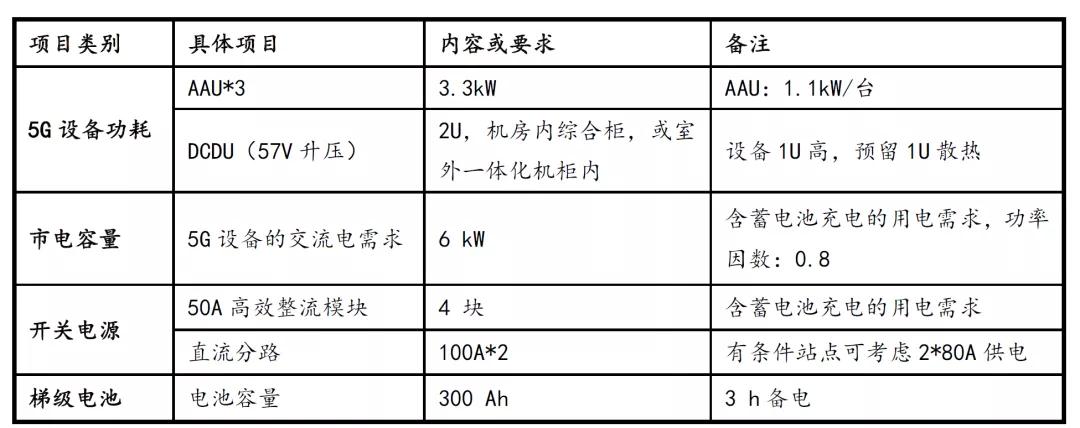
Table 4 5G gNB equipment requirements for AC and DC systems
Transformatieprincipes en stappen:
a) Power matching: Priority is given to reusing the original machine room, switching power supply and battery, and appropriately adding power supply matching according to the site conditions to meet the power supply construction needs of 5G construction.
b) Externe netvoeding: Prioriteit wordt gegeven aan het gebruik van de bestaande externe voeding. In geval van onvoldoende externe voeding kunnen de externe voedingsbehoeften van 5G worden opgelost door middel van piekbelastingvermindering van de batterij, capaciteitsuitbreiding en andere maatregelen om de bouwkosten te minimaliseren. De omzetting van de externe netvoeding is complex en kan worden uitgevoerd volgens de stappen in Figuur 3.
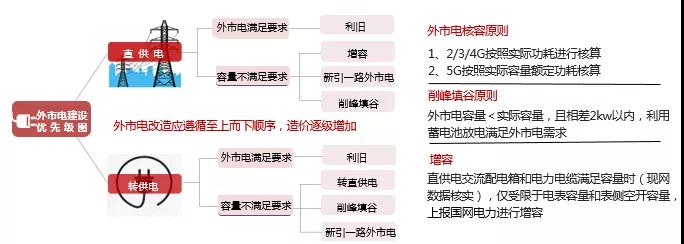
Figure 3 AC system transformation plan
3.5 Build differentiated room distribution systems based on scenarios
Er zijn veel scenario's voor de inrichting van indoor distributiecentra. Het is aan te raden om gedifferentieerde strategieën te hanteren, gebaseerd op de specifieke kenmerken en behoeften van 5G-bedrijven.
a) Voor waardevolle ruimtes wordt het aanbevolen om digitale ruimtescheiding te gebruiken.
b) Gebruik een pico-basisstation + DAS voor gebieden met gemiddelde waarde.
c) Use outdoor covering indoors for low-value areas.
d) Use 5G information sources to feed into existing DAS systems for specific scenarios.
Conclusie
oprichtenProper use is not the purpose of 5G, but good use is the real purpose of 5G.5G network coverage will be launched first in hotspot areas and areas with high demand, and then continue to develop and advance based on the needs of users and services.The main goal of the 5G network is to realize the interconnection of everything and an intelligent society. Therefore, the network deployment strategies and methods are different from the 4G network. It is more necessary to consider all aspects of resources in order to deploy a robust, powerful and flexible 5G network.
Disclaimer: dit artikel komt van internetOvergenomen uit " C114 Communication Network" supports the protection of intellectual property rights. Please indicate the original source and author when reprinting. If there is any infringement, please contact us to delete it.
Related Recommendations