























Service Hotline
Aktualności

Aktualności

Wyzwania i środki zaradcze związane z wdrażaniem technologii 5G na szeroką skalę
2021-12-28
908
streszczenie:With the development of my country’s 5G commercial licenseProvisioning, network-scale deployment has become crucial. This article analyzes in detail the potential for 5G-scale deployment from multiple perspectives.the appropriate time, as well as the problems and challenges that may be faced in 6 aspects, and finally focus on the main challengesZostaną podjęte odpowiednie środki.
Przedmowa
On December 6, 2018, the Ministry of Industry and Information Technology issued 5G system mid- and low-band test frequency licenses to the three major telecom operators. Among them, China Telecom and China Unicom obtained test frequency use licenses in the 3500MHz band, and China Mobile obtained test frequency use licenses in the 2600MHz and 4900MHz frequency bands. Frequency resources are the core strategic resources of mobile communication networks. The issuance of my country's 5G system trial frequency licenses effectively guarantees telecom operators to comprehensively carry out the construction of 5G large-scale trial networks and further promotes the maturity and development of my country's 5G industry chain.
The three major operators are also actively carrying out 5G trial network construction across the country. China Mobile built a large-scale trial network in five cities: Shanghai, Suzhou, Hangzhou, Guangzhou and Wuhan in 2018, and expanded it to 40 cities in 2019. China Telecom has built a cross-province and cross-domain large-scale trial network with SA as the main component and SA/NSA hybrid networking, and has launched 5G innovation demonstration pilots in 17 cities including Beijing, Shanghai, Guangzhou, and Shenzhen. China Unicom has promoted the deployment of "7+33+n" 5G trial network, covering the core areas of seven cities including Beijing, Shanghai, Guangzhou, Shenzhen, Nanjing, Hangzhou, and Xiongan, achieving hotspot area coverage in 33 cities, and customizing 5G networks in n cities.
On June 6, 2019, the Ministry of Industry and Information Technology issued 5G commercial licenses to China Telecom, China Mobile, China Unicom, and China Radio and Television. my country has officially entered the first year of 5G commercialization. Large-scale deployment of 5G network construction is the primary task faced by telecom operators. This article analyzes the possible problems and challenges faced by large-scale deployment of 5G from multiple perspectives such as standards, equipment, basic resource reserves, and vertical industry applications.
Timing of large-scale 5G deployment
The early issuance of my country's 5G commercial licenses does not mean that the conditions for large-scale deployment will be immediately met.Comparing the 4G commercial process, the first version of the R8 standard was promulgated in 2009, and foreign operators began commercial use in 2009. After the ITU officially approved LTE-Advanced as the official 4G standard in 2012, my country officially issued 4G licenses in December 2013. Because there are mature standards, equipment and foreign scale construction experience for reference, domestic operators immediately carried out large-scale network deployment.Pełny standard 5G (R16) zostanie opublikowany dopiero w 2020 roku. Obecnie standardy, układy scalone, sprzęt i aplikacje nie są gotowe do pełnego wdrożenia.Termin wdrożenia technologii 5G na dużą skalę zależy od kilku ważnych czynników.
1.1 Proces standardowy
The two version standards of R15 (Option3 and Option2) were promulgated in December 2017 and June 2018 respectively, and the late drop version standard (Option4/7) was promulgated in June 2019. The R16 standard that truly realizes all the functions of 5G will be promulgated in March 2020 and frozen in June. From the standard process, the current network can only support eMBB and basic URLLC services.
1.2 Chips and equipment are mature
W styczniu 2019 roku Grupa Promocyjna IMT-2020 (5G) ogłosiła podczas spotkania podsumowującego trzecią fazę testów badań i rozwoju technologii 5G, które odbyło się w Pekinie, że testy trzeciej fazy 5G zostały zasadniczo zakończone. Zarówno stacje bazowe 5G, jak i urządzenia sieci szkieletowej mogą obsługiwać tryby sieci niezależnej i sieci zależnych. Główne funkcje są zgodne z oczekiwaniami i osiągnęły poziom sprzed wprowadzenia na rynek.
On May 21, 2019, the Ministry of Industry and Information Technology stated at the State Council’s regular policy briefing held by the State Council Information Office that my country’s 5G products are becoming increasingly mature, and systems, chips, terminals and other links have basically reached commercial levels, and are ready for commercial deployment.
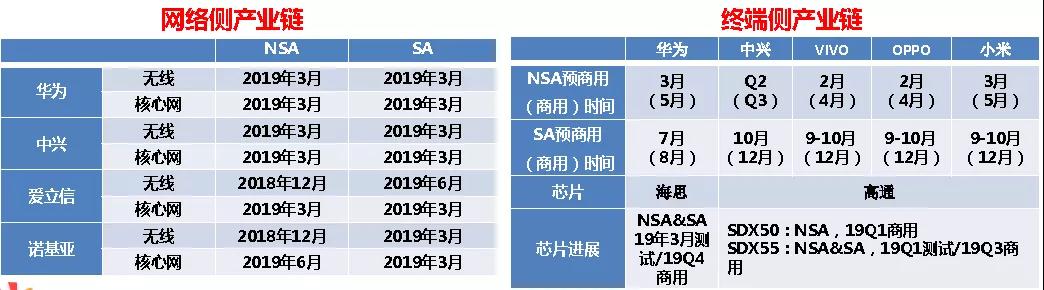
Proces dostaw głównych produktów po stronie sieci 5G i terminali przedstawiono w tabeli 1 i tabeli 2.
1.3 Basic resource reserves
Compared with 4G networks, 5G has undergone revolutionary changes from network structure to equipment form, and has higher and stricter requirements for various basic resources. CU/DU/AAU reconstruction and new business requirements have triggered the adjustment of the 5G access network network structure, with the addition of fronthaul bearing, CU/DU aggregation (C-RAN networking), UPF/MEC sinking and other major changes. The demand for access-side transmission resources (optical switches, pipes, optical cables) and aggregation equipment rooms, two basic physical resources, needs to be adjusted, optimized and added as much as possible before large-scale base station deployment.
The existing towers and floor resources already carry 2/3/4G network equipment of various standards and frequency bands from the three major telecom operators. The degree of co-construction and sharing is very high. It is very difficult to add 5G AAUs, especially to meet the simultaneous deployment of multiple operators. Before large-scale deployment, the existing towers and systems need to be detailed, integrated and optimized to improve the availability and value of the existing sites.
1.4 Application maturity
The design goal of 5G is to fully meet the needs of the three major scenarios (eMBB/uRLLC/mMTC), evolving from to C as the main player to to C and to B flying together. From a certain perspective, the mission of 5G is to fully enable various vertical industries and drive the informatization and intelligent upgrading of all walks of life in society through integration with vertical industries. At present, the integrated application of 5G and vertical industries is still in the preliminary exploration stage (as shown in Figure 1). Telecom operators demonstrate network capabilities and application prospects through various 5G+ application demonstrations, set up platforms, build circles, and form groups to achieve mutual penetration and mutual influence, driving the true commercial maturity of 5G applications, which in turn promotes more complete network construction.
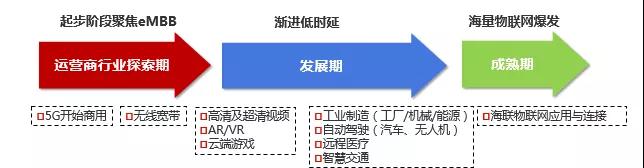
Figure 1 5G application development stages and typical applications
1.5 Local government support
Based on the maturity of standards and technologies, local governments have introduced policies to support the development of 5G-related infrastructure and industries, and formulated clear action plans and development goals. Taking the "Implementation Opinions of the Zhejiang Provincial People's Government on Accelerating the Development of the 5G Industry" as an example, it has detailed plans for 2 time nodes (2020 and 2022) that need to be Based on the completed construction tasks and network coverage goals, by 2022, 5G can be widely used and deeply integrated in various economic and social fields, reach the international leading level, build an excellent 5G industrial ecosystem, and become a national 5G network construction pioneer area and an internationally influential 5G industry development cluster area and 5G innovative application demonstration area.
1.6 The right time for large-scale deployment
W oparciu o powyższe czynniki, rekomendowane tempo wdrażania krajowej sieci 5G przedstawia się następująco: w 2019 r. sieć rozpocznie się w punktach dostępowych w kluczowych miastach i obszarach o dużym zapotrzebowaniu, a następnie będzie się rozwijać i rozwijać; w 2020 r. nastąpi pierwsze wdrożenie na dużą skalę po oficjalnym wprowadzeniu standardu R16, a usługi sieciowe będą dalej dojrzewać. W latach 2012–2022 zakres i głębokość wdrażania sieci będą nadal rozszerzane, a strategia i możliwości wdrażania sieci będą udoskonalane w oparciu o zasięg i scenariusze biznesowe, aby skutecznie dopasować je do zintegrowanego rozwoju różnych branż i technologii 5G oraz wspierać je.
Stojące przed nami wyzwania
After standards and equipment mature, promoting large-scale deployment of 5G networks will still face various difficulties and challenges in network planning, basic resources, and engineering implementation, which can be summarized as follows.
2.1 Choice of network NSA/SA deployment
In the early stage, 5G mainly uses large-bandwidth access capabilities to support large-traffic services, such as VR, AR, 4K/8K high-definition live broadcast backhaul, etc. In order to quickly commercialize 5G, NSA (Option 3 solution) based on 4G core network EPC can be deployed in the early stage. With the maturity of standards, equipment and industries, and the demand for more low-latency and large-connection services, it has become a must to build an SA (5GC+NR, Option 2 solution) network that fully supports 5G new business requirements and related functions.
From the perspective of seizing market opportunities, it is necessary to quickly deploy the 5G network based on NSA and then transform and upgrade it to the SA network. From the comprehensive construction cost (TCO) analysis, the cost of building NSA first is higher than directly deploying the SA network on demand.
2.2 What are the changes and impacts of gNB after CU/DU reconstruction?
The 5G base station gNB after CU/DU reconstruction is divided into three parts of logical functions CU+DU+AAU, which raises the following questions: whether the physical entities of CU/DU are jointly installed or separated, what method is used for fronthaul bearer between AAU and DU, the impact of the form (volume, weight, power consumption) of AAU, and whether the wireless access network architecture needs to be adjusted. Among these issues, the form and deployment of CU and DU are the most critical. Currently, the equipment form provided by the industry is a combination of CU/DU, which is similar to the 4G BBU. It can be deployed centrally or decentrally. The transmission bearer is divided into fronthaul + backhaul. Based on business needs in the later stage, CU and DU are independent physical entities, forming a three-level architecture (CU-DU-AAU). The CU deployment location can be high or low. Based on business needs, DU can be aggregated or dispersed. The transmission bearer is divided into fronthaul + midhaul + backhaul.
2.3 Czy wprowadzono jakieś zmiany w architekturze sieci dostępowej 5G NR?
Since the emergence of distributed base stations (BBU+RRU), wireless access networks have two construction modes: DRAN and C-RAN. The C-RAN mode uses BBU to centrally save computer room resources. Baseband resource collaboration improves efficiency and effectively reduces remote construction costs, but it also increases transmission resources and maintenance pressure. In the 5G era, C-RAN has more important value. In the face of diverse and flexible business scenarios, the wireless access network architecture is required to be more flexible and robust, and the network supports on-demand access to services; CU/DU separation and DU aggregation are conducive to the introduction of SDN/NFV, enabling flexible resource orchestration/slicing and automatic network maintenance; vertical industry integration requires network functions to be decentralized, MEC is deployed, and the media surface is decentralized. The 5G NR access network based on C-RAN can effectively support telecom operators to optimize connection services, strengthen connection applications, and build the ability to compete head-on with Internet companies. Of course, it also faces huge construction and maintenance pressure on basic resources such as computer rooms, pipelines, and optical switches.
2.4 Satysfakcja z zasobów stacji makro/mikro w paśmie Sub 6 GHz
Trzech krajowych operatorów telekomunikacyjnych uzyskało pasma częstotliwości 5G poniżej Sub 6 GHz. Pod względem zasięgu, zasięg 2.6 GHz firmy China Mobile jest najsilniejszy. Z analizy dojrzałości branży wynika, że China Telecom i China Unicom uzyskały pasmo 3.5 GHz. Obecnie trzej główni operatorzy telekomunikacyjni dysponują bardzo bogatymi zasobami terenowymi sieci 2/3/4G, ale nieruchomości te są bardzo zróżnicowane, w tym należące do operatora, firmy obsługującej wieże, firmy zewnętrznej oraz nieruchomości publiczne (wszelkiego rodzaju słupy oświetleniowe, zasoby pięter itp.).
The availability of existing site sites involves many factors. From a coverage perspective, it includes the coverage capabilities of 5G base stations (2.6/3.5GHz), the satisfaction of existing site sites, the acquisition of new site sites, and the acquisition of pole resources for small and micro base stations; from the transformation of existing resources, it includes equipment room facilities and sky towers From the perspective of network structure, it includes basic resource system issues under C-RAN networking and how to anchor 4G base stations; from the perspective of meeting business needs, the analysis includes different value areas, special business scenarios, and different network deployment and site requirements for 2B services.
2.5 5G gNB equipment requirements for supporting transformation
Nowa stacja bazowa 5G gNB ma znacznie wyższe wymagania dotyczące wyposażenia serwerowni i anten niż poprzednie stacje bazowe 2/3/4G. Głównym powodem jest zwiększenie rozmiaru, wagi i poboru mocy nowego sprzętu AAU. Tabela 3 przedstawia aktualną tabelę parametrów typowego sprzętu.
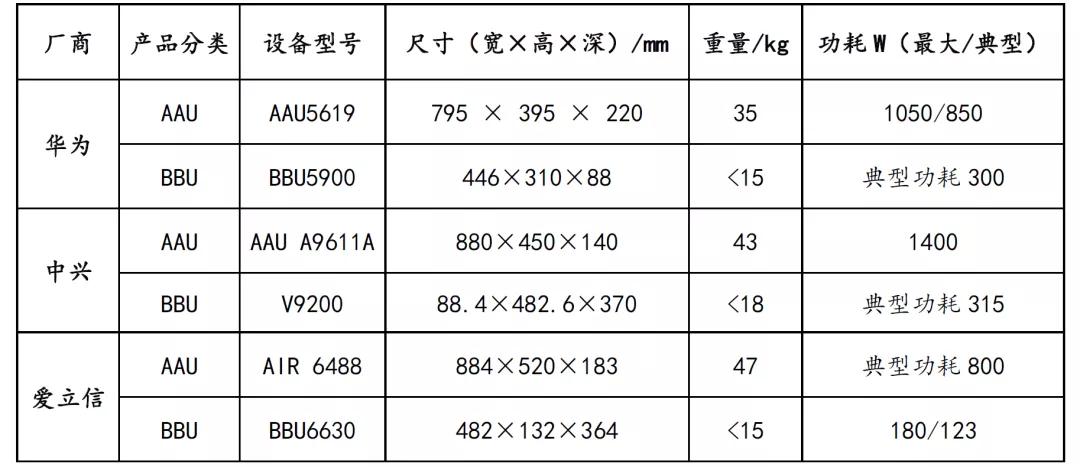
Tabela 3. Parametry fizyczne urządzeń 5G gNB głównych producentów
Nowa forma produktu AAU i jego parametry fizyczne wpływają na cztery czynniki.
a) The sky space is tight. Under the background of co-construction and sharing, multi-operators and multiple systems are deployed on the same tower, which leads to the shortage of antenna resources and the difficulty of adding 5G AAU equipment.
b) Wymagania dotyczące nośności są wyższe. Jednostka AAU 5G ma zazwyczaj duże rozmiary (ponad 35 l), wagę (ponad 40 kg) i dużą powierzchnię nawietrzną (ponad 0.5 m²). Wymagania dotyczące modyfikacji procesu dla masztu wieży widokowej są znacznie wyższe niż w przypadku 4G.
c) Upiększanie terenu jest ograniczone. Istniejąca upiększona antena ma ograniczoną przestrzeń instalacyjną i nie spełnia wymagań dotyczących przestrzeni instalacyjnej i odprowadzania ciepła przez urządzenia 5G AAU.
d) Transformation of AC/DC power supply system. The addition of a 5G system will put greater pressure on the AC and DC power supply systems of existing base stations. Especially in scenarios where multiple sites are shared, insufficient AC mains capacity and transformation are key limiting factors for large-scale 5G deployment. The power supply system is shown in Figure 2.
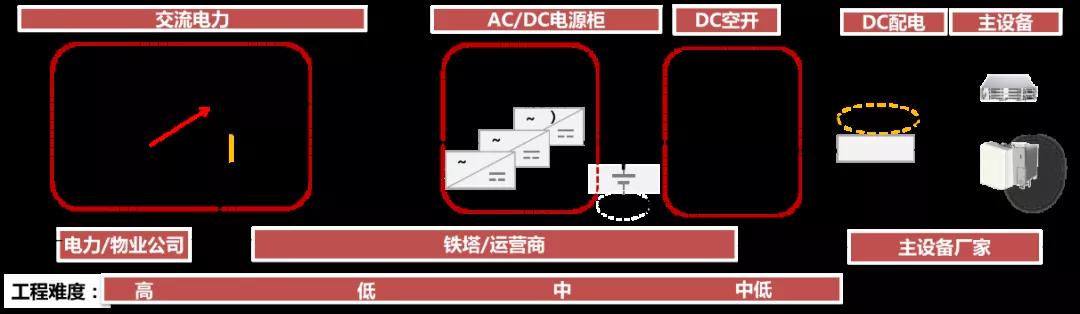
Figure 2 5G base station AC and DC power supply system diagram
2.6 Dyskusja na temat modelu budowy dystrybucji wewnętrznej 5G
The indoor environment is an area with high incidence of data services, and many scenarios are also high-value areas for 5G services. However, the construction of 5G indoor distribution needs to face and consider the following issues.
a) Różnorodność.
(a) Diversity of existing network indoor coverage construction modes, including DAS, small panels, leaky cables, leather stations, etc.
(b) Technologia 5G musi zapewniać zróżnicowane możliwości wsparcia biznesowego.
(c) Rozważenie problemu, w jaki sposób skonstruować różne typy scen pokrycia.
b) Złożoność.
(a) Tradycyjny system DAS to pasywny podsystem pokojowy, którego nie można monitorować ani zarządzać. Trudno jest naprawiać usterki i budować nowe połączenia.
(b) The proportion of digital room distribution deployment is not high and cannot support refined assessment and network resource prediction.
(c) How to transform and maintain requires huge investment in manpower and material resources.
c) Wartość.
(a) Typical indoor business scenarios of 5G include VR/AR, smart manufacturing, smart energy, wireless medical, etc.
(b) Customized indoor coverage system solutions are required for different value scenarios.
d) Ekonomiczne.
(a) Popyt jest ogromny, a lokalizacji jest wiele, więc większość istniejących pokoi wymaga modernizacji.
(b) Operatorzy wprowadzili na szeroką skalę cyfrowe rozwiązania dystrybucji sal w środkowym i późnym etapie rozwoju sieci 4G. W obliczu 5G, wykorzystanie cyfrowej dystrybucji sal znacznie wzrośnie, a koszty zostaną skutecznie obniżone.
(c) Różne scenariusze wymagają stosowania odpowiednich metod konstrukcyjnych w celu osiągnięcia optymalnej efektywności kosztowej.
Środki zaradcze
3.1 Overall response ideas
a) Zacznij od określenia celu i zaplanuj swoje możliwości z wyprzedzeniem. Dogłębna analiza istniejących lokalizacji, serwerowni, zasobów transmisyjnych i innych zasobów, mająca na celu zapewnienie kompleksowego zasięgu sieci 5G SA, w połączeniu z dostosowaniem struktury sieci bezprzewodowego dostępu 5G NR, zgodnie z ogólnym planem C-RAN, planowanie zasobów i rezerwacja przepustowości są przeprowadzane z wyprzedzeniem, aby utworzyć kompletne zasoby podstawowe (lokalizacje, serwerownie, rurociągi, kable optyczne) do użytku komercyjnego na dużą skalę.
b) Equipment is on standby and supporting equipment is available first. Considering the upgrading and supply capabilities of the initial 5G main equipment, there is no rush for full deployment. Based on the site part of the 5G comprehensive deployment plan, site sites, antennas, equipment room facilities and other facilities that need to be renovated or newly built will be renovated in advance as needed to meet the needs of rapid and large-scale deployment of 5G.
c) Set up special projects and make progress together. For the large-scale deployment of 5G networks, a dedicated 5G engineering implementation center and a multi-professional promotion model including wireless, transmission, computer room, and full-service are established to reduce professional communication and coordination losses and improve project construction progress and quality.
d) Przewaga pierwszego gracza i zablokowane zasoby. Wykorzystaj przewagę China Mobile w zakresie wdrażania sieci 5G na dużą skalę i połącz atrybuty lokalizacji, aby z wyprzedzeniem zabezpieczyć wysokiej jakości zasoby lokalizacji, anten i serwerowni od firm obsługujących wieże.
3.2 Użyj C-RAN jako podstawowej architektury do tworzenia podstawowych rezerw zasobów
Before large-scale deployment of 5G, it is necessary to reserve the capacity of basic resources. From the aspects of reducing investment and operation and maintenance costs and future-oriented technology development and business deployment, C-RAN is used as the infrastructure of the 5G NR wireless access network. C-RAN planning and construction relies on the construction of comprehensive service areas. The overall network planning and corresponding basic resource capacity reserves can be completed in the order of surface (integrated service area) to point (C-RAN convergence room) and then to line (fronthaul/backhaul bearer network). In order to better realize the rapid deployment of 5G wireless networks in the future, it is recommended to comprehensively carry out C-RAN architecture evolution planning for 5G evolution in the existing 4G network planning as soon as possible. The specific suggestions are as follows.
a) Carry out transmission planning based on fronthaul access of remote RRU sites as transmission service access requirements, with an optical cable network as the target guide and comprehensive service area as the scope to carry out C-RAN area subdivision planning. It is recommended that a single C-RAN area include about 8 to 10 macro station physical points, with an area of 0.5 to 5km2, and a single integrated service area is subdivided into 3 to 4 C-RAN areas.
b) Carry out access computer room planning oriented to the evolution needs of C-RAN architecture, and select computer rooms with good conditions as BBU centralized setting points. It is recommended that the location of the computer room be selected around the first-level fiber distribution point, which is conducive to double-hanging two convergence computer rooms upwards to form a ring. For the computer room area, it is recommended to configure at least 20 m2.
c) Przeprowadź planowanie dostępu fronthaul dla ewolucji sieci C-RAN: Na tym etapie można rozważyć zastosowanie kolorowych światłowodów do fronthaul. Pojedynczy punkt fizyczny można rozsądnie zaprojektować tak, aby łączyć, demultipleksować i przesyłać konfigurację rdzenia światłowodowego w oparciu o liczbę aktualnie używanych punktów częstotliwości i późniejsze wymagania dotyczące rozbudowy częstotliwości. Jeśli chodzi o wybór zdalnych punktów dostępu, stacje kolokacyjne mogą priorytetowo traktować wykorzystanie istniejących tras kabli optycznych, takich jak makrolokalizacje wykorzystujące stare pierścienie dostępu agregacyjnego i mikrolokalizacje wykorzystujące stare kable optyczne uplink. Lokalizacje w całym obszarze działalności muszą dostosować swoje połączenia. Zgodnie z nowym planem lokalizacji zaleca się, aby nowe lokalizacje miały dostęp do pobliskich central optycznych poziomu 2 i niższych, a nie do central optycznych poziomu 1, co pomoże zaoszczędzić zasoby szkieletowej sieci światłowodowej.
3.3 Complete the optimization and integration of sky surfaces in advance to ensure the availability of towers and masts at existing sites
In order to solve the problem of tight antenna resources in 5G construction, on the premise of reusing the old site as much as possible, combined with the current situation of antenna resources, high-quality space is prepared for 5G AAU according to the following priorities: reuse old poles - build new poles - replace poles - antenna integration (multi-port antenna).
Antenna integration work can be carried out through a single project in advance before 5G large-scale deployment. It is recommended to follow the following rectification principles.
a) Zakres integracji i transformacji powierzchni nieba obejmuje obszary miejskie, powiaty i obszary o dużej koncentracji. Obszary wiejskie i drogi główne nie będą na razie objęte integracją powierzchni nieba.
b) Keep the total number of existing sky surfaces unchanged, and in principle neither add new sky systems nor reduce sky systems (except for site systems with a single sky surface).
c) As much as possible, 5G antennas and existing 4G antennas share an antenna system.
d) During the antenna reconstruction, network optimization and adjustment need to be carried out simultaneously. For the stability of network coverage, during the antenna reconstruction and integration process, try to keep the main 4G coverage layer as fixed as possible.
3.4 Klasyfikacja transformacji systemów zasilania prądem przemiennym i stałym
The AC-DC power system transformation must take into account the current status of existing sites on the one hand, and the 5G equipment and its subsequent evolution on the other. The current equipment requirements for the AC-DC system are shown in Table 4.
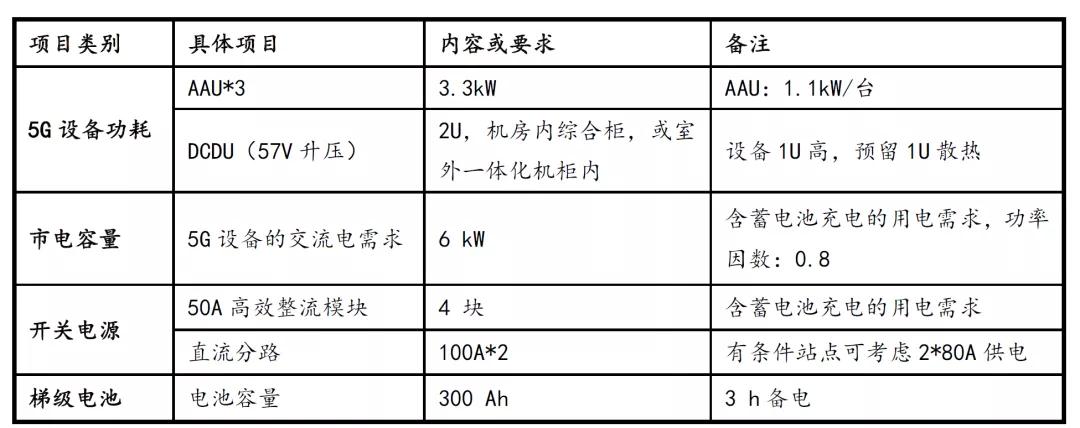
Tabela 4 Wymagania sprzętowe 5G gNB dla systemów AC i DC
Zasady i etapy transformacji:
a) Dopasowanie zasilania: Priorytetem jest ponowne wykorzystanie oryginalnej maszynowni, przełączanie zasilania i akumulatora oraz odpowiednie dodanie dopasowania zasilania zgodnie z warunkami na miejscu, aby spełnić potrzeby konstrukcyjne w zakresie zasilania sieci 5G.
b) External mains power: Priority is given to using the original external power supply. In the case of insufficient external power, 5G external power needs can be solved through battery peak shaving, capacity expansion and other means to minimize construction costs. External mains power transformation is difficult, and the transformation can be completed according to the steps shown in Figure 3.
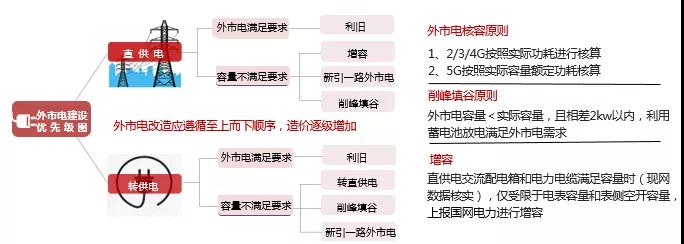
Figure 3 AC system transformation plan
3.5 Build differentiated room distribution systems based on scenarios
There are many indoor distribution construction scenarios. It is recommended to follow differentiated meeting strategies based on 5G business characteristics and needs.
a) It is recommended to use digital room separation for high-value areas.
b) Use pico base station + DAS for medium value areas.
c) Use outdoor covering indoors for low-value areas.
d) Use 5G information sources to feed into existing DAS systems for specific scenarios.
Wniosek
zapewniająCelem 5G nie jest właściwe użytkowanie, ale dobre użytkowanie jest prawdziwym celem 5G.5G network coverage will be launched first in hotspot areas and areas with high demand, and then continue to develop and advance based on the needs of users and services.Głównym celem sieci 5G jest zapewnienie wzajemnego połączenia wszystkich elementów i stworzenie inteligentnego społeczeństwa. Dlatego strategie i metody wdrażania sieci różnią się od strategii i metod wdrażania sieci 4G. Aby wdrożyć solidną, wydajną i elastyczną sieć 5G, konieczne jest uwzględnienie wszystkich aspektów zasobów.
Zastrzeżenie: Ten artykuł pochodzi z InternetuPrzedruk z " C114 Communication Network" supports the protection of intellectual property rights. Please indicate the original source and author when reprinting. If there is any infringement, please contact us to delete it.
Related Recommendations
Kinghelm Zastępca dyrektora ds. sprzedaży Peng Huisheng: Hakka z Shenzhen, wierny swoim pierwotnym aspiracjom dzięki ciężkiej pracy
2026-08-03
2313
Song Shiqiang o strategii: Najważniejsze momenty z elektronicznych dialogów z Szanghaju z 2026 r.
2026-07-21
2521