


















Service Hotline
Nieuws

Nieuws

Waarom wordt de 700M-band van radio en televisie de gouden band genoemd?
2021-12-28
1072
In China, no frequency band is as eye-catching as 700M.
Mobiele communicatie heet dat「gouden band"heeft in het 4G-tijdperk talloze discussies op gang gebracht.
Hoe kan de 700M zo goed en capabel zijn? Hij heeft zo'n goede reputatie en er zijn zulke hoge verwachtingen van.
In het 5G-tijdperk betrad China Radio and Television officieel de markt met 700M en werd daarmee de vierde mobiele operator.
Is this new player with a powerful weapon in his hands a little-known, following the same trend, or is he a distinctive player who takes an eccentric approach?
In this issue, let’s talk about 700M.
een,De "gouden frequentieband" kent ook nadelen.
More than 130 years ago, with the glimmer of electric sparks flickering on Hertz's experimental bench, mankind opened the door to electromagnetic waves. From then on, this invisible and intangible mysterious substance began to be tamed by humans.
Elektromagnetische golven planten zich in de ruimte voort in de vorm van sinusgolven. Hier introduceren we een eenvoudige en magische formule:
C=λf
C: It is the speed of light. The speed of light is a basic constant in the universe. Electromagnetic waves propagate at the speed of light.
λHet is de golflengte, oftewel de afstand die elektromagnetische golven in één cyclus kunnen afleggen.
fHet is de frequentie, dat wil zeggen hoeveel golflengten per seconde kunnen worden uitgezonden. De eenheid is vernoemd naar hertz. Zo betekent 1 Hz dat elektromagnetische golven één golflengte per seconde voortplanten, en 1,000,000 Hz (ook wel 1 MHz of 1 megahertz genoemd) betekent dat elektromagnetische golven één miljoen golflengten per seconde voortplanten.
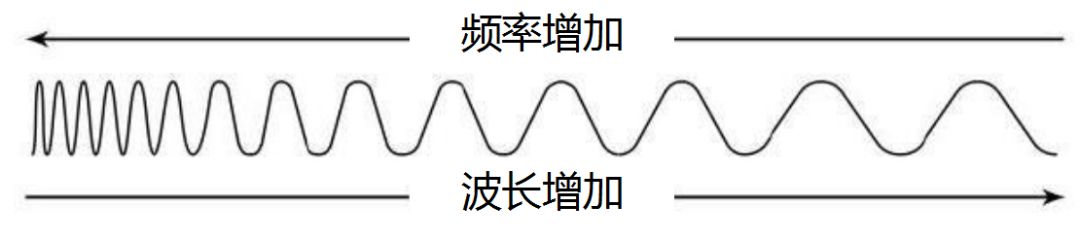
Since the speed of light is constant, wavelength and frequency are inversely proportional, that is, the longer the wavelength, the lower the frequency;Omgekeerd geldt: hoe korter de golflengte, hoe hoger de frequentie.
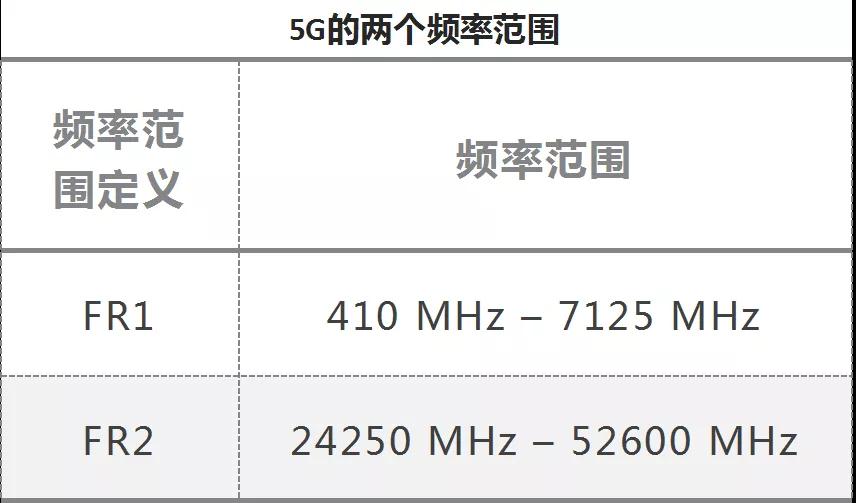
BenedenThe picture is the definition of 5GVan de twee frequentiebanden loopt FR1 van 410 MHz tot 7125 MHz. Het gangbare spectrum voor 4G ligt echter tussen 700 MHz en 3500 MHz. 5G breidt zich verder uit naar hogere frequentiebanden en grotere bandbreedtes, terwijl het tegelijkertijd het 4G-spectrum overneemt.
Hoe hoger de frequentie, hoe groter de beschikbare spectrumbandbreedte en hoe hoger de pieksnelheid die kan worden geleverd. Dit voldoet aan de vraag naar de ultrahoge downloadsnelheden van 5G, maar de nadelen van hogere frequentiebanden mogen niet worden genegeerd.
That is, the higher the frequency, the shorter the wavelength, and the more it tends to propagate in a straight line, the greater the propagation loss in a complex environment, and the worse the refraction and diffraction capabilities. Our most intuitive feeling about this is the poor ability to penetrate walls.
Wifi-signalen en licht zijn bijvoorbeeld beide elektromagnetische golven. Wifi-signalen gebruiken frequenties van 2.4 GHz en 5 GHz. We kunnen ook bespreken of een router in huis door één of twee muren heen kan dringen. De frequentie van zichtbaar licht is erg hoog, honderdduizenden keren hoger dan de frequentie van wifi, dus het kan niet alleen niet door muren heen dringen, het kan zelfs niet door papier heen dringen.
Therefore, when building base stations, the higher the frequency band used, the smaller the coverage radius of the base station. If you want to achieve continuous coverage, the base stations must be built very densely. In other words, the higher the frequency band, the more base stations need to be built, and the cost will naturally increase.
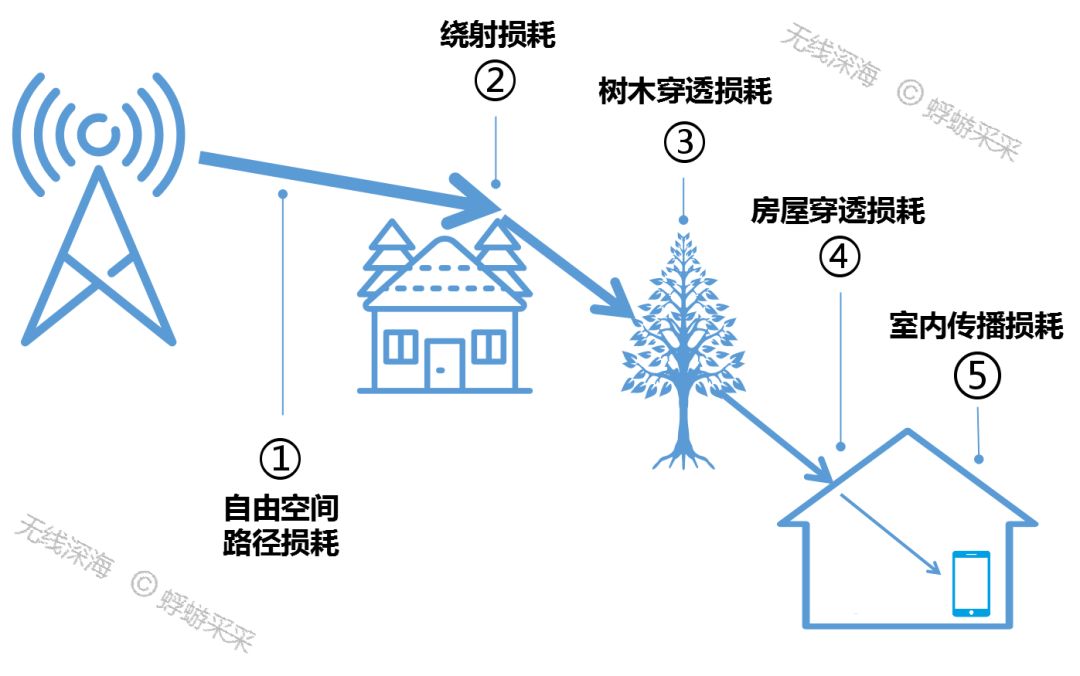
Moreover, the higher the frequency of the signal, the more difficult it is to provide indoor coverage.
As shown in the figure above, in order for the base station signal to reach your home from the base station, it needs to pass through five major killers: outdoor propagation loss, diffraction loss, penetration loss from trees and houses, and indoor propagation loss. Only the strong can survive.
700 MHz is precies zo'n krachtpatser.
Het is de meest gebruikte laagfrequentieband voor mobiele communicatie (minder dan 1 GHz, ook wel Sub1G genoemd), met weinig signaalverlies en een zeer groot bereik.
Eind 2020 had China Mobile ongeveer 350,000 5G-basisstations gebouwd, waarmee in principe de meeste steden op prefectuurniveau gedekt waren. Maar om de uitgestrekte districten en voorsteden te dekken, zijn er meer basisstations nodig.
The 5G spectrum used by China Mobile is 2.6GHz, which is slightly higher than the 4G spectrum. Currently, China Mobile has a total of 3.15 million 4G base stations across the country. For 5G coverage to reach the level of 4G coverage, you can imagine the number of new base stations that need to be built.
According to reports, using the 700M frequency band, only 450,000 to 500,000 base stations need to be built to cover the whole country. Radio and Television plans to build 400,000 base stations in 2021, which will cover more than 90% of villages across the country.
Het is duidelijk dat het dekkingsvoordeel van de 700 MHz-frequentieband enorm is, vandaar de naam."Gouden Band"reden.
Dus dit"goudfrequentiebandIs het echt perfect?
Zoals het spreekwoord luidt: succes is net zo erg als mislukking. De tekortkomingen en voordelen van 700M zijn oorzakelijk en onlosmakelijk met elkaar verbonden.
Omdat de frequentie van 700 MHz laag is, is de golflengte relatief groot. Daarom moet de benodigde antenne-eenheid voor het verzenden en ontvangen van signalen navenant groter zijn. Het antenneoppervlak is echter beperkt en biedt vanzelfsprekend geen ruimte voor een te groot aantal oscillatoren.
As a result, the core technology of 5G - massive antenna array (Massive MIMO) has basically missed 700M.
De gangbare 5G-producten die momenteel commercieel worden gebruikt in de 2600M- of 3500M-frequentiebanden, maken allemaal gebruik van 192 vibratoren.64 dagenWireDe AAU-variant kan worden gebruikt, terwijl de 700M-variant alleen de eerdere RRU-variant plus een 4-poorts antenne kan gebruiken.
Bovendien is de mobiele telefoon2600Mor3500MUnder the frequency bandIt can support 4-antenna reception, but under 700M, it can only support 2-antenna reception.
Op deze manier, vanuit het perspectief van celcapaciteit,2600Mor3500MfrequentiebandIt can support 16 streams of data concurrently, while 700M can only support 4 streams of data concurrently. For a single mobile phone, use2600Mor3500MfrequentiebandBij gebruik van 700M kunnen er 4 datastromen tegelijk worden ontvangen, maar bij gebruik van 700M kunnen er slechts 2 datastromen tegelijk worden ontvangen.
Moreover, the available bandwidth of 700M is also higher than that of hundreds of megabits.3500MfrequentiebandMuch smaller, which adds to the problem of insufficient capacity.
Met andere woorden, vanuit het oogpunt van dekking is 700 miljoen"Gouden Band", maar de capaciteit is beperkt.
2. 700M frequency band and bandwidth
Since the 700M spectrum is so hot, which section of 700M is the one that we are talking about in the streets? Could it be the 100M bandwidth from 700MHz to 800MHz?
In het 4G-tijdperk definieerde 3GPP een reeks frequentiebandlijsten, waaronder 700 MHz.
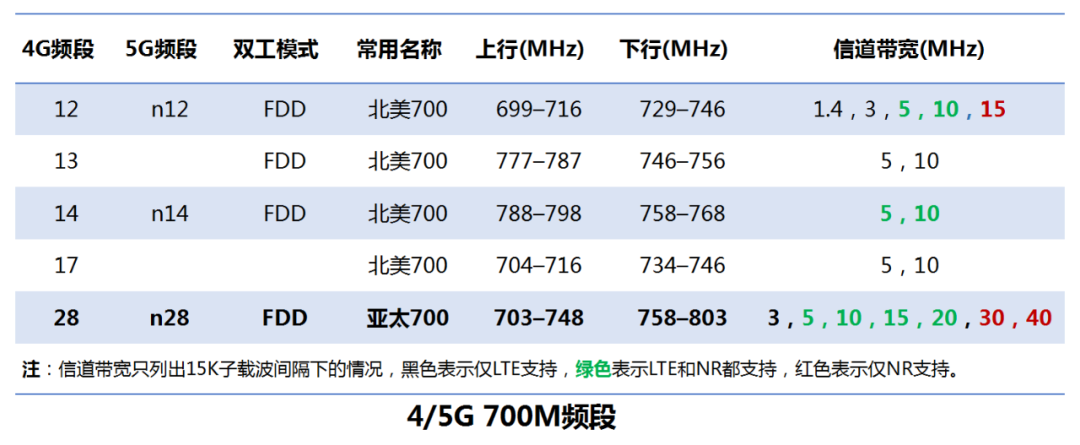
As can be seen from the picture above, the 700M defined by 4G is divided into two series: North American 700 and Asia-Pacific 700. Among them, B12, B13, B14, and B17 belong to North American 700, and as the name suggests, they are mainly used in North America; B28 is called Asia-Pacific 700, and is mainly used in the Asia-Pacific region.
In fact, due to its large bandwidth and good coverage, Asia Pacific 700 has been widely used in the 4G era. The scope is not limited to Asia-Pacific, as long as this frequency band is available in a certain country and supported by mobile phones.
In het 5G-tijdperk is Noord-Amerika 700 te gefragmenteerd en definieert het alleen n12 en n14. Azië-Pacific 700 (n28) blijft zeer populair.
In the 4G era, the maximum carrier bandwidth was 20M, but in order to pursue ultra-high speeds in 5G, the larger the channel bandwidth, the better.
Hoeveel bandbreedte moet het protocol dan definiëren voor n28? Ten eerste mag deze de maximale bandbreedte van 45M niet overschrijden. Ten tweede moet iedereen die dit nodig heeft, zich uitspreken en het voorstellen aan 3GPP.
Therefore, China Radio and Television raised its arms and shouted: This frequency band is exclusive to my family, and I hope to use it for large-bandwidth 5G, supporting 30MAnd 40M bandwidth is a must!
The reasons for this proposal were very good, and 3GPP accepted it.
Since this n28 belongs to FDD mode, different frequencies need to be used to distinguish uplink and downlink. In other words, the uplink frequency band used by mobile phones and the downlink frequency band used by base stations are different.
Not only are the uplink and downlink frequency bands different, but the bandwidth can also be different.
Het basisstation kan een maximale bandbreedte van 40 MHz gebruiken, maar de mobiele telefoon kan slechts een maximale bandbreedte van 30 MHz gebruiken. Deze bandbreedte van 30 MHz is vastgelegd: 703-733 MHz of 718-748 MHz, u kunt kiezen.
Although the Ministry of Industry and Information Technology has issued a document to 703-743/758-798MHz(op en neer)All walks of life40M bandbreedte)It is used for 4G and 5G, but currently, it seems that radio and television still use 30M for uplink and 30M for downlink.703-733MHz, the downward trend is758-788MHz.
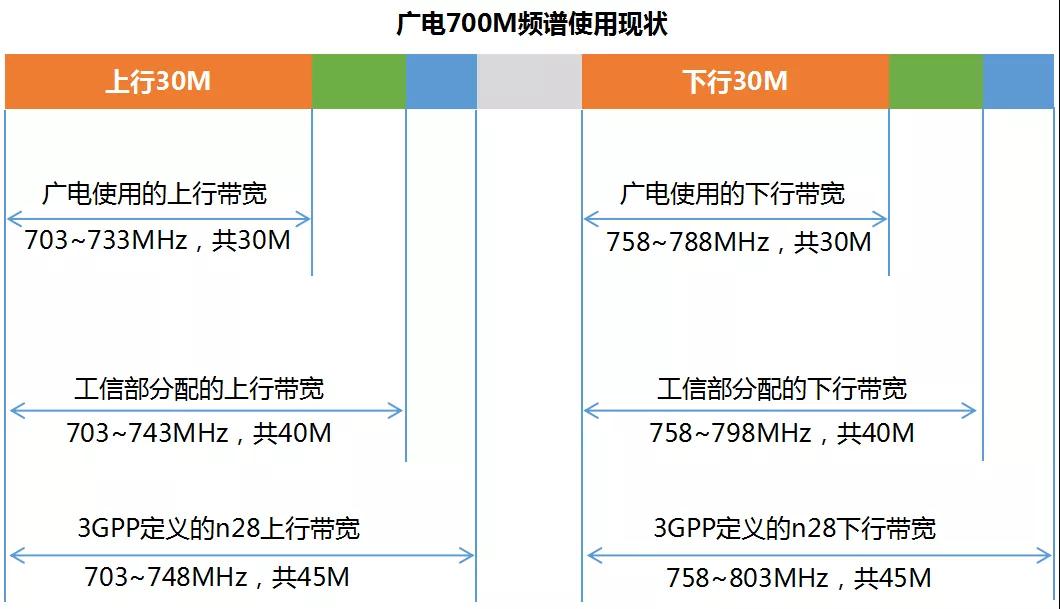
Uit de bovenstaande afbeelding kunnen we ook het geheim van FDD aflezen: het gebruik van twee aparte frequentiespectra voor de uplink en de downlink. Daarom gebruiken we voor het gebruik van radio- en televisiefrequentiebanden vaak de aanduiding 2x30M, oftewel 30M bandbreedte voor zowel de uplink als de downlink, wat neerkomt op een totaal van 60M.
Therefore, if we must compare the amount of spectrum resources between radio and television FDD 700M carriers and TDD 2600M or 3500M carriers, the relationship is 60:100, or 3:5.
Since the TDD mode can freely adjust the ratio of uplink and downlink time slots, it can well support different service types such as downlink-dominated, uplink-dominated, and uplink-downlink balance.
Omdat de spectrumbandbreedte die gebruikt wordt voor de uplink en downlink symmetrisch is, is FDD geschikter voor diensten met een evenwichtige uplink en downlink.
In actual use, the advantages of both can be combined,2600M or3500MThe carrier mainly focuses on downlink capacity. While 700M supplements the downlink capacity, it also focuses on uplink coverage.
Dit is"Hoge- en laagfrequente netwerken".
3. 700 miljoen "gezamenlijke bouw en delen"
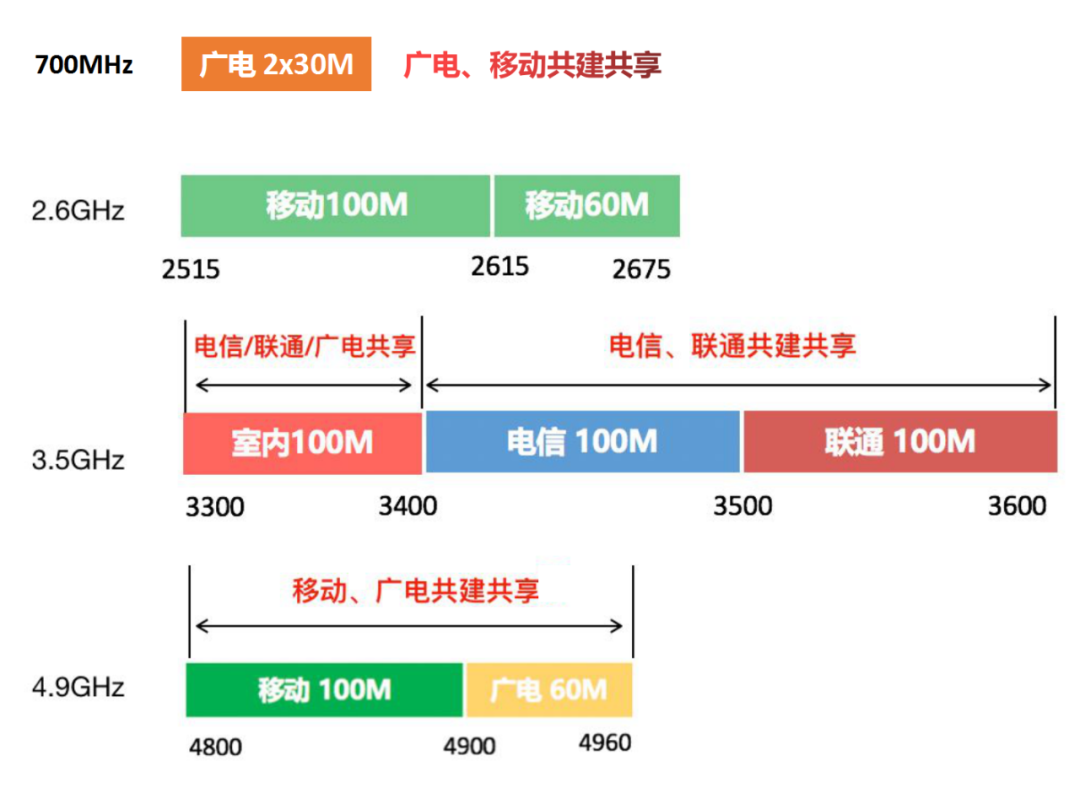
At present, in addition to 700M, radio and television also has 60MHz bandwidth on 4.9G. These two frequency bands are one low and one high, one FDD and one TDD. Coverage and capacity, taking into account both uplink and downlink, isn't it beautiful?
Destijds hadden China Unicom en China Telecom besloten om samen 5G te ontwikkelen en te delen, waardoor ze de 200 MHz-band op 3.5 GHz in handen hadden.De combinatie van FDD en TDD, met een bandbreedte van 45 MHz op 2.1 GHz (zowel hoge als lage frequenties), zorgt niet alleen voor een breed frequentiebereik, maar ook voor een goede dekking.
Now China Mobile is a little panicked. It has 160M bandwidth on 2.6GHz, which is smaller than the bandwidth of China Telecom and China Unicom on 3.5GHz. Although there is still 100M on 4.9GHz, the high frequency band has weak coverage and cannot compete with China Telecom and China Unicom.
It would be great if we could borrow the 700M from Radio and Television! As soon as the two families talked, they hit it off and decided to build and share together.
Dat radio en televisie de "gouden frequentieband" van 700 MHz hebben."In combinatie met 4.9 GHz is er geen gebrek aan frequentiebanden. Waarom zouden we 5G samen met China Mobile willen ontwikkelen en delen?"
Het is in feite behoorlijk moeilijk om een radio- en televisiebedrijf helemaal vanaf nul op te zetten, zelfs met veel potentieel: alles begint vanaf nul en er is weinig ervaring; na de aanleg van de draadloze verbinding is het nodig om de dragers aan te leggen, wat kostbaar is; het bedrijf is klein en heeft een zwakke drijvende kracht in de industriële keten; er wordt veel geld uitgegeven aan de aanleg van het netwerk en het is moeilijk te zeggen of de inkomsten de operationele kosten zullen dekken.
But with the support of industry leader China Mobile, everything will be easy:
1. Delen van het hemeloppervlak700M is direct gekoppeld aan China Mobile's 900M, waarbij antennes en zendmasten worden gedeeld, en de kosten laag zijn.
2. Overdracht delen: China Mobile’s bearer network is very complete. If it can be borrowed, it will not only be low-cost, but also enable 700M 5G to be quickly activated.
3. CapaciteitsdelingRadio en televisie delen de 700M-band, wat niet alleen de netwerkdekking van China Mobile verbetert, maar ook het capaciteitsvoordeel van China Mobile op de 2.6 GHz-band benut. Zo krijgen beide partijen wat ze nodig hebben en vullen ze elkaar aan.
4. Verlaag de kostenDoor gezamenlijk een netwerk van 700 miljoen abonnees op te bouwen met een investeringsverhouding van 1:1, kan de financiële druk op radio en televisie worden verlicht en kan de aanleg van een 5G-netwerk tegen lage kosten en in een snel tempo worden gerealiseerd.
5. Industriële aantrekkingskrachtAls 's werelds grootste operator kan China Mobile de 700M-industrieketen snel ontwikkelen en de kansen en mogelijkheden van de 5G-uitrol benutten.
Daarnaast China MobileenThe 4.9GHz frequency band of radio and television is also close to each other, and they can also be co-constructed and shared. It is really a match made in heaven.
4. Wat zijn de voordelen van 5G voor radio en televisie?
China's three traditional major operators have been in the field for many years and have a large number of users. As a new player in the 5G era, China Radio and Television will obviously not be able to compete with its predecessors if it only provides homogeneous services.
Hoe kunnen radio en televisie dan van elkaar onderscheidende diensten leveren?Het is natuurlijk mijn eigen vakgebied:radio en televisie.
In fact, as early as the 3G era, 3GPP had already supported Multimedia Broadcast Multicast Service (MBMS), which can achieve functions similar to mobile TV. However, due to the complexity of the network and the need for content management, it has not been developed.
In the 4G era, the original MBMS has been upgraded to eMBMS (enhancedmultimedialichaambroadcast multicast service), however it still has not developed.
In het 5G-tijdperk wordt een nieuwe 5G-uitzendservice (NRMB) geïntroduceerd in de R17-standaard van het 3GPP-protocol. Dit is een doelstelling voor de bedrijfsontwikkeling van radio en televisie.
Radio and Television not only has high-quality 700M spectrum, which can achieve 5G wide area coverage, but also has rich radio and television resources. This advantage is simply unique.
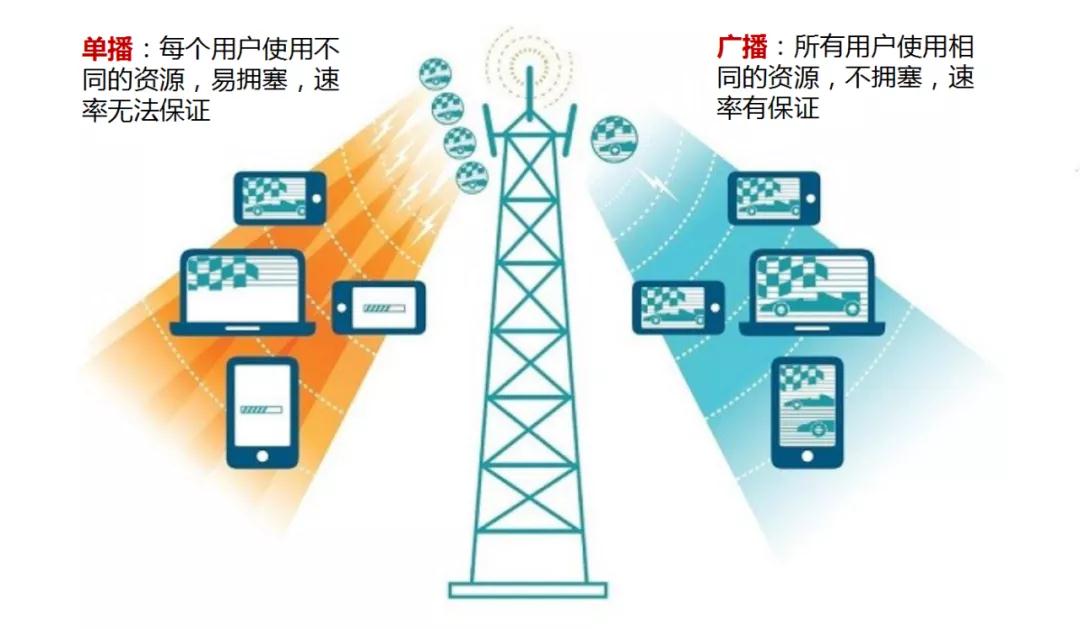
Omdat de uitzendservice geen interactie vereist, heeft deze alleen een downlink en geen uplink.Therefore, there is no need to authenticate the mobile phone. As long as the mobile phone supports it, it can receive video broadcasts. It can be used on TVs, cars, and wearable devices without any problem.
Moreover, the base station only needs one channel to send, and the number of users who can receive the broadcast at the same time is not limited. This not only greatly saves network resources, but also achieves the effect of sending once and charging multiple users.
Onlangs zei Zeng Qingjun, adjunct-directeur van China Radio en Televisie: "State Grid zet zich ervoor in dat elke mobiele telefoon radio en televisie kan kijken tijdens de aankomende Olympische Winterspelen van 2022, zonder netwerkcongestie of onvoldoende dataverkeer!"
This all looks so great, let’s wait and see!
Related Recommendations