





















Service Hotline
News

News

Why is Radio and Television’s 700M called the golden band?
2021-12-28
1072
In China, no frequency band is as eye-catching as 700M.
It is called mobile communication「golden band」, has triggered countless topics in the 4G era.
How can 700M be so good and capable? It has such a good reputation and carries so many expectations?
In the 5G era, China Radio and Television officially entered the market with 700M, becoming the fourth mobile operator.
Is this new player with a powerful weapon in his hands a little-known, following the same trend, or is he a distinctive player who takes an eccentric approach?
In this issue, let’s talk about 700M.
one,The "golden frequency band" also has shortcomings
More than 130 years ago, with the glimmer of electric sparks flickering on Hertz's experimental bench, mankind opened the door to electromagnetic waves. From then on, this invisible and intangible mysterious substance began to be tamed by humans.
Electromagnetic waves propagate in space in the form of sine waves. Here we need to introduce a simple and magical formula:
C=λf
C: It is the speed of light. The speed of light is a basic constant in the universe. Electromagnetic waves propagate at the speed of light.
λ: It is the wavelength, which is the distance that electromagnetic waves can propagate in one cycle.
f: It is the frequency, that is, how many wavelengths can be transmitted per second. The unit is named after hertz. For example, 1Hz means that electromagnetic waves propagate one wavelength per second, and 1,000,000Hz (also called 1MHz or 1 megahertz) means that electromagnetic waves propagate one million wavelengths per second.
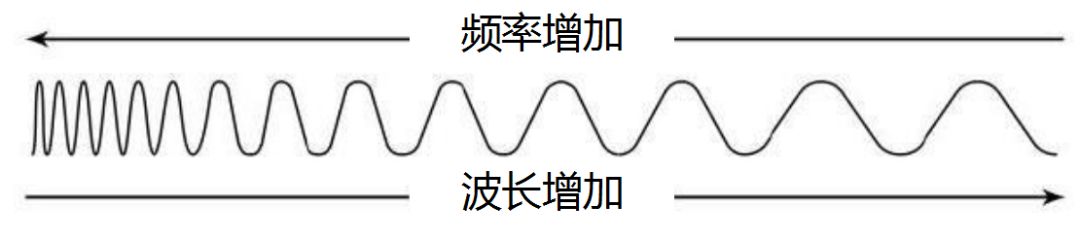
Since the speed of light is constant, wavelength and frequency are inversely proportional, that is, the longer the wavelength, the lower the frequency;Conversely, the shorter the wavelength, the higher the frequency.
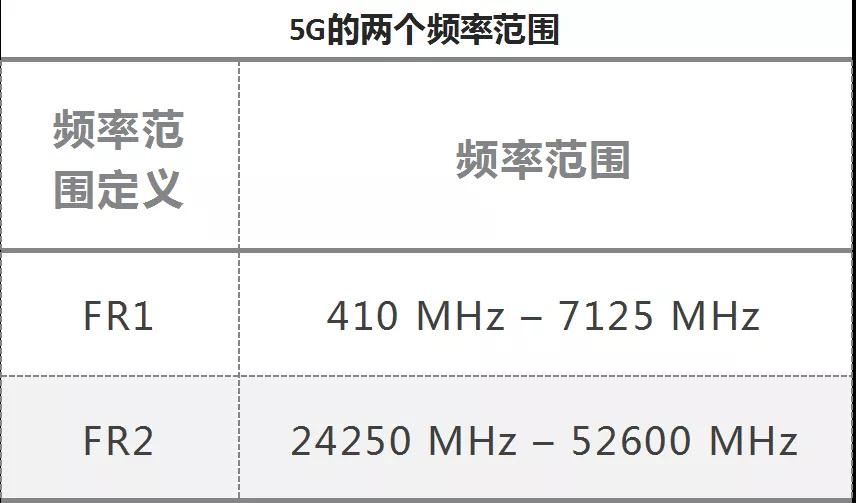
DownThe picture is the definition of 5GOf the two frequency bands, FR1 ranges from 410MHz to 7125MHz. In fact, the mainstream spectrum used by 4G is between 700MHz and 3500MHz. 5G continues to expand to high frequency bands and large bandwidths while inheriting the 4G spectrum.
The higher the frequency, the greater the available spectrum bandwidth and the higher the peak rate that can be provided. This meets the demand for 5G's ultra-high download rates, but the shortcomings of higher frequency bands cannot be ignored.
That is, the higher the frequency, the shorter the wavelength, and the more it tends to propagate in a straight line, the greater the propagation loss in a complex environment, and the worse the refraction and diffraction capabilities. Our most intuitive feeling about this is the poor ability to penetrate walls.
For example, WiFi signals and lights are both electromagnetic waves. WiFi signals use frequencies of 2.4GHz and 5GHz. We can also discuss whether a home router can penetrate one wall or two walls. The frequency of visible light is very high, hundreds of thousands of times the frequency of WiFi, so not only can it not penetrate walls, it can't even penetrate paper.
Therefore, when building base stations, the higher the frequency band used, the smaller the coverage radius of the base station. If you want to achieve continuous coverage, the base stations must be built very densely. In other words, the higher the frequency band, the more base stations need to be built, and the cost will naturally increase.
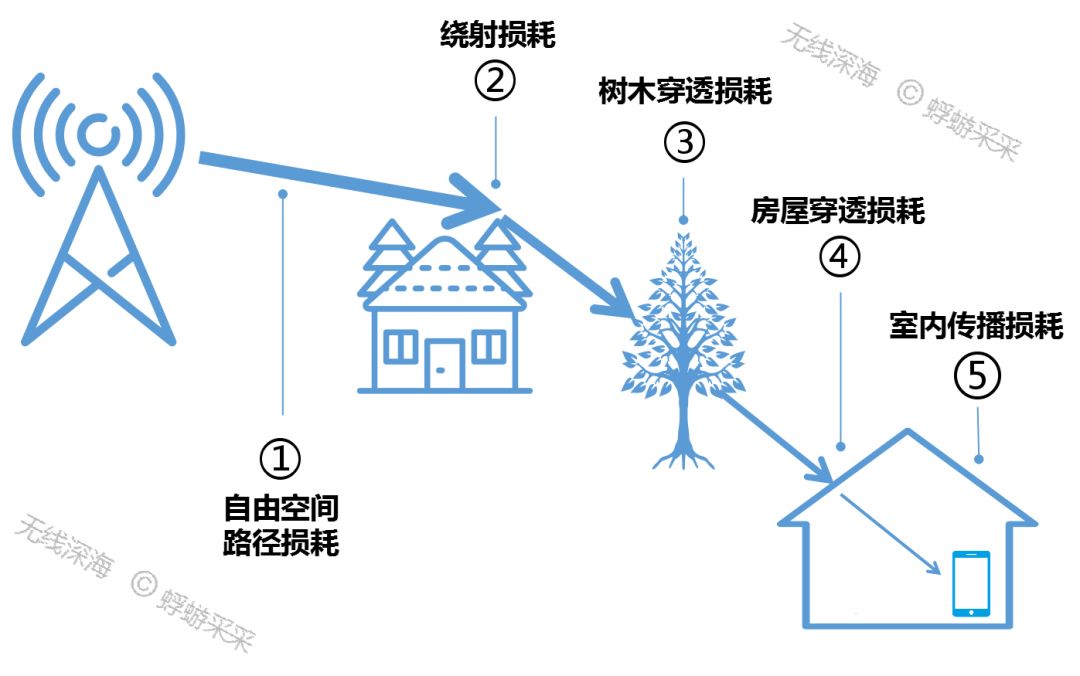
Moreover, the higher the frequency of the signal, the more difficult it is to provide indoor coverage.
As shown in the figure above, in order for the base station signal to reach your home from the base station, it needs to pass through five major killers: outdoor propagation loss, diffraction loss, penetration loss from trees and houses, and indoor propagation loss. Only the strong can survive.
700MHz is exactly such a powerhouse.
It is the most widely used low-frequency band for mobile communications (less than 1GHz, also called Sub1G), with small propagation loss and very strong coverage capabilities.
By the end of 2020, China Mobile had built approximately 350,000 5G base stations, basically achieving coverage in most prefecture-level cities. But to cover the vast counties and suburbs, more base stations are needed.
The 5G spectrum used by China Mobile is 2.6GHz, which is slightly higher than the 4G spectrum. Currently, China Mobile has a total of 3.15 million 4G base stations across the country. For 5G coverage to reach the level of 4G coverage, you can imagine the number of new base stations that need to be built.
According to reports, using the 700M frequency band, only 450,000 to 500,000 base stations need to be built to cover the whole country. Radio and Television plans to build 400,000 base stations in 2021, which will cover more than 90% of villages across the country.
It can be seen that the coverage advantage of the 700M frequency band is very huge, which is why it is called"Golden Band"reason.
So, this"goldFrequency bandIs it really perfect?
As the saying goes, success is as bad as failure. The shortcomings and advantages of 700M are causal and inseparable.
Since the frequency of 700M is low, the wavelength is relatively large, so when signals are sent or received, the size of the antenna element required must also be correspondingly larger. However, the area of the antenna is limited and naturally cannot accommodate too many oscillators.
As a result, the core technology of 5G - massive antenna array (Massive MIMO) has basically missed 700M.
Currently, the mainstream 5G products in commercial use in the 2600M or 3500M frequency bands are all 192 vibrators.64 daysWireAAU form, while 700M can only use the previous RRU form plus 4-port antenna.
Moreover, the mobile phone is2600Mor3500MUnder the frequency bandIt can support 4-antenna reception, but under 700M, it can only support 2-antenna reception.
In this way, from the perspective of cell capacity,2600Mor3500Mfrequency bandIt can support 16 streams of data concurrently, while 700M can only support 4 streams of data concurrently. For a single mobile phone, use2600Mor3500Mfrequency bandWhen using 700M, it can receive 4 streams of data at the same time, but when using 700M, it can only receive 2 streams of data at the same time.
Moreover, the available bandwidth of 700M is also higher than that of hundreds of megabits.3500Mfrequency bandMuch smaller, which adds to the problem of insufficient capacity.
In other words, from a coverage perspective, 700M is"Golden Band", but it is short in capacity.
2. 700M frequency band and bandwidth
Since the 700M spectrum is so hot, which section of 700M is the one that we are talking about in the streets? Could it be the 100M bandwidth from 700MHz to 800MHz?
In fact, in the 4G era, 3GPP defined a series of frequency band lists, including 700M.
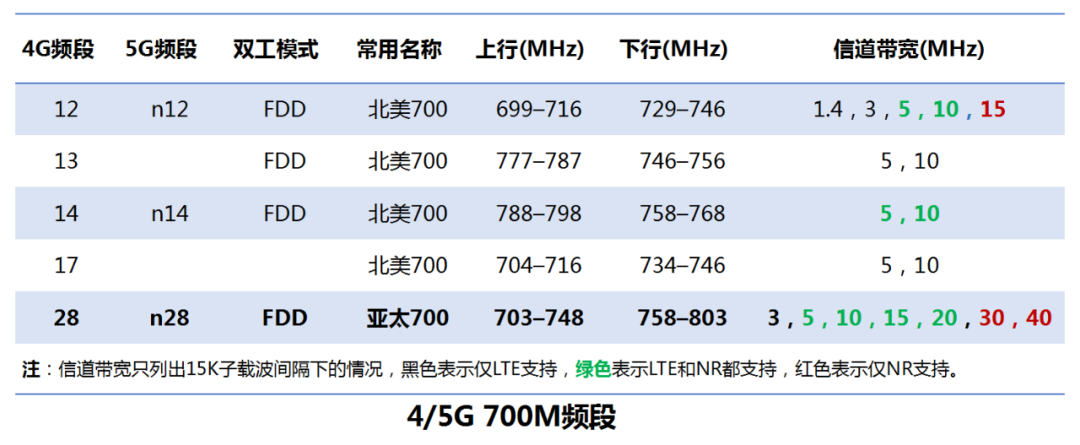
As can be seen from the picture above, the 700M defined by 4G is divided into two series: North American 700 and Asia-Pacific 700. Among them, B12, B13, B14, and B17 belong to North American 700, and as the name suggests, they are mainly used in North America; B28 is called Asia-Pacific 700, and is mainly used in the Asia-Pacific region.
In fact, due to its large bandwidth and good coverage, Asia Pacific 700 has been widely used in the 4G era. The scope is not limited to Asia-Pacific, as long as this frequency band is available in a certain country and supported by mobile phones.
In the 5G era, North America 700 is too fragmented and only defines n12 and n14. Asia Pacific 700 (n28) is still highly favored.
In the 4G era, the maximum carrier bandwidth was 20M, but in order to pursue ultra-high speeds in 5G, the larger the channel bandwidth, the better.
So how much carrier bandwidth should the protocol define for n28? First of all, it must not exceed the maximum range of 45M. Secondly, whoever needs it should raise his voice and propose it to 3GPP.
Therefore, China Radio and Television raised its arms and shouted: This frequency band is exclusive to my family, and I hope to use it for large-bandwidth 5G, supporting 30MAnd 40M bandwidth is a must!
The reasons for this proposal were very good, and 3GPP accepted it.
Since this n28 belongs to FDD mode, different frequencies need to be used to distinguish uplink and downlink. In other words, the uplink frequency band used by mobile phones and the downlink frequency band used by base stations are different.
Not only are the uplink and downlink frequency bands different, but the bandwidth can also be different.
The base station can use a maximum bandwidth of 40M, but the mobile phone can only use a maximum bandwidth of 30M, and the 30M bandwidth has been fixed: 703-733MHz, or 718-748MHz, you can choose.
Although the Ministry of Industry and Information Technology has issued a document to 703-743/758-798MHz(up and downAll walks of life40M bandwidth)It is used for 4G and 5G, but currently, it seems that radio and television still use 30M for uplink and 30M for downlink.703-733MHz, the downward trend is758-788MHz。
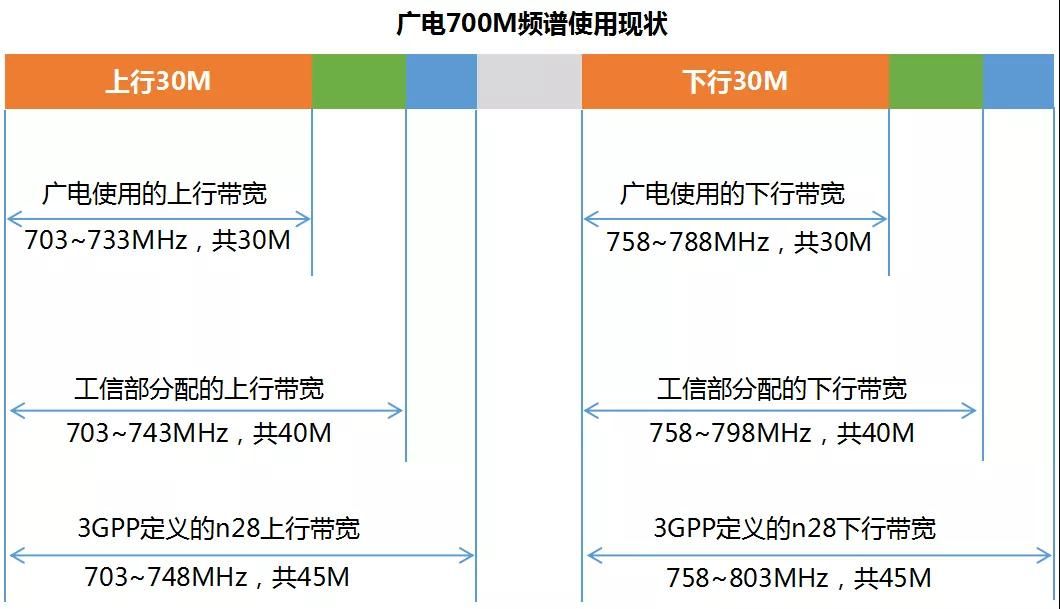
From the above figure, we can also see the secret of FDD: using two separate spectrums for uplink and downlink. Therefore, for the use of radio and television frequency bands, we often use 2x30M to describe it, that is, 30M bandwidth for uplink and downlink, and a total of 60M is used.
Therefore, if we must compare the amount of spectrum resources between radio and television FDD 700M carriers and TDD 2600M or 3500M carriers, the relationship is 60:100, or 3:5.
Since the TDD mode can freely adjust the ratio of uplink and downlink time slots, it can well support different service types such as downlink-dominated, uplink-dominated, and uplink-downlink balance.
Since the spectrum bandwidth used in uplink and downlink is symmetrical, FDD is more suitable for services with a balanced uplink and downlink.
In actual use, the advantages of both can be combined,2600M or3500MThe carrier mainly focuses on downlink capacity. While 700M supplements the downlink capacity, it also focuses on uplink coverage.
this is"High and low frequency networking"。
3. 700M "co-construction and sharing"
At present, in addition to 700M, radio and television also has 60MHz bandwidth on 4.9G. These two frequency bands are one low and one high, one FDD and one TDD. Coverage and capacity, taking into account both uplink and downlink, isn't it beautiful?
At that time, China Unicom and China Telecom had decided to co-build and share 5G, so they had the 200M band on 3.5GHz.Wide, coupled with the 45M bandwidth on 2.1GHz, which is also high and low frequency, the combination of FDD and TDD not only has a wide frequency band, but also has good coverage.
Now China Mobile is a little panicked. It has 160M bandwidth on 2.6GHz, which is smaller than the bandwidth of China Telecom and China Unicom on 3.5GHz. Although there is still 100M on 4.9GHz, the high frequency band has weak coverage and cannot compete with China Telecom and China Unicom.
It would be great if we could borrow the 700M from Radio and Television! As soon as the two families talked, they hit it off and decided to build and share together.
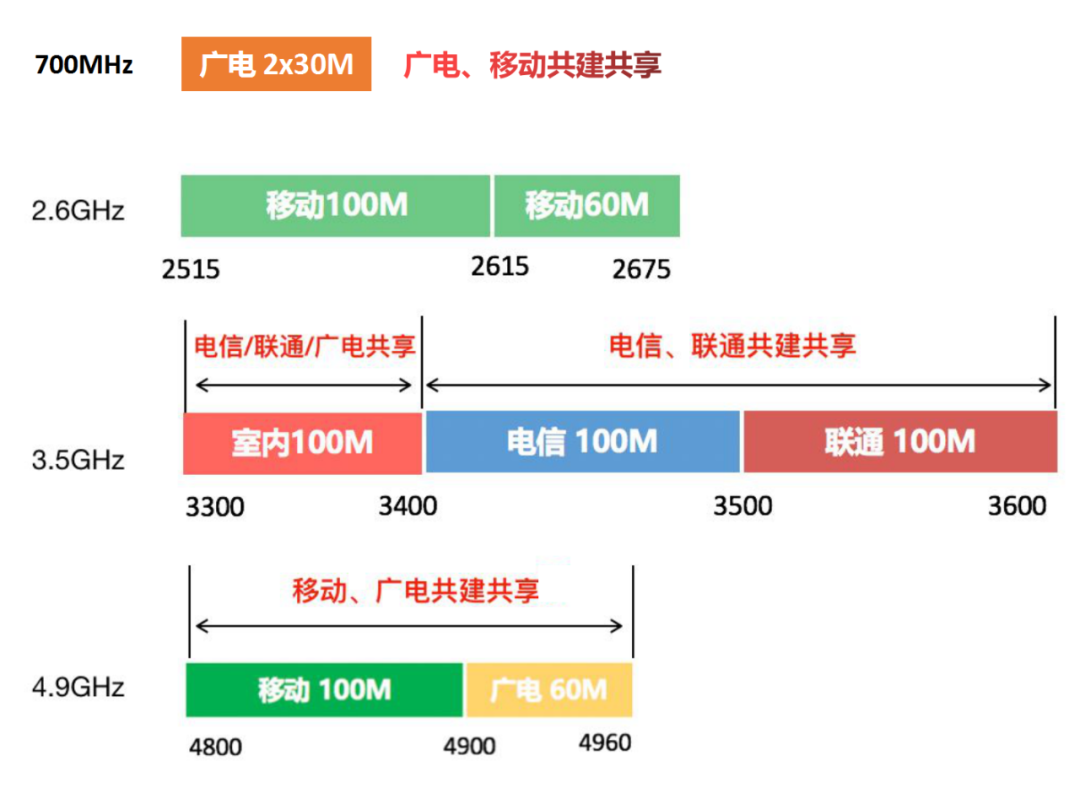
That radio and television has 700M "golden frequency band""Coupled with 4.9GHz, there is no shortage of frequency bands. Why do we want to co-build and share 5G with China Mobile?"
In fact, it is quite difficult to start a radio and television company from scratch even though it has a lot of power: everything starts from scratch, and there is little experience; after building wireless, it is necessary to build bearer, which is costly; it is small and has a weak driving force on the industrial chain; it spends a lot of money to build the network, and it is difficult to say whether the income can sustain the operating costs.
But with the support of industry leader China Mobile, everything will be easy:
1. Sky surface sharing: 700M is directly combined with China Mobile's 900M, sharing antennas and towers, and the cost is low.
2. Transfer sharing: China Mobile’s bearer network is very complete. If it can be borrowed, it will not only be low-cost, but also enable 700M 5G to be quickly activated.
3. Capacity sharing: Radio and television share 700M, which not only improves network coverage for China Mobile, but also enjoys China Mobile's capacity advantage in 2.6GHz, each getting what it needs and complementing each other.
4. Reduce costs: Jointly building a 700M network with an investment ratio of 1:1 can alleviate the financial pressure on radio and television and achieve low-cost and rapid 5G network construction.
5. Industrial pull: As the world's largest operator, China Mobile can quickly mature the 700M industry chain and seize the 5G construction window and opportunities of the times.
In addition, China MobileandThe 4.9GHz frequency band of radio and television is also close to each other, and they can also be co-constructed and shared. It is really a match made in heaven.
4. What are the advantages of radio and television doing 5G?
China's three traditional major operators have been in the field for many years and have a large number of users. As a new player in the 5G era, China Radio and Television will obviously not be able to compete with its predecessors if it only provides homogeneous services.
So how can radio and television achieve differentiated services?Naturally, it’s my own line of work:radio and television。
In fact, as early as the 3G era, 3GPP had already supported Multimedia Broadcast Multicast Service (MBMS), which can achieve functions similar to mobile TV. However, due to the complexity of the network and the need for content management, it has not been developed.
In the 4G era, the original MBMS has been upgraded to eMBMS (enhancedmultimediabodybroadcast multicast service), however it still has not developed.
In the 5G era, a new 5G broadcast multicast service (NRMB) will be introduced in the R17 standard of the 3GPP protocol. This is the business development goal of radio and television.
Radio and Television not only has high-quality 700M spectrum, which can achieve 5G wide area coverage, but also has rich radio and television resources. This advantage is simply unique.
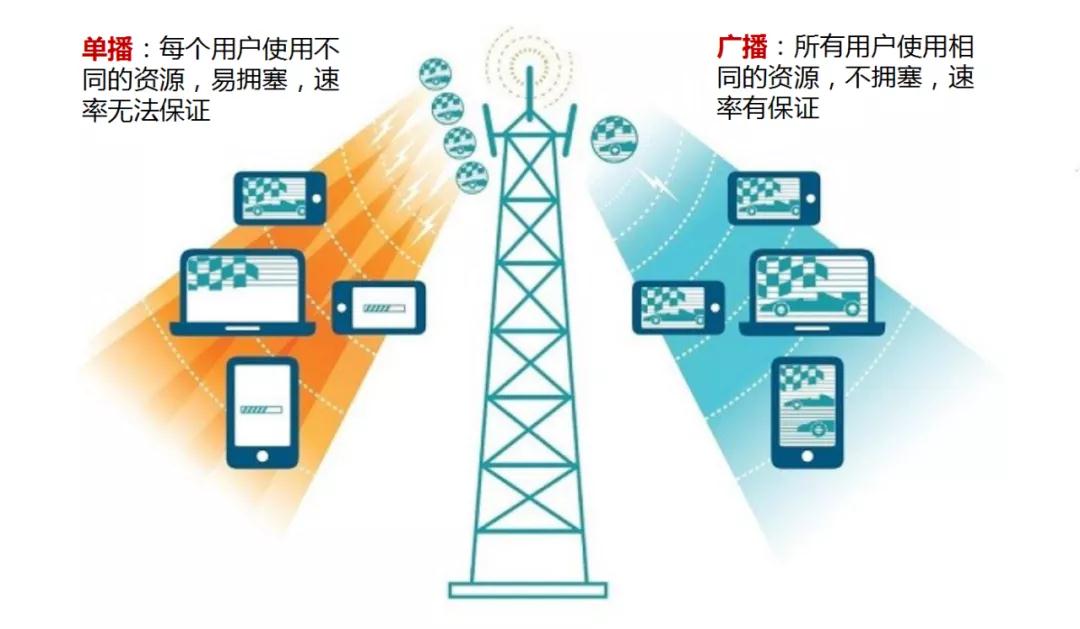
Since the broadcast service does not require interaction, it only has downlink and does not require uplink.Therefore, there is no need to authenticate the mobile phone. As long as the mobile phone supports it, it can receive video broadcasts. It can be used on TVs, cars, and wearable devices without any problem.
Moreover, the base station only needs one channel to send, and the number of users who can receive the broadcast at the same time is not limited. This not only greatly saves network resources, but also achieves the effect of sending once and charging multiple users.
Recently, Zeng Qingjun, deputy general manager of China Radio and Television, said: State Grid is committed to allowing every mobile phone to watch radio and television at the upcoming 2022 Winter Olympics, without network congestion or insufficient data traffic!
This all looks so great, let’s wait and see!
Related Recommendations