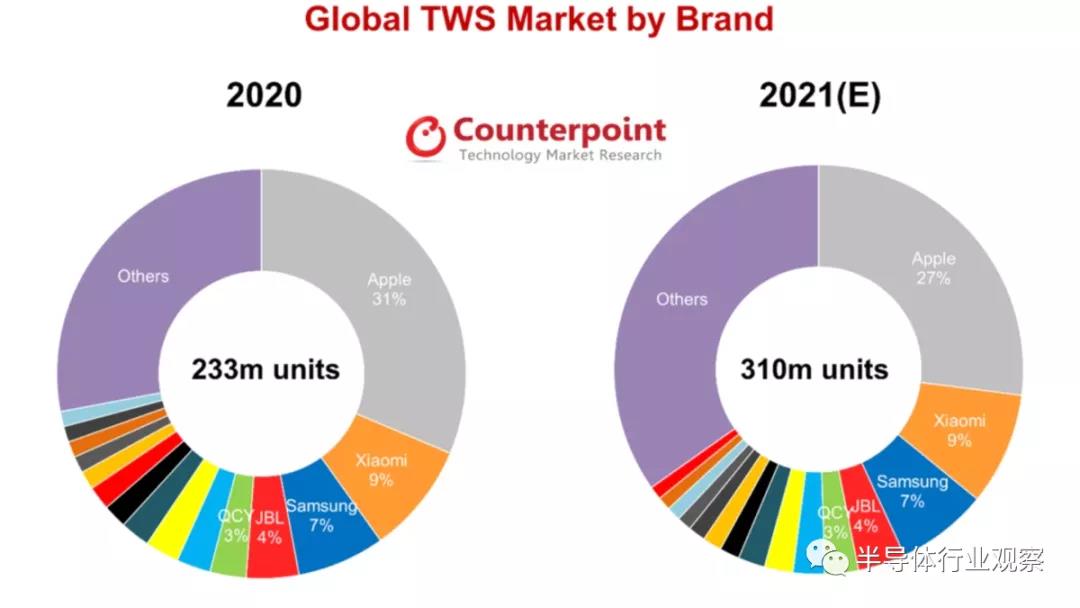
In recent years, the development momentum of TWS headsets has been explosive. There is still a lot of room for development in terms of market development, technological innovation and application. According to data from Counterpoint, the global TWS headset market will grow by 33% year-on-year in 2021, reaching 310 million units. Apple will remain in the lead, but the research firm predicts that the mid- to low-end segment will see high growth that will continue throughout the year.
(Image source: Counterpoint)TWS earphones became an instant hit with Apple's Air Pods, and non-Apple camps are increasingly following suit. The core of TWS earphones is the Bluetooth chip. In the past two or three years, the TWS Bluetooth chip market has attracted a number of domestic manufacturers such as Hengxuan, Zhongke Lanxun, Jieli, Action Core, Unisoc, and Goodix to join the market.Now it seems that the first wave of TWS players have almost come out. They are either on the way to be listed or have already been listed. Representatives include Hengxuan Technology, Zhongke Lanxun and Jerry Technology. The current mainstream TWS headset master Bluetooth chips in the market include Apple H1 chip, HiSilicon Kirin A1 chip, Qualcomm QCC5100 series chip, Hengxuan BES series chip, Airoda AB1536 chip, etc. In the high-end market, only the Kirin A1 chip can compete with Qualcomm and Apple, but there has been no progress after A1, and it is unknown whether it will withdraw from the TWS chip market.In fact, whether it is the recent boom in the TWS Bluetooth headset chip market or the competition in WiFi chips and fingerprint recognition chips in the early years, it has been shown that every profitable market will attract a large number of domestic chip entrepreneurs to invest in it. And now as some new manufacturers begin to enter the market to carve up this market, is the domestic TWS chip market structure likely to change?The first batch of TWS Bluetooth chip players have already "tasted the sweetness"
Speaking of the first domestic TWS Bluetooth chip players, Hengxuan Technology can be said to be the number one domestic TWS Bluetooth chip company. With its forward-looking product layout, Hengxuan Technology can be said to have taken the lead. In 2016, Apple launched Air Pods, and in 2017, Hengxuan Technology launched the BES2000 series of chips, which were adopted because they realized the binaural call function earlier. This series of ordinary Bluetooth audio chips brought Hengxuan Technology sales revenue of 217 million yuan in 2018. In 2018, the company launched the BES2300 series of low-power smart Bluetooth audio chips using the 28nm advanced process. At that time, the overall power consumption of headphones needed to be less than 6mA, and Hengxuan Technology was able to achieve a level of less than 5mA.The subsequent BES2300Y realized full integration of Bluetooth audio technology and active noise reduction technology earlier, and the BES2300ZP even began to apply the company's independently developed new generation Bluetooth true wireless patented technology (IBRT), significantly narrowing the experience gap between non-Apple TWS headphones and Apple Air Pods.To achieve such achievements, Hengxuan Technology has a great competitive advantage. They not only have the technology accumulation from the RDA team, but also invested a lot of money in ANC active noise reduction. In addition, Xiaomi is also their investor. Taken together, whether in terms of technology, capital or market, Hengxuan Technology has some advantages that others cannot match, and has also won a large number of brand manufacturers. Hengxuan Technology is not only a supplier to mobile phone brands such as Samsung, OPPO, and Xiaomi, as well as professional audio manufacturers such as Harman and SONY, but also a supplier of audio products to Internet companies such as Google, Alibaba, and Baidu.On December 16, 2020, Hengxuan Technology, which was established only five years ago, successfully landed on the Science and Technology Innovation Board. The opening price on the day of listing was 391 yuan, with a market value of 45 billion.In addition to Hengxuan, Zhongke Lanxun and Jerry Technology, two newcomers to TWS Bluetooth chips, are also working hard to rush for IPO. These two chip companies rooted in Zhuhai relied on their team's years of accumulation in Bluetooth and audio to dominate the white-label TWS Bluetooth headset market in 2019. Entering 2020, both parties have launched chips with ANC solutions and began to enter the high-end market.Taking advantage of the explosion of TWS headsets, many TWS Bluetooth chip manufacturers are working hard to sprint towards the Science and Technology Innovation Board or A shares. For example, Yi Zhaowei is in the listing guidance stage and plans to pass the A-share IPO; ActionXin is also on the way to IPO on the Science and Technology Innovation Board.As Hu Liming, chairman and CEO of Jingfeng Mingyuan, said at a meeting before, the development of these companies is inseparable from these three elements, namely the right market, competitive advantage and sustainable strategy (reasonable profits). The right market is very important. For early emerging markets, there is a risk of not being able to take off. Choosing the right track is crucial for a start-up. The next step is how to use your own competitive advantages to grab a share in the right market. After grabbing a share, if you want to survive in the long term, you need to have a sustainable strategy, that is, to control profits reasonably.New players enter the game
The boom in the TWS market has also made some manufacturers that had previously focused on mobile phones and the Internet of Things eager to give it a try, including Dayu Semiconductor, Tailing Micro, and Wuqi Micro under Xiaomi. In fact, from the perspective of market capacity, despite the boom in the past two years, according to Counterpoint Research statistics, the market penetration rate of TWS wireless headsets is only 15%. Especially in the Android market, there is still a lot of room for growth. Under this situation, it is understandable for these companies to enter this market.At this year's World Semiconductor Conference, Dayu Semiconductor, a subsidiary of Xiaomi, exhibited Dayu U2. According to the author, Dayu U2 is a system-level SoC for a high-performance, low-power Bluetooth 5.2 dual-mode terminal smart audio platform. It has two 150M RISC-V, 1M RAM, and unbreakable sandbox protection. The customer algorithm exclusively uses RISC-V, and customer applications are deployed independently, without affecting the stability of the Bluetooth system. It supports TWS technology, voice wake-up, and its hardware-level ANC/ENC double-feed active noise reduction. It is worth mentioning that the power consumption of Dayu U2 is 1/3 lower than AirPods when playing music, and 1/2 lower than AirPods in standby.Dayu Semiconductor was spun off from Xiaomi Songguo. After technological accumulation, market verification and team training for mobile phone SoC chips, Dayu Semiconductor will now fully focus on the new tracks of artificial intelligence and the Internet of Things. As a team that has successfully built product-level chips, Big Fish has its natural advantages and unique genes when it comes to the industry's pain point of rapid productization.However, Xiaomi invested in Hengxuan Technology in the past, and now Bigu has begun to devote itself to the TWS Bluetooth chip track. With the support of Xiaomi's terminal ecosystem, the application of Bigu U2 should be as easy as a duck in water. This may have some impact on the existing TWS pattern.In addition, according to market rumors, OPPO seems to be also making TWS Bluetooth chips. In 2019, OPPO's "Core" plan was launched, and the call for self-developed chips was very high. Xiaomi and OPPO are the two domestic mobile phone brands most interested in chips.The LE Audio (Low Energy Audio, low-power audio) standard launched early last year also attracted some manufacturers that originally made BLE chips to join the TWS battlefield. Tailing Micro, a domestic chip manufacturer that focuses on BLE chips, is one of them. Tailing Micro's shipments of wireless Bluetooth and Zigbee products rank first in China and fifth in the world. The leading strength in BLE chips, especially low power consumption, can be well applied to TWS Bluetooth chips, which is one of the reasons for Tailing Micro to enter this extremely competitive TWS market. In addition, Xiaomi also invested in Tailingwei. Telink Micro's TLSR9515 is a TWS Bluetooth chip, and the TLSR9 series SoC chip is a new generation of high-performance multi-mode IoT products launched by Telink after embracing the RISC-V ecosystem.Founded in 2002, Goodix made its fortune in fixed-line chips, and then entered the capacitive fingerprint chip market with great success. Now it has also set its sights on TWS Bluetooth chips. Zhang Fan of Goodix Technology has publicly stated before that a very important application of Bluetooth is TWS headsets, and Goodix Technology combines low-power Bluetooth and high-quality audio technology in the solutions it provides. In addition, Goodix Technology also has in-ear detection, touch and heart rate detection solutions.Goodix Technology's BLE products were mass-produced for the first time in 2020, but the shipment volume has already exceeded one million pieces, and it is expected that this year's shipments will exceed 10 million pieces. The company will also further launch more competitive TWS SoC solutions this year. TWS headphones will also be a new front for Goodix to showcase its years of technology accumulation and provide customers with easy-to-use, fully competitive products.Another company that has entered the TWS Bluetooth chip is Wuqi Microelectronics. Wuqi Microelectronics is a company focused on the research and development of IoT communications, security and terminal smart semiconductor chips. Wuqiwei is also the first domestic manufacturer to mass-produce RISC-V chips, with shipments reaching one million units. Wuqi Microelectronics' strength in entering the TWS market is that the company has leading technical capabilities in digital-analog hybrid, low power consumption, and neural network design and implementation.In 2019, Wuqiwei launched the WQ7003 chip that supports the Bluetooth BT5.0 version and uses a 40nm process, which is also a product that the company continues to mass-produce. In 2020, Wuqiwei upgraded on this basis and released the 22nm ultra-low power consumption WQ7033 series, mainly for mid-to-high-end customers. According to Wuqiwei, this chip leads TWS headsets into the 3.0mA era. All technical indicators of WQ7033 are in line with AirPods Pro. In terms of active noise reduction, Wuqi Microelectronics' ANC solution supports up to six microphones, an ADC to DAC delay of less than 6uS, and a power consumption of less than 6mA when ANC is working. In 2021, Wuqi Microelectronics will also launch and mass-produce a more optimized WQ7053 series of chips.The future competition point of TWS Bluetooth chip
From a technical fundamental point of view, the current TWS Bluetooth headset chips have gradually matured in terms of master-slave switching, smart charging compartment, low power consumption, low latency and other technologies. The gap between high-end and low-end chips has gradually narrowed, and product function definitions have also tended to be consistent. In October 2019, with the release of AirPods Pro, ANC (active noise reduction) replaced "delay" and became the new focus of the TWS headset industry. It has also become a top priority for manufacturers to pursue.In addition to ANC, power consumption and size are eternal pursuits. The reason why TWS Bluetooth headsets have developed rapidly in the past two years and achieved such a high penetration rate has a lot to do with its breakthrough in power consumption. It is relatively simple to reduce the power consumption from 30mA to 10mA, but it is a difficult test to reduce the power consumption to less than 10mA. However, we can see from the above that many TWS Bluetooth chip manufacturers have done an excellent job in terms of power consumption.Reducing size is also a goal pursued by chip designers, especially in wearable devices. Smaller size means flexibility in product design and the ability to integrate larger-capacity batteries. Therefore, technology is also an important step in the evolution of TWS Bluetooth chips.At the same time, technically, new technology standards such as Bluetooth 5.2 and LE Audio are areas that manufacturers need to pay close attention to.As for the future development trend of TWS headsets, it will be mainly divided into two product paths: one is the basic functional type, and the other is the extended type. Basic functional headphones, which only need to meet the needs of listening to music and making calls. The extended type refers to adding functions such as AI, hearing aid and pulse detection to TWS Bluetooth headsets.
Is the TWS Bluetooth chip pattern likely to change?
The TWS headset Bluetooth chip is undoubtedly a hot commodity, attracting so many domestic chip manufacturers to join the game. As more domestic brand manufacturers join, the melee for Android-side TWS Bluetooth chips will continue. But the current TWS market structure may change.For example, if Xiaomi (borrowed from Big Fish) and OPPO terminal manufacturers start to develop their own TWS Bluetooth chips, they can completely install them on their own terminal brands. Goodix also has many sales channels. Their existence and continued development will inevitably have an impact on independent TWS Bluetooth chip suppliers.Moreover, it may be a trend for mobile phone or terminal manufacturers to make (or invest in) TWS Bluetooth chips. But it is certain that under such a situation, the price of TWS products will be more affordable to the people, and various brands will be more sensitive to the price of Bluetooth chips.This reminds me of an old question. If a system manufacturer makes the chip you make, or a major chip manufacturer integrates the chip you make, how should you respond?
The "Kinghelm" trademark was originally registered by Kinghelm Company. It has a very high visibility and reputation. It develops and produces a series of products that are widely used in satellite navigation and positioning and other fields. Mainly includes: RJ45-RJ45 interface-connector-RF connector-adapter cable-coaxial connector-type-c interface-type-c-pin header-female header-SMA-fpc-FFC-waterproof connector-hdmi-hdmi interface-usb connector- Terminal - terminal wire - terminal board - terminal block - terminal block - rfid - positioning and navigation antenna - communication antenna - antenna connection line - glue stick antenna - suction cup antenna - 433 antenna - 4G antenna - Beidou expert - GPS antenna and other factory direct sales - welcome to consult customer service online or contact us by phone.
This content comes from the Internet/Semiconductor Industry Watch, this website only provides reprinting. The views, stance, technology, etc. of this article have nothing to do with this website. If there is any infringement, please contact us to delete it!