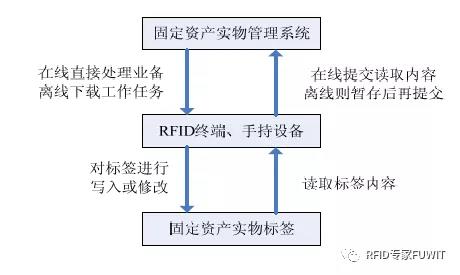
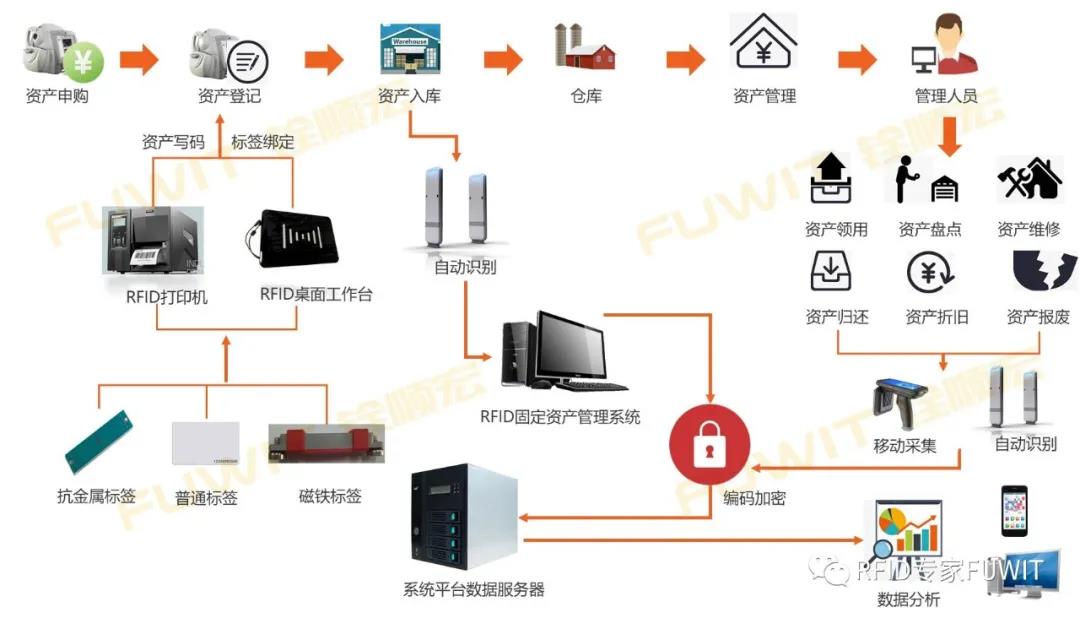
In the enterprise's fixed asset management business, fixed assets are directly received from the material procurement department, or transferred to production and operation after the completion of the project to form fixed assets. Fixed assets in use have been replaced through technological upgrading and transformation from one production site to another. Some fixed assets have to be scrapped due to accidents or natural wear and tear. There are many types of fixed asset business segments of enterprises, and rapid technological updates lead to rapid changes and replacement of fixed assets. The enterprise’s physical fixed assets management model is shown in the figure below:
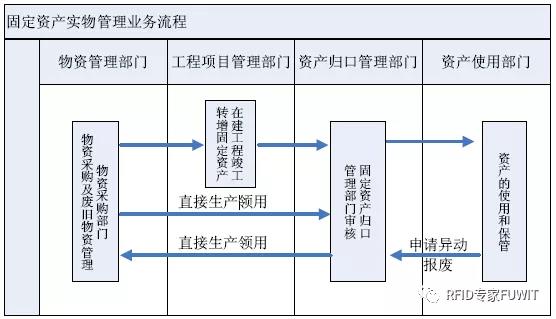
In the past asset management business, the following problems were common: ●Registration and inventory workWhen purchasing fixed assets in the Fixed Asset Purchase Approval Form, a card account must be registered for each fixed asset, indicating the number, value, and receiving department of the fixed asset in considerable detail. Then the custody account shall be registered according to the card account, and a unified number shall be affixed to each fixed asset to facilitate verification. Fixed assets must be depreciated at the end of each month, and depreciation registration must be carried out on the account book. This kind of work is highly repetitive and involves a huge number of ledger cards. Errors often occur during specific work, and it takes a long time and takes up a lot of staff time. Moreover, manual transcription of physical information and information modification of status changes are weak links in ensuring the consistency of "accounts, items, and cards". Because of this weak link, it will still lead to "discrepancies between accounts and facts", which also restricts the maximum management effect of the management information system. ●Fixed asset depreciationThe value of fixed assets is accrued monthly as current expenses, so depreciation calculations are not performed on fixed assets every month. From the perspective of work difficulty, it is not difficult. The problem lies in the huge number of fixed assets, each asset has a corresponding card, and different assets have different useful lives and different depreciation methods. In the processing of depreciation work, it is often necessary to register several thick stacks of books and cards, and the workload can be imagined. In particular, this kind of repetitive and tedious work will produce inevitable errors, causing the information reflected in the relevant reports to be distorted or even lost.Therefore, due to various reasons, the business management system only obtains precise and inaccurate data (such as asset depreciation, book value, inventory quantity, etc.), which not only leads to the loss of assets, but also cannot accurately reflect the company's operating results and performance. The lack of timely information reflection affects the company's operational efficiency and leads to repeated asset purchases. It is meaningless to analyze and make decisions based on this.2. Application of RFID technology
In order to solve the problems caused by the weak link of manual transcription of on-site fixed asset information, the following points must be achieved: ●Automatically collect physical information in batches from a distance; ●Write the management data information (or inspection record) and the physical object information into the electronic tag, and the electronic label is installed (pasted) on the physical object; ●The information collected is not only the number of equipment (assets) and fixed assets, but should have the same information as the equipment (fixed assets) ledger; ●When the management data information changes (or during inspection), the relevant information will be modified (or recorded) on site; (reflect the physical information to the management system) ●Based on the physical change information, start relevant business processes to update equipment (assets) and fixed assets ledgers in real time to ensure that management data information is consistent with the site;RFID is a non-contact automatic identification technology that automatically identifies target objects and obtains relevant data through radio frequency signals. The identification work does not require manual intervention and can collect physical information in batches automatically over a long distance. It is the basis for ensuring the accuracy and integrity of physical information.
Fixed assets management is an important part of enterprise management. Fixed assets have the characteristics of high value, long life cycle, and difficult management. In response to these problems, computer and radio frequency data collection technology are used to achieve information management of fixed assets.
3.1 System hardware architecture
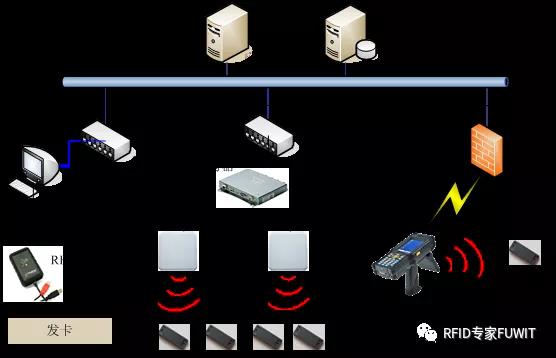
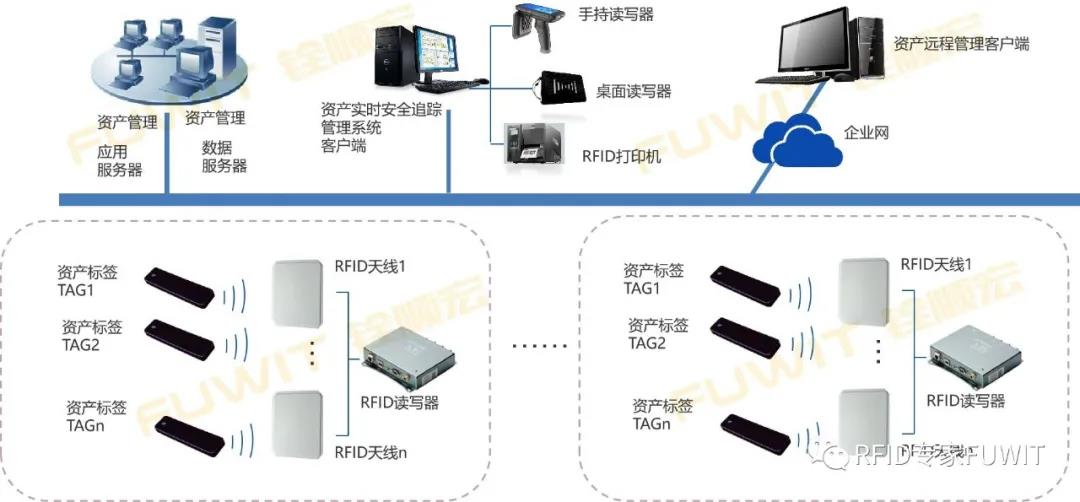
RFID physical management system is mainly used for real-time online visual management of fixed assets. Dynamic tracking and positioning management of the addition, change, and scrapping of fixed assets, enabling quick and accurate inventory of fixed assets. Its basic hardware architecture is as shown below:
3.2 System functions
3.2.1issue card
Use the RFID card issuer to write the fixed asset identity information into the RFID tag, and bind the RFID tag to the corresponding asset to generate basic data information for fixed asset management.
3.2.2Inbound and outbound management
Deploy RFID identification equipment at the entry and exit points of fixed assets, as shown in Figure 3.2:
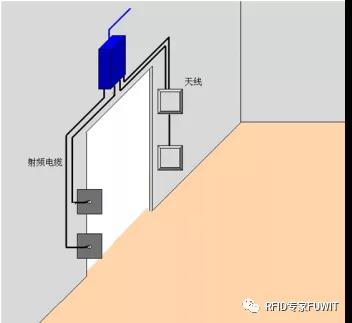
F
ig3.2 Inbound and outbound subsystem
When fixed assets are in and out of the warehouse, the RFID reader emits radio frequency signals through the antenna, and the RFID tag on the asset obtains the induced current, so that the RFID tag acquires the ability to be activated and sends its own code and other information to the reader. The reader receives the information and uploads it to the asset management application system through the network. The system automatically completes the identification of the asset identity and registers the asset information, such as asset model, asset number, entry and exit time, handler, approver, etc.; and grasps the flow of assets in real time.
At the same time, the system can also verify the identity and authority of the recipient. If there is a discrepancy, the system will automatically alert the police. The system can provide functions such as query, analysis and statistics, and printing, greatly improving the informatization level of asset management.
3.2.3inventory
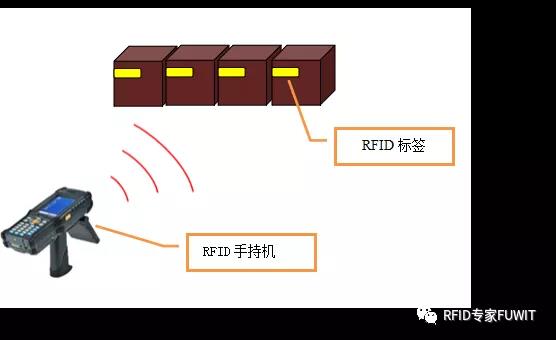
Before taking inventory, download the fixed asset information to the handheld RFID device. During the inventory, misplaced and missing assets are highlighted on the application. Operators can update inventory count results through the user interface. After the inventory is completed, the data results are uploaded to the RFID system when the application is connected to the computer network. The working method of inventory is shown in Fig3.3.
F
ig3.3 Inventory subsystemInventory counting refers to updating the location of assets and identifying misplaced or missing assets. Unlike barcodes, RFID readers do not read tags individually and maintain the location association between the RFID tag and the cabinet. This allows operators to be alerted if missing or new assets are found while scanning tags.
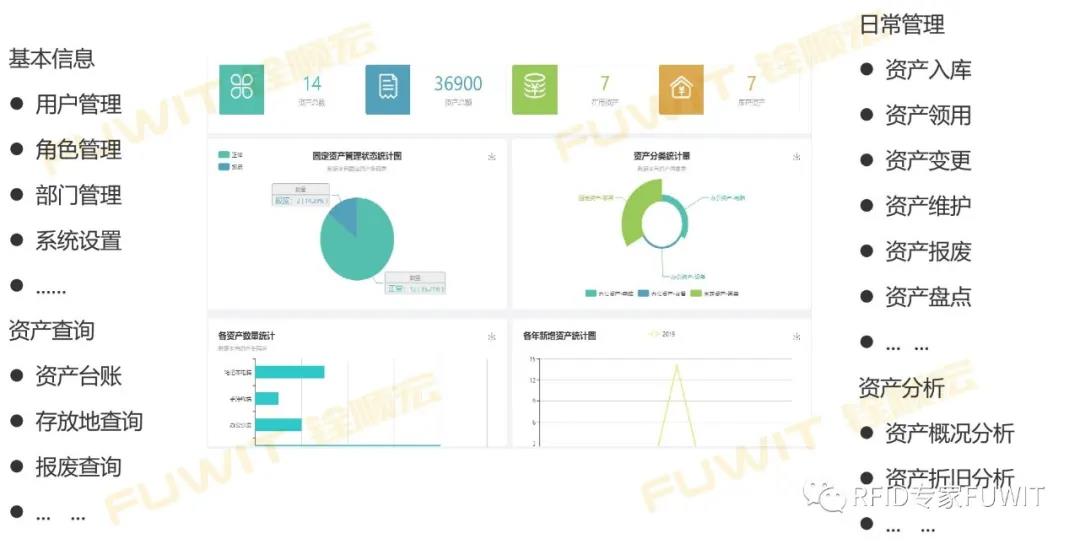
●Daily asset management functionsMainly includes daily work such as adding, modifying, withdrawing, transferring, deleting, splitting and calculating depreciation rate and residual value rate of fixed assets. Including calculating monthly depreciation of fixed assets and printing monthly depreciation reports.
●Fixed assets monthly report Query classified statistical monthly (annual) reports, monthly reports of increased fixed assets this month, monthly reports of decreased fixed assets this month, and monthly depreciation reports (annual reports) of fixed assets based on conditions such as unit, department, time, etc., and provide printing functions.
●Comprehensive inquiry on fixed assets
You can query the status of a single or a batch of fixed assets. The query conditions include asset cards, custody status, valid asset information, department asset statistics, exit assets, transferred assets, historical assets, name specifications, start and end dates, units or departments.
●System maintenance function
The system administrator shall compile the asset classification code table, exit method code table, purchase method code table, storage location code table, department code table, custodian personnel table, and unit name table. Perform operations such as adding, modifying, and deleting. Provide operators with the ability to modify their own passwords. System administrators can freely set the operating permissions of each subordinate operator on functions.
●Security management function Provide various security management methods. Password management function: maintain accounts and passwords.
Permission control function: Divide users into different levels to determine user permissions to use the system, and determine different permissions based on different permissions.operation.
3.3 Application revenue
Introducing physical information collection tools using RFID technology to effectively solve the bottleneck problem of fixed asset data analysis and collection input and real-time recording of actual consumption information of fixed assets. To truly reflect the actual situation and actual distribution of fixed assets, truly achieve online and visual management, achieve the unification of physical objects and management ledgers, completely unify accounts, cards, and objects, and achieve integrated visual management of physical objects and management systems.
4. System topology diagram
7. Mobile management platform
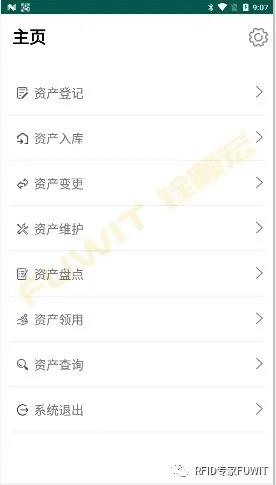
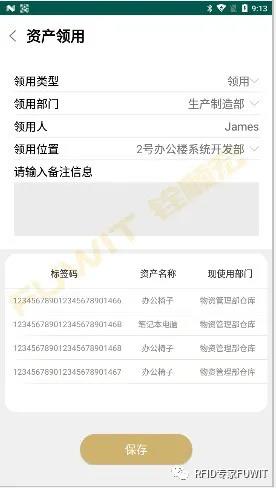
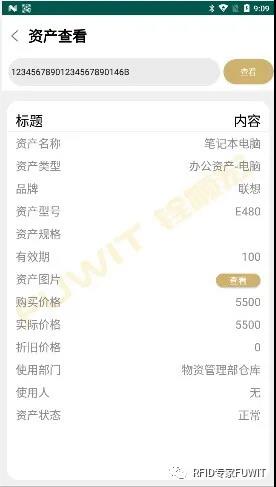
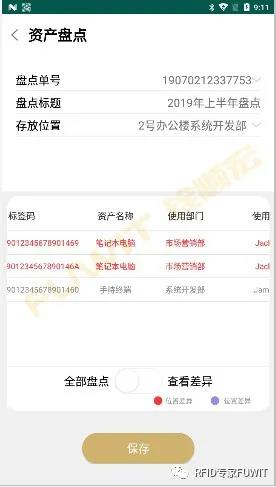
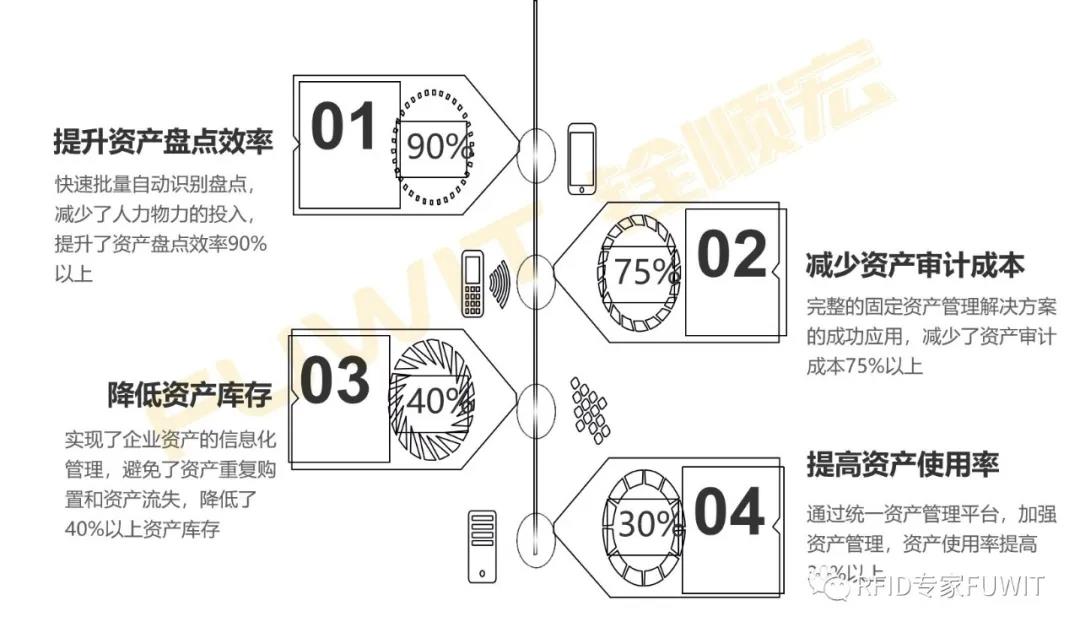
The application of RFID technology in fixed asset management has huge advantages. It has a very important impact on improving the management efficiency of physical assets, tracking and managing the entire life cycle of physical assets, and strengthening supervision and monitoring. The key to RFID technology lies in the speed and accuracy of data collection, and its core equipment lies in fixed readers and handheld devices.
9.1固定式读写器
Fixed readers and writers are mainly used to complete the entry and exit of fixed assets at each circulation node. They need to collect the incoming and outgoing fixed assets in batches, quickly and accurately.
FU-M6-A is a four-channel ultra-high frequency RFID reader with a high-speed reading capability of 750 tags/second. It can be connected to up to 4 antennas at the same time, covering a wider range and quickly collecting data while ensuring no missed reads. At the same time, FU-M6-A has strong anti-interference ability, can adapt to various harsh industrial environments, supports WIFI connection, and can be deployed in key nodes more easily and flexibly.

tag protocol | EPCglobal Gen 2 (ISO 18000-6C) DRM支持;ISO 18000-6B (*可选); I-PX (*optional) |
Antenna connector | 4 reverse TNC connectors; supports 4 independent antennas |
RFoutput | Independent read and write mode, 5 to 31.5dBm output (1.4W), ±0.5dBm adjustable |
Frequency characteristics | FCC(NA,SA)902-928MHz;ETSI(EU) 865.6-867.6MHz;MIC(Korea)910-914MHz;SRRC-MII(P.R.China);920-925MHz |
Communication interface | 10/100 Base-T Ethernet; |
Wireless network (optional) | Built-in 802.11 b/g (*optional); |
Tag reading rate | Greater than 750 tags/second |
Tag reading distance | 大于30feet(9 M)采用6dBi天线(36dBm EIRP) |
Maximum read and writeEPC IDlength | 最高496bits |
operating system | Linux kernel version 2.6 |
9.2 手持设备
Handheld devices are mainly used for searching, inventorying and processing daily business processes of fixed assets. They involve many functions and have a wide range of applications, which puts forward higher requirements for the RFID reading module in the device.
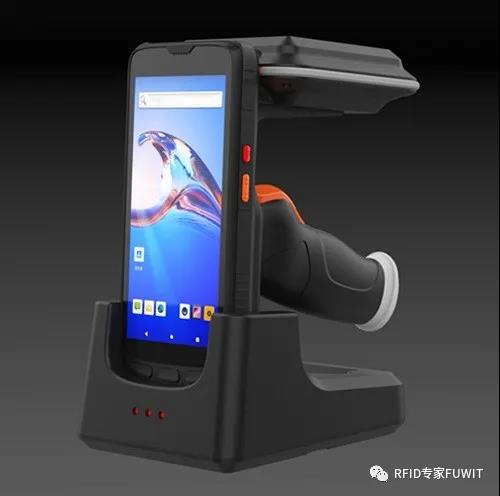
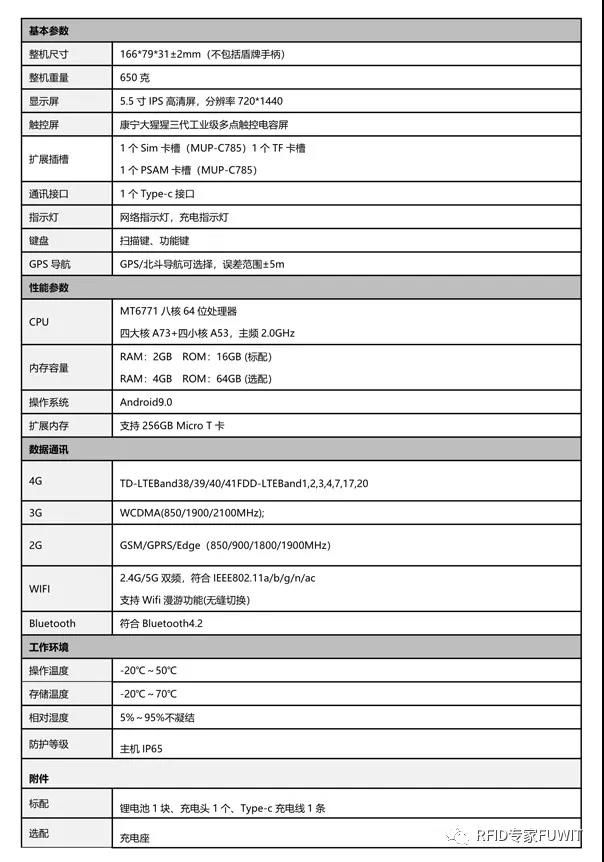
ThingMagic M6e-Micro, an ultra-high frequency RFID mold that adopts ultra-small module structure design and excellent "fast search algorithm", can be embedded into a variety of commonly used handheld and portable devices. It can read tags at a speed of up to 750 tags/second, has low power consumption, and responds quickly after receiving instructions. At the same time, it has a superior multi-label anti-collision algorithm, which is especially suitable for inventory in warehouses; its unique adjustable power from -5dbm to +30dbm can be easily applied in fixed asset management, ensuring fast search, inventory and daily stable work.
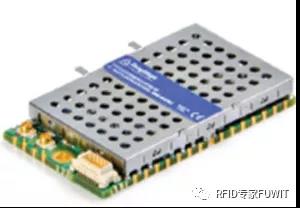
tag protocol | EPCglobal Gen 2 (ISO 18000-6C) DRM支持;ISO 18000-6B (*可选); I-PX (*optional) |
Antenna connector | 2 x 50 ohm UFL connections to the edge of the machine or motherboard, supporting 2 independent antennas |
RFoutput | Independent read and write mode, -5 to 30dBm output, ±1dBm adjustable |
Frequency characteristics | ETSI (EU, India) 865.6-867.6 MHz;TRAI 865-867 MHz (India);KCC (Korea) 917-920.8 MHz;ACMA (Australia) 920-926 MHz;SRRC-MII (P.R.China) 920-925 MHz;Open (Customizable channel plan;865-868MHz and 902-928 MHz); |
connector | Equipped with 28-pin stamp hole connector connection mode (including power supply, communication and GPIO) |
Communication interface | Serial asynchronous communication, 3.3V or 5V logic; Baud rate 9600-921, 600bps; USB2.0 hardware interface (up to 12Mbps) Restart and shutdown control |
Tag reading rate | Greater than 750 tags/second; use high performance settings |
Tag reading distance | 大于30feet(9 M)采用6dBi天线(36dBm EIRP) |
9.3 equipmentChecklist
serial number | Product name | model | Function | quantity | other |
1 | Fixed reader/writer | FU-M6-A | Reader/Writer | 1 |
|
2 | antenna | RAA915-9R40 | Reader antenna | 4 |
|
3 | RF cable | custom made | RF cable | 4 |
|
4 | mobile handheld terminal | W9900X | Mobile work | 1 |
|
This content comes from the Internet/RFID专家FUWIT, this website only provides reprinting. The views, stance, technology, etc. of this article have nothing to do with this website. If there is any infringement, please contact us to delete it!