






















Service Hotline
News

News

Amazon’s new communication technology is based on LoRa! Support the expansion of its smart home ecosystem
2021-12-29
1001
Introduction to reading:
At the Amazon hardware conference, the media mostly focused on more than a dozen smart hardware devices, but the Sidewalk technology deserves more attention. Its release implies Amazon's intention to further expand the smart home ecosystem, and this intention is closely related to LoRa, a low-power wide-area network technology familiar to the industry.

On Wednesday, Amazon held its annual hardware conference in Seattle. At the conference, it released more than ten new products, covering a variety of speakers, doorbells, security monitors, routers, smart rings and smart glasses wearable devices that support Alexa voice assistant, forming a rich and diverse range of smart hardware devices.However, in addition to smart hardware, Amazon also announced a low-power, long-range wireless technology called Sidewalk that can control home devices over a larger range than wireless networks such as Wi-Fi or Bluetooth.At the press conference, the media mostly focused on more than a dozen smart hardware devices, but the author believes that the Sidewalk technology deserves more attention. Its release implies Amazon's intention to further expand the smart home ecosystem, and this intention is closely related to LoRa, a low-power wide-area network technology familiar to the industry.
Not reinventing the wheel, innovation based on LoRa
Amazon Device Director Dave Limp mentioned that long distance is the most important advantage of the Sidewalk protocol. Sidewalk uses the existing 900MHz spectrum and can connect to devices up to 1.6 kilometers away.However, the details of this technology have not been announced, which has caused some speculation and even complaints, such as the person in the picture below:
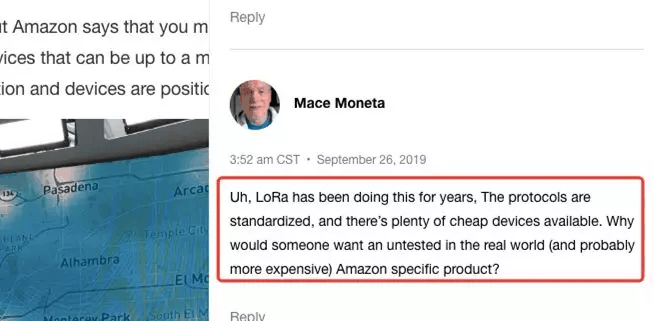
"LoRa has been around for years, has a standardized protocol and plenty of cheap equipment available, so why would anyone else use an Amazon-proprietary product that hasn't been tested in the industry?"This argument also makes sense. After all, "reinventing the wheel" will make the industry more fragmented.
However, as far as the author understands, Amazon Sidework is not reinventing the wheel.This communication technology is actually a protocol launched based on LoRa modulation technology and suitable for long-distance communication in smart homes and consumer-grade smart hardware., supplementing the shortcomings of WiFi, Bluetooth, Zigbee, Zwave and other technologies previously used for smart home and consumer-grade smart hardware communications. In other words, Sidewalk is actually an innovation in smart home and consumer-grade smart hardware communication using existing mature technology.
Because it is based on mature LoRa physical layer technology, Amazon and its hardware partners can directly reuse existing LoRa industry ecological resources in hardware development, and the development of Sidewalk related products can also be implemented quickly and at low cost.Therefore, Amazon hopes to expand Sidewalk into its smart hardware industry ecosystem. This is not a task to be done from scratch. In a sense, it is also using LoRa's existing industry ecosystem to expand its own ecosystem.
Amazon announced at this conference its first product based on Sidewalk, the "Fetch" pet dog tracking tag. The tag can set up an electronic fence. As long as the dog leaves the designated area, the owner will receive an alert. This device will be launched next year.Compared with traditional Bluetooth pet tracking devices, which only have a range of 100 meters, Sidewalk allows people to expand the range of tracking their pets to more than 1 kilometer.
In fact, Fetch is not Amazon’s first product to use LoRa.In early 2018, Amazon acquired Ring, a smart home company, for US$1 billion to accelerate its entry into the smart home field. Ring is famous for its smart doorbells, security cameras and floodlights. After the acquisition, Ring's products began to be integrated with the Amazon Alexa voice platform, and many products were connected to Echo speakers.Among them, a smart lamp launched by Ring that is connected to an Echo speaker has a built-in LoRa chip to control the smart lamp.
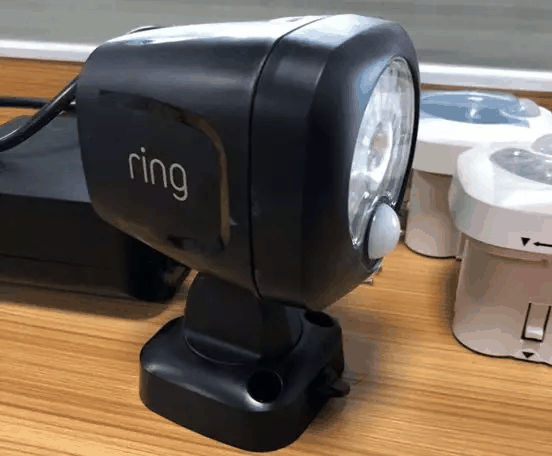
Due to the expanded communication range, mature solutions and lower costs, Amazon smart hardware products may have built-in LoRa chips in the future and use the Sidewalk protocol to allow communities, families and individual users to connect over long distances.
Two-way efforts, LoRa industry ecology is also actively cooperating
Not only smart home players like Amazon are actively exploring innovations in new communication methods, but mainstream manufacturers in the LoRa industry ecosystem are also actively cooperating, specifically designing underlying technologies and products for large-scale scenarios to support rapid implementation on the application side.
As we all know, LoRa is a linear frequency modulation spread spectrum modulation technology that can increase communication distance on the basis of lower power consumption. Semtech, a company, packages LoRa technology into radio frequency chips to provide support for the product development of hardware manufacturers.Based on LoRa physical layer technology, manufacturers can design specific specifications for different IoT scenarios.
Among them, LoRaWAN, as an important standard in the field of IoT communication, has been widely promoted in the past few years. A large number of IoT network operators around the world use LoRaWAN to deploy wide area networks, including national public networks, metropolitan area networks and industry private networks.However, LoRaWAN, as a wide-area network deployment specification, more defines and takes into account the issues of universal communication and large-scale network deployment of low-power devices, and may not be able to quickly support some specific scenarios.
For example, there are many control scenarios in the smart home field, including the control of turning on and off door locks, lights and other equipment, which have certain requirements on latency. If the standard LoRaWAN specification is still used at this time, it will inevitably lead to poor user experience.Currently, many manufacturers design MAC layer specifications for specific scenarios to improve user experience.Many players in the domestic LoRa ecosystem, such as CLAA, Alibaba Cloud IoT and other manufacturers, design appropriate communication protocols for some large-scale application scenarios.
Of course, the underlying chips are also exploring products for application scenarios.At the end of July this year, Semtech announced the launch of the new LoRa smart home device LLCC68d in Shenzhen. Its intention is to expand the market application scope of LoRa from To B industry applications to To C smart homes, smart communities and consumer applications.
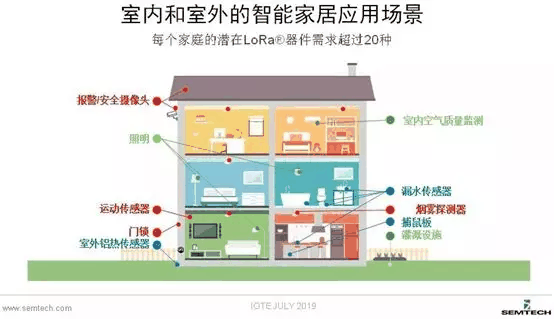
Compared with the traditional SX1278/6, the LLCC68d chip is designed for home, community and consumer scenarios, can meet low-latency smart home applications such as smart locks and lighting, and is compatible with existing LoRaWAN networks.Of course, LLCC68d can also support proprietary communication protocols, which gives a large number of smart home manufacturers more innovation opportunities.
The author speculates that the current Sidewalk protocol corresponds to the LLCC68d chip, that is, smart hardware that uses the Amazon Sidewalk protocol will choose the LLCC68d chip to achieve long-distance communication.As a large-scale application scenario in the field of Internet of Things, smart home will form a market worth hundreds of billions of dollars in the next few years. As the shipments of smart home products increase, Sidewalk and its similar communication protocols in home scenarios will enable the LoRa ecosystem to achieve widespread deployment in smart homes.
From indoors to outdoors, the smart home ecosystem expands
In the author's opinion, Amazon's launch of Sidewalk technology is of great significance. This is an important step in expanding its smart home ecological footprint. Because Sidewalk's low power consumption and long-distance characteristics allow Amazon smart home products to go out of the house, and then launch various outdoor products to occupy the community and individual consumer markets.
As Amazon said at the press conference, with the cooperation of Sidewalk, users can use Echo speakers in the house to activate the weather station on the sidewalk to understand the rainfall outside, turn on the watering sensor in the garden in the room, and even activate the sensor in the mailbox to know whether the mail has been delivered.Traditional WiFi, Bluetooth, Zigbee and other protocols cannot support devices from indoors to outdoors due to the communication distance. With the support of Sidewalk, Amazon can continue to launch products for outdoor scenarios such as community and personal wear in the future.
Over the past few years, as an e-commerce and cloud computing giant, Amazon has launched a number of cost-effective hardware products that have had a very wide impact on the industry. Typical representatives are Kindle and Echo smart speakers.The former is Amazon's entrance to digital content such as books, music, and videos, expanding the sales of its digital content;The latter is the entrance to its Alexa intelligent voice assistant, increasing its stickiness in AI, cloud computing, digital content and e-commerce.
At present, Amazon's smart hardware has a dominant position in the market, especially smart speakers, which occupy the first position in the U.S. market. Echo occupies about 70% of the smart speaker market share.With the success of smart speakers, Amazon continues to expand the number of smart hardware categories, continue to occupy the home and personal consumer markets, acquire more users and data, and then expand its industrial ecological influence.
The Alexa smart voice assistant is already the core of Amazon's hardware ecosystem. Amazon has opened Alexa to third-party manufacturers to expand the boundaries of the hardware ecosystem.Sidewalk can also be considered as another core weapon to expand hardware categories and boundaries. In addition to Amazon's own smart home products, Amazon also encourages more smart home manufacturers to adopt Sidewalk technology, thereby forming a broader smart home ecosystem.Of course, with the promotion of Sidewalk, LoRa's layout in the smart home ecosystem has also been further expanded.
Amazon device director Dave Limp also mentioned 4G/5G technology, but he believed that cellular networks are expensive and complex, and may not necessarily meet the needs of smart homes.In the author's opinion, Amazon promotes Sidewalk technology not only because of these characteristics of cellular networks, but also because cellular networks rely on operators and cannot influence them themselves, and its own communication technology is more conducive to its influence in the industrial ecology.
Of course, to achieve a communication distance of more than 1 km, hardware using Sidewalk technology needs to be connected to a base station or gateway, and the deployment of base stations and gateways is more important.In an external press release, Amazon mentioned that it had distributed 700 testing devices to many households in Los Angeles. In just three weeks, it covered the densely populated Los Angeles area.

The author predicts thatMost of these 700 test devices should be LoRa gateways that support the Sidewalk specification.。Due to the wide communication distance of LoRa, by distributing LoRa gateways to households, such "crowdsourcing" methods can be used to quickly deploy the network, covering major population areas, thereby supporting the networking of various smart home products.
The cost of LoRa gateway is low. At the beginning of this year, at a LoRa conference held in the Netherlands, the LoRa developer community TTN released a $69 LoRaWAN gateway. It can be seen that LoRaWAN gateway can achieve low cost.As a private protocol gateway, its cost may be lower than that of a LoRaWAN gateway, which will lay a good foundation for its promotion in the smart home field.
However, if Sidewalk-based smart home products are fully commercialized, they will target customers in all regions of the United States. How will every user who purchases Amazon smart hardware products have network coverage?Does the user who purchases the hardware bundle the gateway, or is it specifically deployed through other means?This may be an important issue that needs to be solved in the future commercial promotion of Sidewalk.
Amazon has achieved first-mover advantage in the field of smart speakers through Alexa voice assistant and Echo, thereby driving the development of its smart home ecosystem. However, with the efforts of competitors such as Google and Apple, this first-mover advantage is gradually weakening.Using Sidewalk to expand the territory of smart home categories and expand the hardware ecosystem may become another first-mover advantage for Amazon. If this technology can bring a leading edge to its smart home ecosystem, it is not ruled out that other smart home giants will also launch low-power wide-area communication technology in the future to expand their territory and build their own ecosystem.By then, LoRa may quietly enter the ecology of other smart home players again.
While the spotlight is more focused on the dozen or so pieces of hardware released by Amazon, the low-key Sidewalk technology may have a more profound impact on Amazon's smart home strategy and ecosystem.
This article is reproduced from the "Internet of Things Think Tank" public account. If there is any infringement, please leave a message in the background and contact us for deletion.
Related Recommendations