






















Service Hotline
News

News

↑↑↑The Beidou Final Star was successfully launched! “Beidou Constellation” shines with Shanghai’s wisdom
2021-12-29
1260
On the morning of June 23, the last Beidou-3 global networking satellite was successfully launched.
From its launch in 2009 to the launch of the 30th satellite today, the completion of the Beidou-3 system marks the successful conclusion of the "three-step" development strategy for the development of satellite navigation systems suitable for national conditions that our country has been exploring since the 1980s.
There are 24 Beidou satellites in medium earth orbit, 3 in geostationary orbit, and 3 in inclined geosynchronous orbit. Almost every Beidou satellite shining in the sky embodies the hard work and contribution of scientific researchers in Shanghai.
"One star is connected, all stars are connected"
Let satellites also "talk to the sky"
The Beidou navigation satellite development team of the Chinese Academy of Sciences in Zhangjiang, Pudong, has completed the development and launch of 12 satellites in the Beidou-3 system. It will build a basic system for the Beidou navigation system in 2018 and provide global services. It will complete the complete system construction in 2020 and also provide a new solution for the construction of China's Beidou global satellite navigation system.
This year, the team has just been established for ten years. The average age of the team members is only over 30 years old. It can be said to be a new recruit in the aerospace field. It is this "formidable" force that injects more innovative inspiration into the stable and leading satellite research and development. During the development process of Beidou-3, they completed hundreds of key technology research projects for satellite applications.
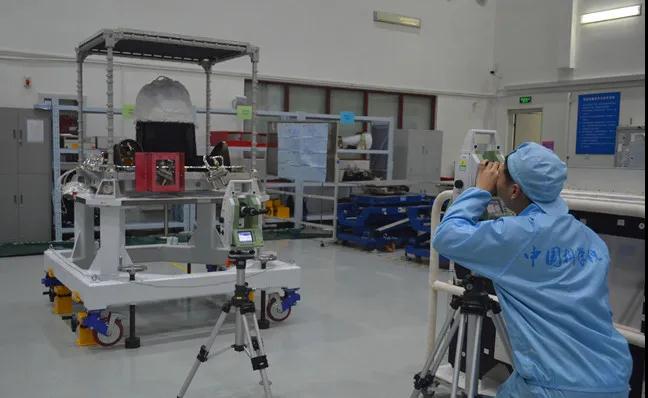
▲Researchers are conducting precision measurements on the Beidou-3 satellite (Photo courtesy of the Microsatellite Innovation Institute of the Chinese Academy of Sciences)
There is an unwritten rule in the aerospace field that the new technology used on each star generally does not exceed 30%, but this team used nearly 80% of the new technology on the first test star.
Driven by innovation, this young team boldly attempts to revolutionize satellite design ideas and management forms as a whole. This young team uses technologies such as frame panel structure, independent star sensor positioning, and high-functional density integrated electronic architecture to create the "Chinese Academy of Sciences Navigation Satellite Dedicated Platform", which effectively enhances the adaptability and scalability of satellites.
They proposed an original "functional chain" design concept to optimize and integrate the internal resources of the satellite to the maximum extent. They replaced more than 20 computers originally used for control with one high-performance computer, which significantly reduced costs while increasing functional density.
What’s more worth mentioning is thatThey have made breakthroughs in inter-satellite link technology, achieving "one-star connectivity, star-to-star connectivity", allowing satellites to "talk to each other in the sky" and solving the bottleneck that restricted Beidou's global network.
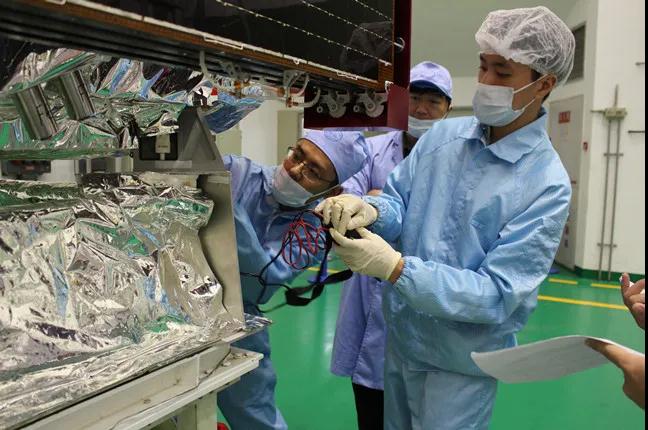
▲Beidou-3 is undergoing final assembly at the launch site (Photo courtesy of the Institute of Microsatellite Innovation, Chinese Academy of Sciences)
Following the first test satellite, the team also made breakthroughs in satellite autonomous diagnosis and recovery technology in the subsequent development of the Beidou-3 global networking satellite, allowing the satellite to have "self-diagnosis and self-recovery" capabilities. Satellites can perform autonomous health diagnosis, fault isolation and recovery without any ground intervention, greatly improving satellite availability.
In addition, Beidou-3 also used a high-power gallium nitride-based solid-state amplifier for the first time to effectively improve signal quality; it broke through high-precision time-frequency seamless switching technology, laying the foundation for achieving high continuity of global system signals; it adopted the domestic Loongson + FLASH architecture, filling the gap in domestic aerospace processors, and realizing the localization of all core devices, driving the development of the entire industry chain.
While watching the last Beidou-3 global networking satellite successfully launched into orbit, this team has begun a new journey. According to my country's navigation strategic needs, a more ubiquitous, more integrated, and more intelligent integrated positioning, navigation and timing system will be built in 2035. They will continue to fight for the next generation of navigation satellites.
Create a strong “heart” of Beidou
It takes 6 million years to get an error of 1 second
Time and spatial location information are important strategic resources for a country. Obtaining satellite position information and precise time information on the satellite are the two core parameters of navigation satellites - a time difference of one billionth of a second (1 nanosecond) will lead to a distance error of 0.3 meters.
To achieve decimeter-level and centimeter-level navigation and positioning accuracy, Beidou satellites must have a strong and reliable "heart" - a spaceborne atomic clock, and a sharp and clear "brain" - an information processing system.
In 2002, the Shanghai Observatory of the Chinese Academy of Sciences launched research on passive spaceborne hydrogen atomic clocks based on years of development of ground-based active hydrogen atomic clocks. In 2015, my country's first spaceborne hydrogen atomic clock completed by them was launched with the new generation of Beidou navigation satellites.
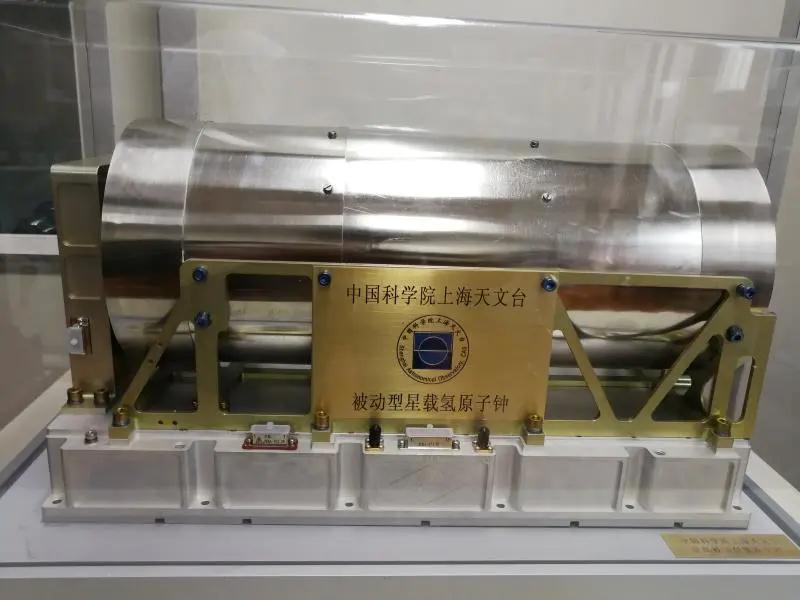
▲Prototype model of the spaceborne hydrogen atomic clock on Beidou-3 (photo courtesy of Shanghai Observatory)
Over the past five years, the performance of the hydrogen clocks that have followed the Beidou satellites into space has been continuously improved, and the components, raw materials, and core technologies have been completely controlled independently.This time, a hydrogen clock provided by the Shanghai Observatory followed the "Final Star" into space. Its accuracy has reached an error of less than 1 nanosecond per day, which is equivalent to an error of one second in 6 million years. It is currently one of the best-performing atomic clocks in the sky.
Just as Beidou is coming to an end, scientific researchers at the Shanghai Observatory have developed a lighter "heart" of Beidou: they have successfully reduced the weight of the hydrogen clock from 23 kilograms to 13 kilograms. Three units will be delivered to users by the end of the year for use in Beidou network satellites next year.
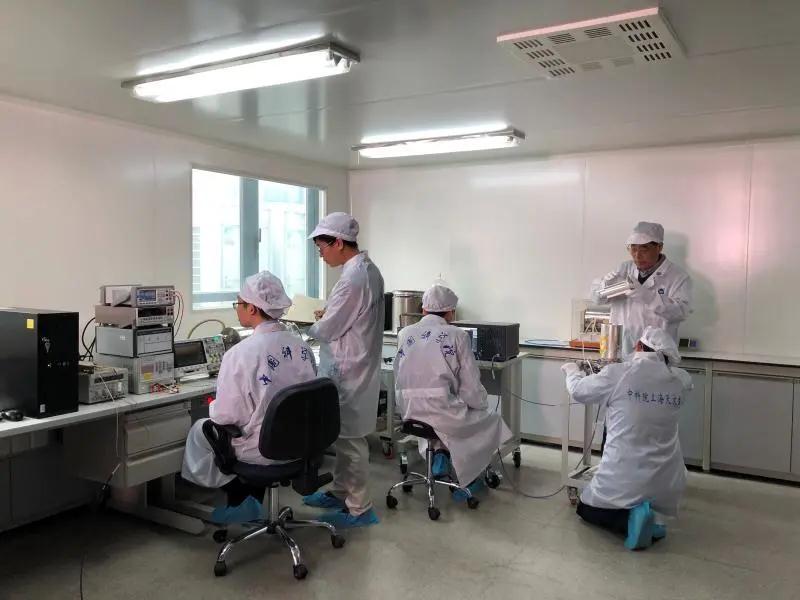
▲Scientific researchers from the Shanghai Observatory are testing the hydrogen clock under development (Photo courtesy of the Shanghai Observatory)
With a strong "heart", you also need a sharp "brain". The Shanghai Observatory has developed the "most powerful brain" for Beidou that can correct errors in real time and have multiple backups to achieve "fast, accurate and stable" positioning requirements.
In order to build the "most powerful brain", Hu Xiaogong, technical director of the information processing system of the Shanghai Observatory of the Chinese Academy of Sciences, led the team through a painful transformation "from scientists to engineers".
When trying to apply the formulas left by Newton and Einstein for calculating natural celestial bodies to the orbit calculations of man-made celestial bodies such as orbiting satellites, they encountered too many unexpected situations. final,They overcame various adverse conditions and proposed and implemented the "regional monitoring network + inter-satellite link" satellite-ground-satellite joint precision orbit determination technology for the first time in the world. They also designed a specially designed algorithm and finally achieved the precise positioning performance indicators of Beidou-3.
In order to further calculate the accuracy of Beidou, the Shanghai Observatory has also developed a special laser "sky ruler" - the first movable all-day satellite laser ranging system in China, with a maximum range of 38,800 kilometers, and has been successfully used in centimeter-level precision laser ranging of Beidou satellites. These have made irreplaceable and key contributions to the realization of global services by my country's Beidou satellite navigation.
Foundation reinforcement
Make location services as convenient as the Internet
If the MicroStar Research Institute and the Shanghai Observatory are both working hard to build the Beidou navigation system, then Qianxun Position, a Shanghai high-tech company, is using cloud computing, big data processing, and its own proficient algorithms to turn "Beidou signals" into a convenient service experience like using the mobile Internet.
Centimeter-level positioning, millimeter-level sensing, and nanosecond-level timing are the results achieved by the new system Qianxun Positioning has built for the global satellite navigation field in the past five years.. As of 2019, the high-precision services of this system can cover most areas in the country except uninhabited areas.

▲The demonstration picture of agricultural plant protection drone operation displayed by Qianxun Position Positioning System. The positioning accuracy reaches centimeter level, which can effectively reduce the amount of pesticide spraying (picture provided by Qianxun Position)
"Beidou has completed its global network. We will simultaneously provide global enhanced services within this year, and the entire link will support the latest signals of Beidou-3." Chen Jinpei, CEO of Qianxun Position, said that both of the company's core products currently support the latest signals.
Starting in November 2019, Qianxun Position replaced the core equipment in the Beidou satellite ground-based enhancement station with the independently developed "Qianlong" space-time server to improve the processing capabilities of all satellite navigation public service signals including Beidou-3. The replacement work is nearing completion.
With the successful launch of the Beidou global network satellite, Chen Jinpei believes that a broader market will soon emerge. "In the next three years, Beidou will accelerate its positioning and serve more than 1 billion users."
In the past five years, Qianxun Positioning has worked hand in hand with global mainstream chip manufacturers and industry partners to combine Beidou high-precision positioning technology with 5G and artificial intelligence in fields such as autonomous driving, industry upgrades, surveying and mapping, smart cities, and public services to promote the implementation of Beidou applications. It is expected that six models of autonomous vehicles equipped with Beidou’s high-precision positioning technology will be officially mass-produced and launched this year.

▲Scene demonstration picture of Qianxun positioning system. In the future, each vehicle will be labeled with precise time and space to better realize vehicle-road collaboration (picture provided by Qianxun Position)
Beidou Navigation has opened up an extremely vast world. In 2019, Qianxun Positioning launched the "Beidou Intelligent Maker" competition, opening up relevant technology platforms and allowing various innovative companies and individuals to participate in the application development of high-precision positioning capabilities. As a result, 40% of the contestants were born after 1995, and 70% of the contestants were under 35 years old.
June 23 is the final day of the Beidou system’s global networking, and it is also the day when a new era of Beidou navigation applications begins.
This article is reproduced from "Xu Qimin Shanghai Science and Technology", support the protection of intellectual property rights, please indicate the original source and author when reprinting. If there is any infringement, please contact us to delete it.
Related Recommendations