






















Service Hotline
News

News

Beidou+4G/5G indoor positioning technology and applications
2021-12-28
1039
Indoor positioning technology is now in a very hot research and exploration stage, showing a state in which a hundred flowers are blooming.The main existing problems in this area are operating costs and investment.Mobile communication networks can not only engage in communication services, but can also take advantage of the opportunities of large-scale network deployment of 4G and 5G to research and develop space-ground integrated, low-cost, and high-precision positioning systems together with the Beidou system.
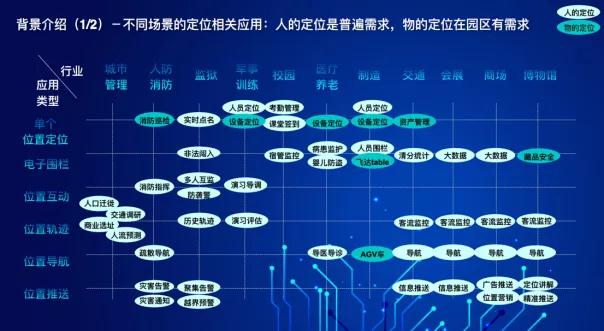
Why is indoor positioning gradually gaining popularity in the industry? From the beginning of WIFI positioning to the present, indoor positioning has a history of more than ten years, but there has always been an issue of operating costs. 2019 is the first year of 5G. At this stage, 5G is mainly supported by IoT, which is the Internet of Everything, empowering all industries. This not only brings about the positioning needs of people, but also the positioning needs of objects, such as many emergency and fire-related application needs, robot navigation in the medical industry, medical distribution logistics, etc. all have indoor positioning needs.
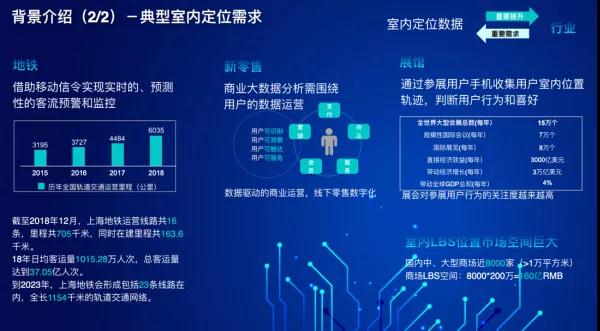
In the subway, especially in the smart subway field where 5G and STO are cooperating, China Telecom's desensitized user data can locate heat maps, which is the diversion of people's flow. In terms of new retail, China Resources and Wanda have also begun exploring indoor positioning. New retail originally hoped to transform traditional retail. Now Wal-Mart in the United States is planning to change its operating model by analyzing the path of users selecting goods, which is also the need of new retail. In terms of exhibition halls, China will have a huge market in the future. For example, at the Shanghai International Exhibition Center, there are a lot of exhibitions and exhibition activities. Nowadays, road signs are mostly used for directions. In fact, sometimes it is difficult to find the exhibition halls you want to go to even if there are road signs, so people also have a need for the positioning of large exhibition halls.
In areas that do not include image recognition and AI positioning, indoor positioning technologies related to wireless communication technology are used. Wireless communication technology is mainly provided through operators. For example, Shanghai Telecom has deployed 4G and 5G networks on the largest scale. In addition, Shanghai Telecom has also deployed chainNET. There are also many people engaged in related research work in the Internet of Things. One of the more popular ones is UWB. Apple mentioned UWB technology when it released the iPhone 11 at the press conference. What are the advantages of China Telecom? Just 5G. We are communicating with Huawei that 5G simulation data can achieve indoor positioning accuracy of about 1 meter. This is the indoor positioning solution considered by Shanghai Telecom. Our advantage lies in the collection end. The base station, WIFI and wired network are all collection ends, and we can understand the data upload situation. In addition, we also need basic data, that is, CAD drawings. We use building CAD drawings with network points to create the distribution system for each building. These are the basis of data. On this basis, a geographical information system for indoor operators is first formed. There are three main types of algorithms: fingerprint database, TODA and field strength triangulation positioning. Positioning data is continuously uploaded through this terminal, and then the position can be calculated through the algorithm engine. Because now it is all internal applications and the platform is in the computer room. Next, we hope to conduct data desensitization through exploration. From a security perspective, we also need to explore how to open capabilities.
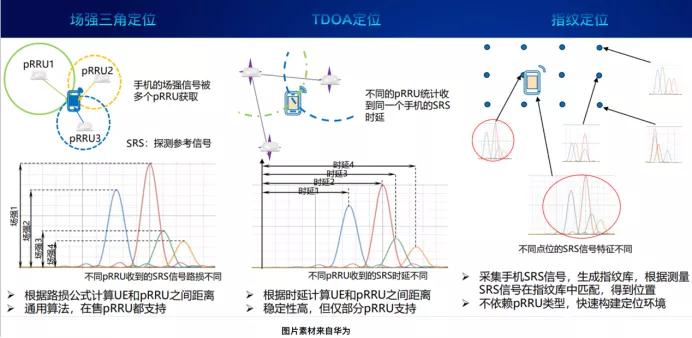
Regarding the formation of the GIS solution, it must first be combined with the Beidou system to develop a seamless indoor and outdoor map network. This map must first create a unified coordinate system. The Internet map is our base map. On this base map, indoor information is connected through coordinate matching, and then a basic map GIS system is formed. In addition, for the positioning solution, we use the most basic network, and all architectures are basically secondary-based. That is, the PRU serves as a base station and collects uploaded data into the computer room by scanning the terminals of objects and people. This is one of our advantages. It will be added to the positioning engine and deployed centrally to calculate the location of all mobile phones or objects. Shanghai Telecom has also tested several major technologies for indoor positioning. One of them is initial positioning technology. After two or three years of hard work, this technology has been realized. The data includes intensity information, etc. The initial positioning can locate the floor. In addition, there are three main methods for precise positioning. The first is the uplink standard. All base stations can scan the broadband signal of the wireless network. After the data is transmitted up, the point location and time difference are calculated through the path. The data may contain outdoor GPS signals, as well as some base station information and strength information. This plan has been implemented by first forming an information map and then combining it with other information to finally locate the residential area floors and floors of the subdivision system.
5G’s positioning advantages. The first is standardization, that is, 3GPP has defined standard positioning network sources and standard benefits in Rel-15 and Rel-16, so we do not need to change the information transmission from the base station side to the mobile phone side. Later we will add a computing platform to calculate these data. 5G has two other major advantages. One is high bandwidth. The larger the bandwidth, the easier it is to identify more signals and calculate the time difference. There will be no error in the delay and the accuracy will be improved. Another advantage of 5G is multiple antennas, so there will be a new calculation method next. 5G can use different antennas to correspond to different users, thereby more accurately locating the user's location. At present, it seems that 5G has relatively strong advantages indoors. So this year we also discussed the hope of cooperating with Beidou to carry out 5G+Beidou indoor and outdoor positioning research and expand it.
What are the advantages of telecommunications? Our Shanghai Telecom will participate in the construction of all basic networks. Regardless of the pipe network or Shanghai's market size, it ranks first. With Beidou, it will become a stronger integrated space and ground network. In the process of 5G development, we hope to develop a support system represented by cloud + AI + security, and also hope to build an ecosystem. After the arrival of 5G, the competition among operators is the competition among ecosystems, so we need to encapsulate our own capabilities. In addition to encapsulating location information, we also hope to open up capabilities through existing large network resources and cloud resources to build a system and ecosystem.
The following introduces the application cases of Shanghai Telecom
Case 1:Network planningThe business application of network optimization indoor positioning uses three-dimensional simulation, online iteration and accurate prediction, targeted construction investment, determines user location through indoor positioning, efficiently handles user complaints, conducts virtual CQT testing through indoor positioning, reduces costs and increases efficiency, locates items, and accurately manages equipment assets.
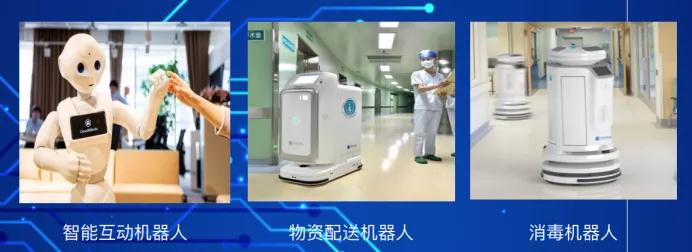
Case 2:The business application of medical indoor positioning is based on 5G's high-bandwidth, low-latency intelligent pipeline, which connects robots and big data platforms. Through the big data analysis capabilities of the cloud platform, it can quickly acquire data collection and analysis capabilities and learning capabilities to meet the needs of multi-scenario applications.
Case three:Business applications of industrial indoor positioning. In some large-scale manufacturing assembly processes, managing parts and tools through indoor positioning systems can greatly improve efficiency.
Case four:Business applications of commercial 4G/WIFI positioning. For example, publishing a LOGO on an indoor map makes it easier for users to find themselves on a complicated map; users can comment on and share applications; instantly initiate new product notifications, group purchase notifications, etc. to terminals to discover and capture potential customers; and can combine preferential strategies to attract old customers, and at the same time develop new customers with the help of applications in users' social circles.
Case five:Business application of indoor positioning for people flow monitoring. Four main application scenarios: urban passenger flow monitoring: combined with outdoor data to monitor the distribution and trend of passenger flow in the city, and giving travel suggestions; in-station passenger flow monitoring, real-time monitoring of passenger flow conditions in the station, providing data reference for safe passenger flow control; cross-sectional passenger flow monitoring: counting passenger flow between stations, and reporting train congestion levels on light strips; precise accounting: counting the annual passenger flow proportion of each subway line to guide profit sharing.
Case six:Business application of smart subway indoor positioning. On October 31, the “5G+ Smart Metro Platform” jointly built by Shanghai STO Metro Group and partners such as Shanghai Telecom, CASCO, Huawei, and Shanghai Comservice was officially launched at Xujing East Station of Shanghai Metro. Relying on applications based on 5G high-bandwidth network, such as high-definition mobile video, high-definition intercom, customer service personnel positioning, etc., it empowers subway operating companies to implement emergency plans for large passenger flows, and implement passenger flow evacuation guidance and other services for the scene of large passenger flow at the China International Import Expo. The platform monitors the passenger flow data of the "Three Lines and Three Stations" and the CIIE venues in real time, analyzes it based on historical data, and accurately predicts the passenger flow situation in the next 15 minutes. This allows commanders to more effectively judge the day's operation organization and work plan, and initiate passenger flow emergency management plans in advance if necessary, such as notifying passengers in advance of changing bus routes.
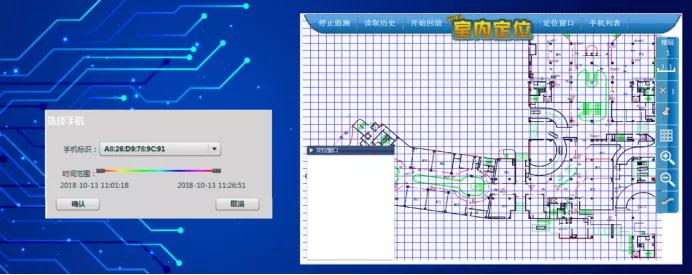
Case 7:Business application of indoor WIFI positioning for public safety. Select the monitoring floor to monitor the location information of the positioning terminal in real time; select the mobile phone and time range to play back the location movement process of the mobile phone.
We hope that the integration of Beidou and 5G will bring more benefits and profit growth points to industry applications in the future!
This article is reprinted from the "Shanghai Beidou Navigation Innovation Research Institute", which supports the protection of intellectual property rights. Please indicate the original source and author when reprinting. If there is any infringement, please contact us to delete it.
Related Recommendations