






















Service Hotline
News

News

2020 China 5G New Infrastructure Research Report
2021-12-28
882
1. The importance of 5G new infrastructure
What does 5G mean to society?
Changes in the nature of business are the significance of 5G new infrastructure
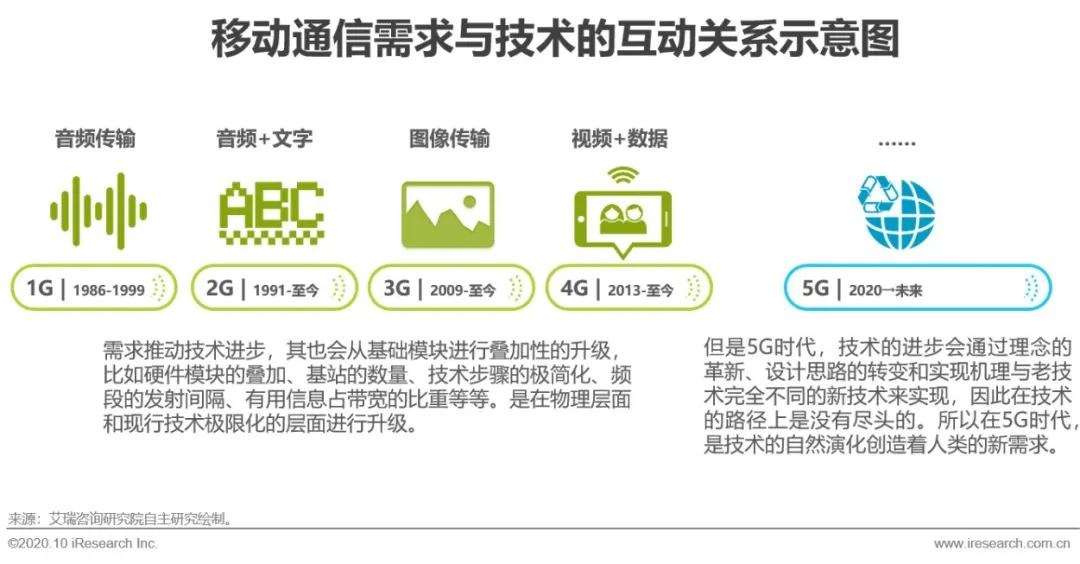
Communication services and humans are closely related to the attributes of humans as three-dimensional creatures in terms of the functions that communication technologies of different generations can achieve. From 1G to 4G, people’s communication needs from voice to graphics to video have driven technological progress. But just like the relationship between physics and mathematics, humans explain and quantify physical phenomena through mathematical calculations. However, when the primary and secondary relationships are reversed, it is difficult to find evidence of existence in the physical world for many feasible conclusions in mathematical logic, and it is even difficult for humans to understand them. This logic also exists in the development process of demand and technology. The ability to realize real-time video communication is the boundary of human basic communication needs, but technological progress will not stop because of this, and it is difficult to imagine where technology that exceeds basic human needs will take reality. Therefore, the emergence of 5G cannot be purely based on the improvement of data transmission speed. This quantitative change to qualitative change in speed will change the existing business logic and profit model bit by bit. For example: the gradual freeing of smart hardware, the diversification of mobile business service entrances, and the possible transformation between 2C and 2B2C, etc...
Greater business opportunities behind the economic outlook
Changes in the ownership of link media and service terminals have triggered a revolution in business models
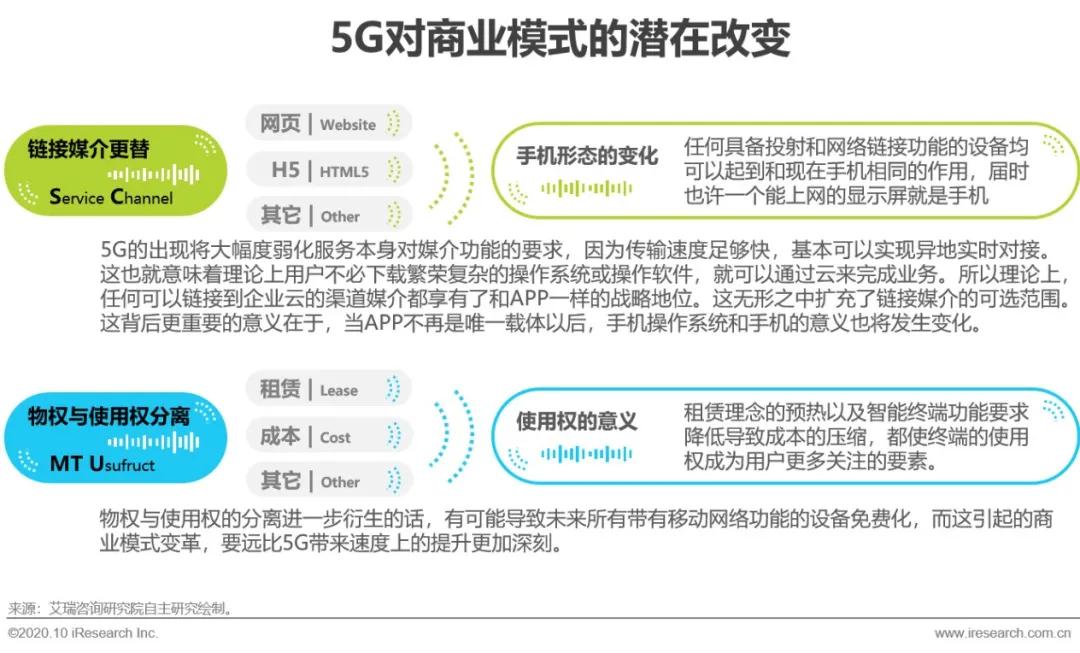
The most apparent change of 5G is the increase in communication speed, but when the communication speed increases to a certain level, users' needs and concerns will change. Demand changes like this have happened several times, and the user demand points that have been weakened in each round are precisely the flaws that technology has made up for in that round of revolution. For example: users are worried about the storage capacity of computers and mobile phones, users are worried about data transmission speed, etc. These demand points will become "usual" for users in the new technology era. In the 5G era, this shift in demand may occur at the following two levels: the replacement of link media and the separation of property rights and usage rights of smart devices.
Potential subversion of China’s digital economy business logic
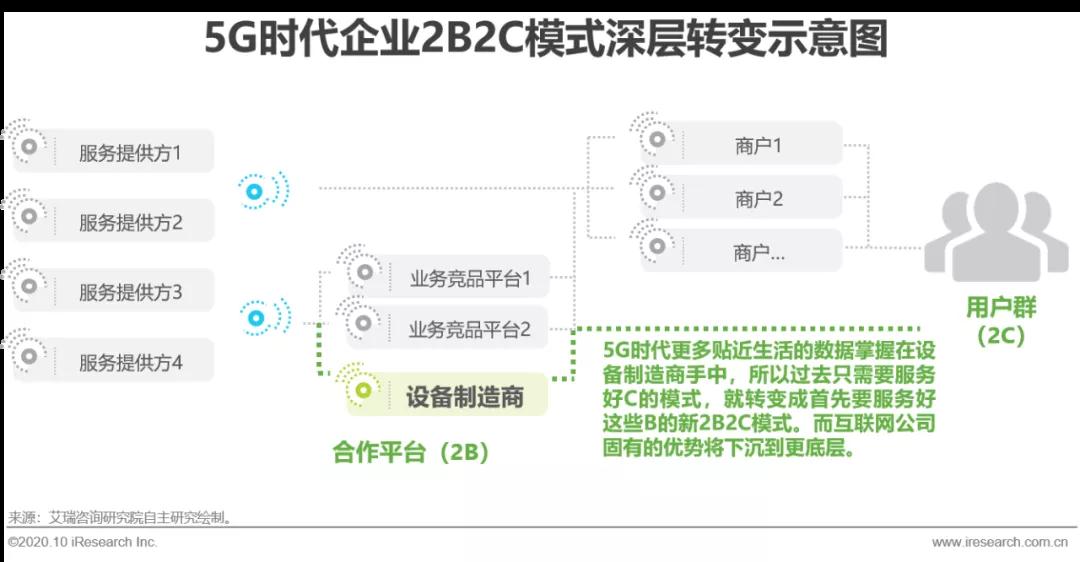
A profound transformation from the essential 2C model to the 2B2C model
To improve the 5G environment, the most obvious thing for existing Internet companies and entrepreneurs to do isAt this stage, we are reaching cooperation with all platforms with link value to expand our channels for future service output. In addition, what is more hidden and more important is the issue of business model selection.
For current Internet companies, the 2B2C business model is not new. In all subdivided industries where giants exist, such as payment and cloud services, 2B2C has long been a business path that non-giant companies have both taken the initiative and been forced to choose. This seemingly ancient path may face deeper changes in the 5G era. There are currently two 2B2C models in theory. The main difference between these two models is the choice of B. One is more respected by the market. B is a merchant that directly faces the user's business scenario, and the other is a cooperation platform that holds traffic. To a certain extent, in order to ensure an excellent conversion rate, the second type of traffic B has a certain competitive relationship with the company itself. In the 5G era, the deep transformation of the 2B2C model is based on the transformation of the second type of traffic B.
2 The driving effect of 5G new infrastructure
5G new infrastructure drives industrial development-Network Planning and Design Institute
Operator design institutes have a high market share, while non-operator communication design institutes benefit little.
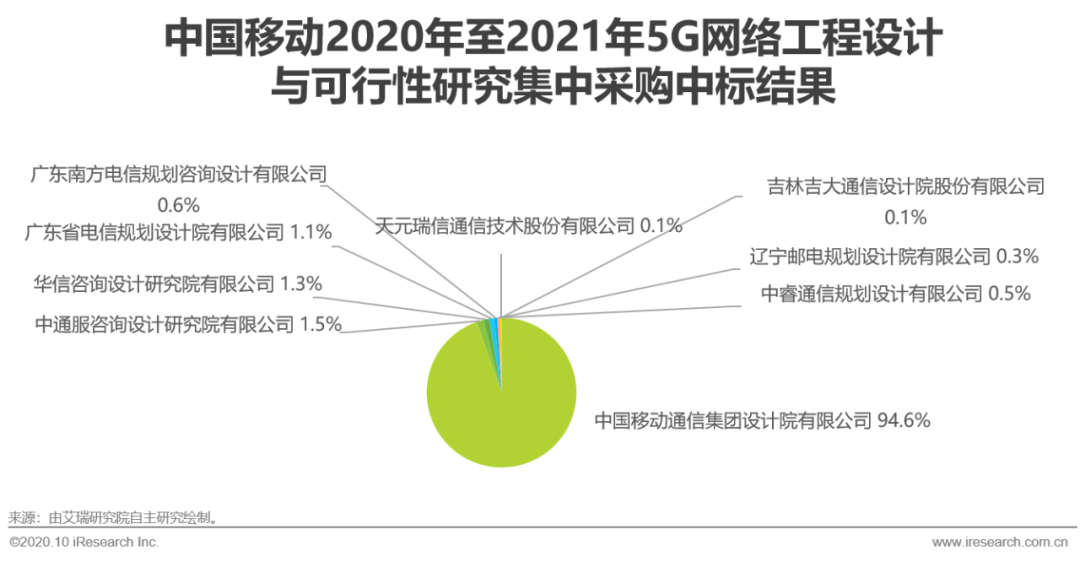
5G network planning is the planning of site and construction plans based on the characteristics of 5G technology, the use of frequency bands and the actual physical environment. It is the beginning of the 5G network life cycle and the first link to benefit from the 5G new infrastructure policy. At present, my country's communications planning enterprises can be roughly divided into four categories: operator design institutes, private design institutes, design institutes controlled by universities and state-owned enterprise design institutes. Among them, design institutes owned by operators have absolute advantages and high market shares, especially China Communications Services Co., Ltd., which is owned by China Telecom and is owned by China Mobile and China Unicom. The following mainly takes China Mobile's 5G network planning and centralized procurement as an example for analysis. In November 2019, China Mobile publicly released the centralized procurement of communications engineering design and feasibility studies from 2020 to 2021, of which the scale of the 5G network part is approximately 28 billion yuan. China Mobile's China Mobile Design Institute's bid-winning share is as high as 26.51 billion, accounting for 94.6%. China Telecom's China Communications Consulting, Huaxin, Guangdong Telecom, Guangdong Southern Telecom and Zhongrui Communications Design Institute have won a total of 1.41 billion bids, accounting for about 5%. The operator's design institutes' cumulative bid-winning share is about 99.6%. It can be seen that in 5G network planning, operator design institutes have an absolute advantage, while non-operator communication design institutes benefit little and are difficult to enjoy the dividends brought by 5G new infrastructure.
5G new infrastructure drives industrial development-Equipment manufacturers
With large scale and high gross profit, comprehensive 5G equipment manufacturers benefit the most.
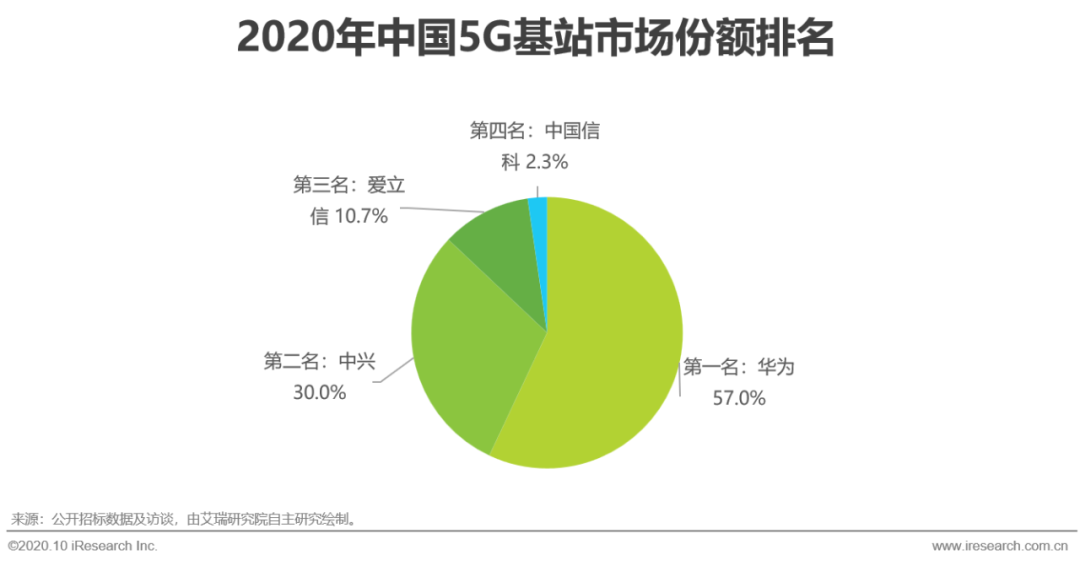
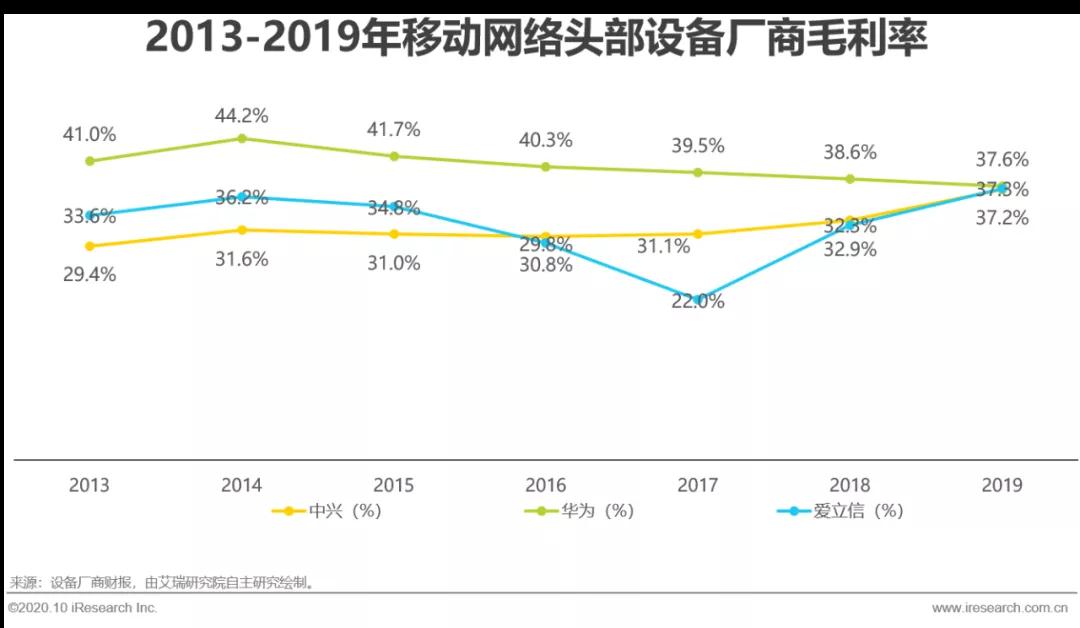
The 5G network consists of three parts: wireless access network, bearer network and core network. The corresponding network elements are base stations, transmission equipment and core network equipment. In 2020, the 5G equipment bidding scale of the three major domestic telecom operators is nearly 100 billion, of which the base station scale is the highest, with a total of approximately 69.8 billion. In 2020, China Mobile purchased 230,000 base stations, and China Telecom jointly purchased 250,000 base stations, bringing the total to more than 480,000 stations. Ranking according to the number of base stations, from high to low are Huawei, ZTE, Ericsson and China Information Technology, with shares of 57%, 30%, 10.7% and 2.3% respectively. Huawei and ZTE have a cumulative share of 87%. In addition to base stations, Huawei, ZTE and Ericsson also achieved the top three shares in core network procurement. Huawei and ZTE also achieved high shares in transmission equipment procurement. Judging from the main 4G network construction cycle, from 2013 to 2019, the overall gross profit margin of Huawei, ZTE and Ericsson was more than 30%, and the gross profit margin of their operator business was even higher than the company's overall gross profit margin. It can be seen that the scale of 5G equipment procurement is large and the gross profit is high. Comprehensive 5G equipment manufacturers such as ZTE, Huawei and Ericsson benefit the most.
5G new infrastructure drives industry development-small base station manufacturers
5G network construction is slow to release demand for small base stations, and small base station manufacturers benefit late
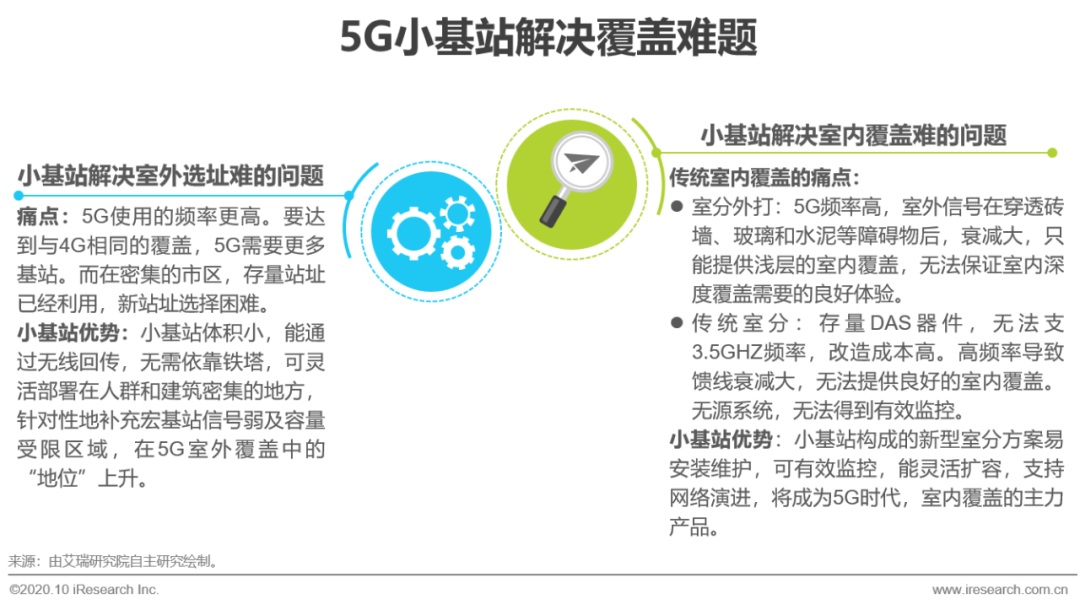
Compared with macro base stations, small base stations refer to wireless access points that are small in size, low in power, and flexible in installation. They are supplements to macro base stations and are mainly used in areas with weak macro base coverage, blind spots, and limited capacity. Compared with macro base stations, the threshold for small base stations is lower. In addition to the four macro base station manufacturers of Huawei, ZTE, Ericsson and Datang, a large number of small and medium-sized enterprises have also entered the field of small base stations. However, this field is still in the stage of full competition with low concentration and has not yet formed an oligopoly structure.
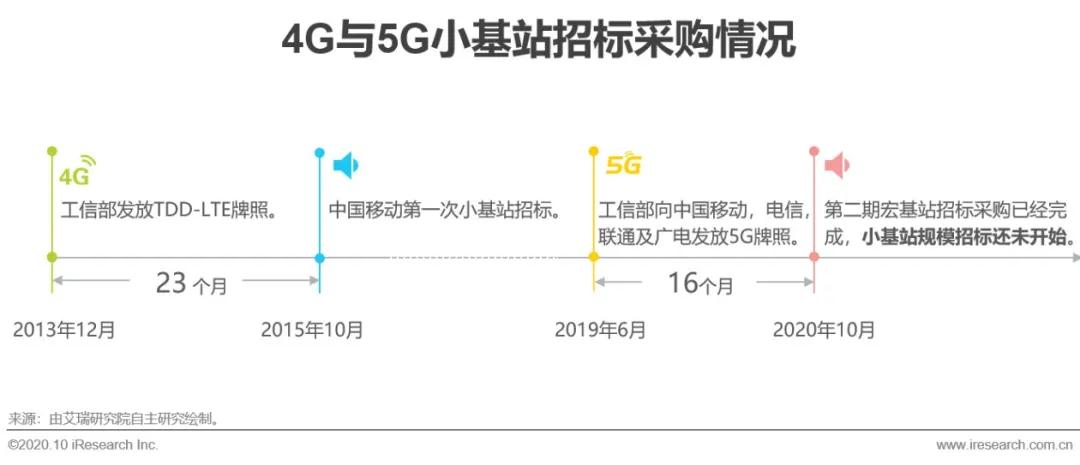
From a functional perspective, the main role of small base stations is to fill blind spots and heat. Therefore, in the early stages of 5G network construction, which mainly aims at rapid coverage, telecom operators have little demand for small base stations. Judging from the 4G bidding situation, in December 2013, the Ministry of Industry and Information Technology issued 4G licenses. In October 2015, China Mobile conducted its first centralized procurement of small base stations, with an interval of 23 months. Judging from the 5G bidding situation, in June 2019, the Ministry of Industry and Information Technology issued 5G licenses. In the second quarter of 2020, the three major operators have completed the second purchase of macro base stations. As of September 2020, the three major telecom operators have completed the construction of 690,000 macro base stations. However, so far, operators have still not started purchasing 5G small base stations. Compared with 4G, 5G's higher frequency band results in poorer indoor coverage of macro base stations, more sites, and more complex application scenarios. The advantages of small base stations will be more obvious, and the demand for small base stations in 5G network construction will come earlier. But overall, the demand for small base stations from 5G network construction is relatively slow, and small base station manufacturers benefit later.
5G new infrastructure drives industrial development-Optical module manufacturers
5G construction boosts demand for optical modules, and optical module manufacturers focusing on the telecommunications market benefit greatly
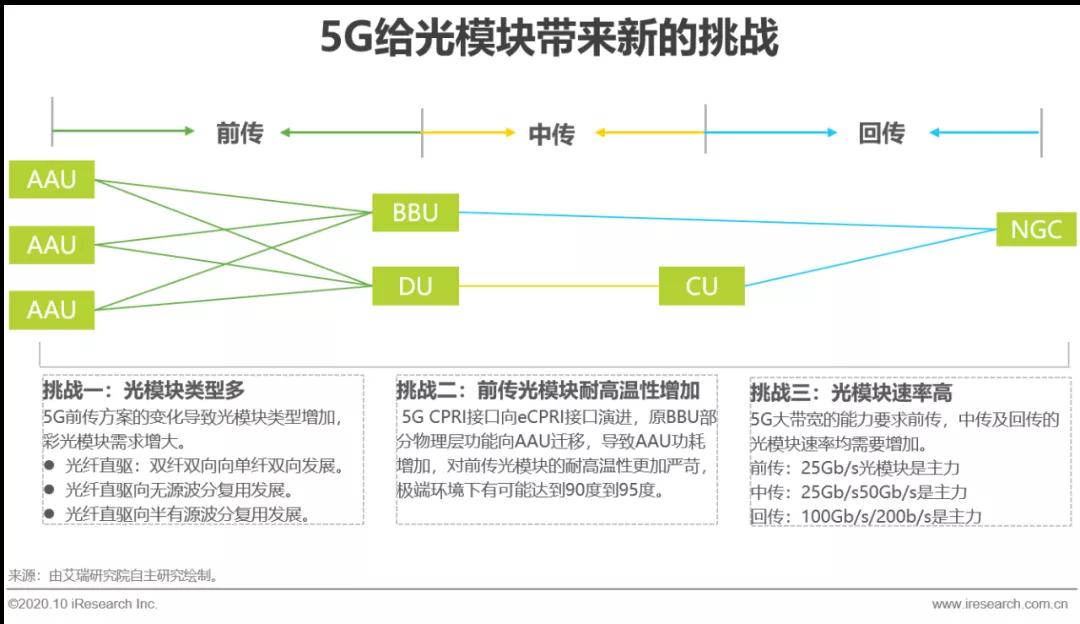
At present, optical fiber has become the main method of data transmission. Optical modules mainly solve the problems of photoelectric conversion and electro-optical conversion between equipment and optical fibers during optical fiber transmission. An optical fiber link requires a pair of optical modules. The transmitting end optical module is used for electro-optical conversion, and the receiving end optical module is used for photoelectric conversion. The telecommunications market and data communication market are the main application scenarios of optical modules. Different application scenarios have different requirements for optical modules. In 5G network construction, optical modules are mainly used in fronthaul from BBU/DU to AAU, midhaul from DU to CU, and backhaul from CU to the core network. The network architecture and fronthaul method will affect the number and type of optical modules required for a single station. In the current network construction, a large proportion of fronthaul uses fiber direct connection, which requires three pairs of 25G gray optical modules, while a small proportion uses wavelength division multiplexing, which requires three pairs of 25G color optical modules. At present, the BBU has not been separated in the existing network. If the CU and DU are separated in the future, a pair of 25G optical modules will be needed for midhaul.
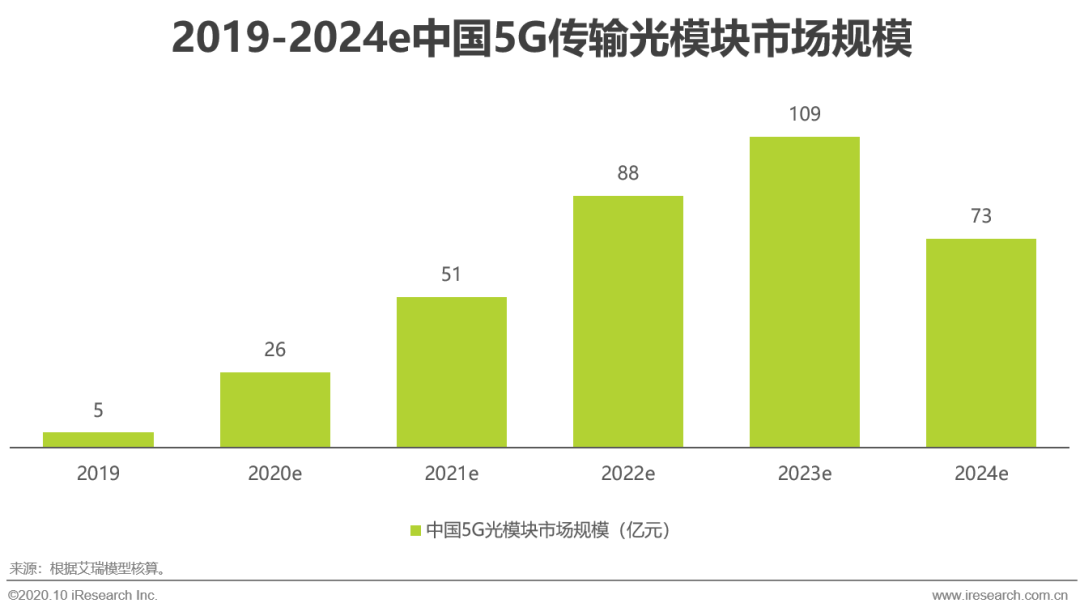
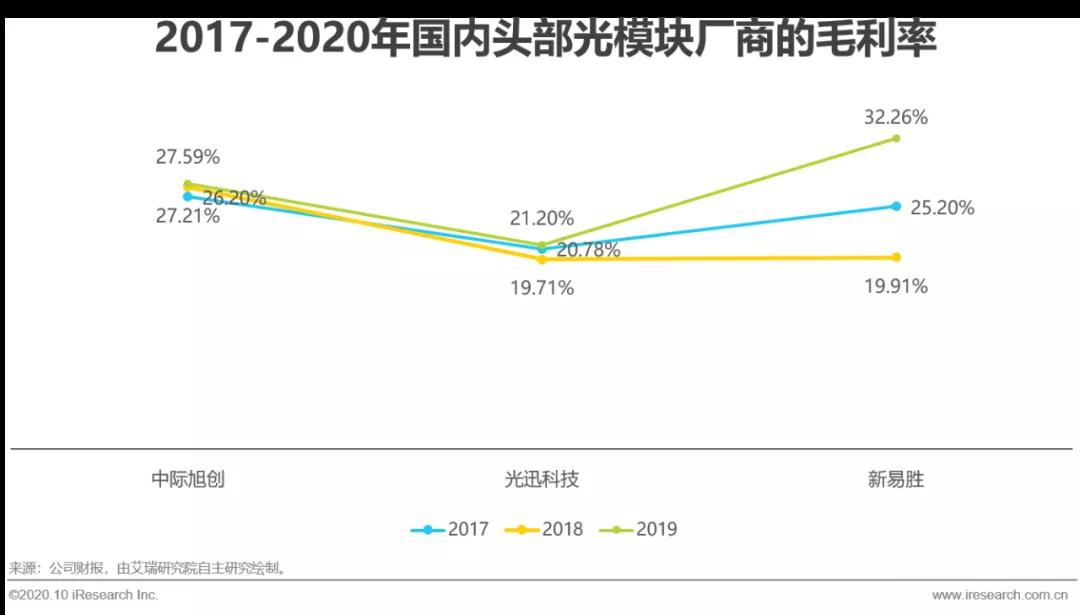
Calculated from the demand side, China's 5G network construction can drive an optical module market size of approximately 35.5 billion. Optical module manufacturers focus on different markets, produce different products, and serve different customers. However, whether it is an optical module manufacturer focusing on the telecommunications market or the data communication market, it can achieve a gross profit of 20% to 30%. Overall, 5G network construction has high demand for optical modules, and optical module manufacturers focusing on the telecommunications market will benefit greatly.
5G new infrastructure drives industrial development-engineering construction companies
The threshold is high, the concentration is high, the qualifications of small enterprises are poor, and the "old" enterprises have great advantages.
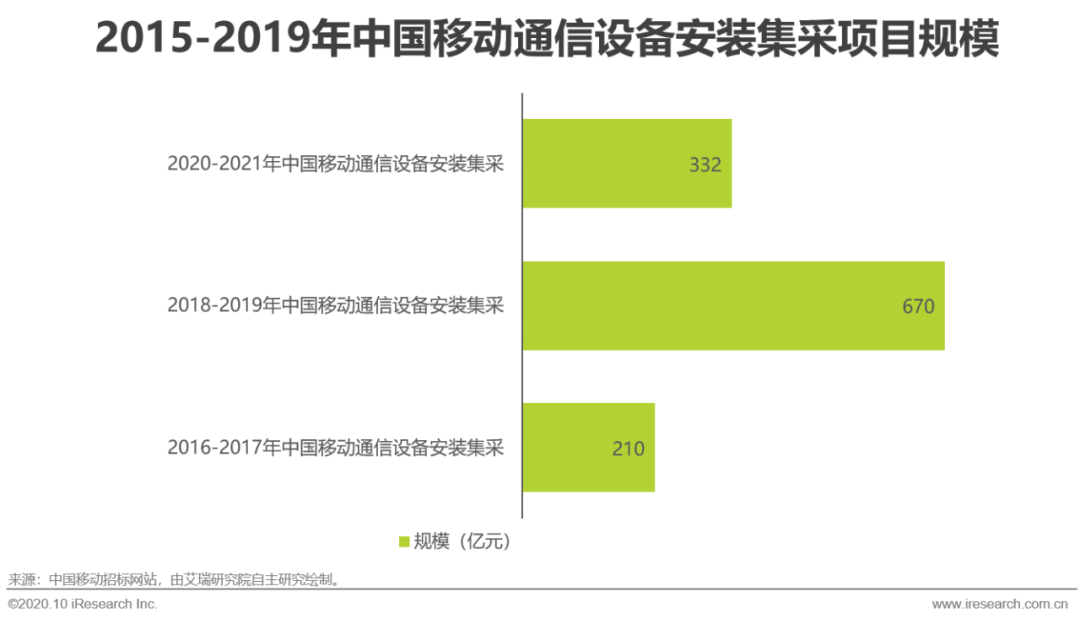
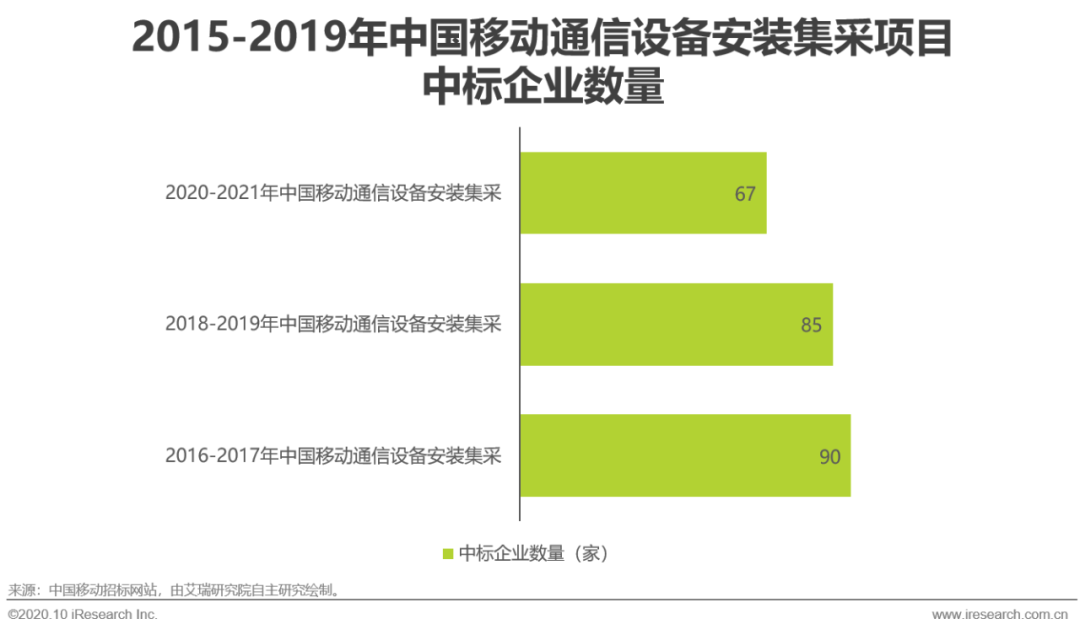
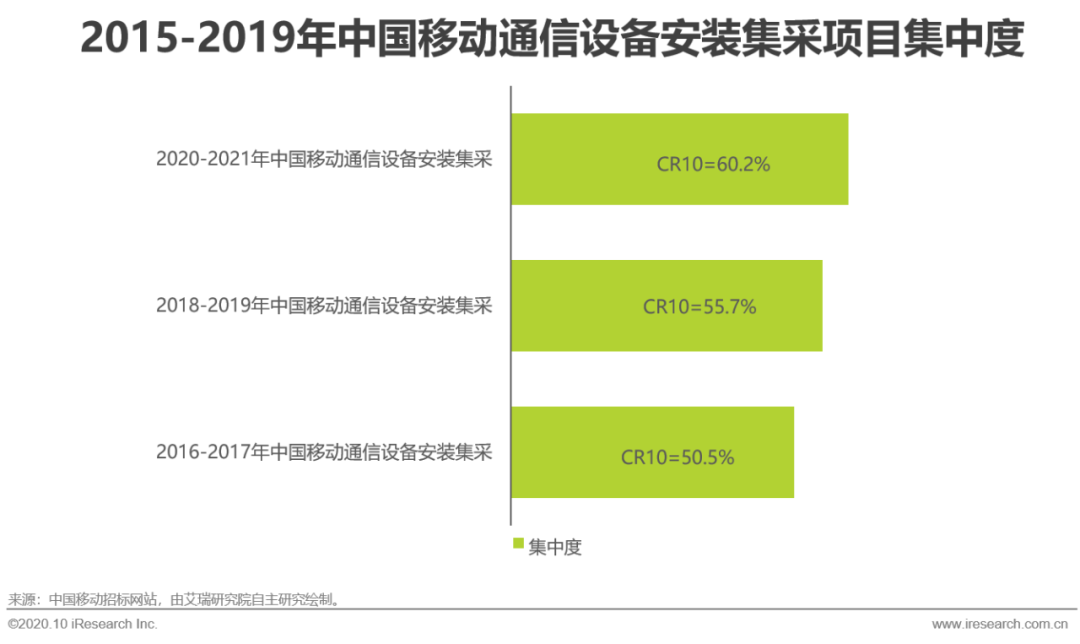
5G network construction refers to the construction of the network by engineering construction enterprises based on the planning report of the design institute, and construction in strict accordance with the planned equipment locations, antenna angles and wiring specifications. It is the second stage of the 5G network life cycle. General contracting qualification for communication engineering construction is a must-have qualification for entering this industry, and the higher the qualification, the larger the scale of projects that can be undertaken. At present, there are nearly 4,000 companies in my country with general contracting qualifications for communication engineering construction. Among them, there are more than 290 companies that can undertake large-scale projects such as equipment installation, that is, with first-level qualifications for general contracting of communication engineering construction. Competition in the industry is fierce.
3
Multiple parties work together to accelerate 5G new infrastructure
5G technology development
Equipment manufacturers and operators should continue to increase investment in research and development to promote the continuous development of 5G technology
As mentioned earlier, 5G development is a long-term process, and the progress of standard formulation, productization, and network deployment will affect the speed of new infrastructure. 5G standards are constantly evolving to better realize the 5G "vision". The R15 standard is mainly for eMBB and basic uRLLC applications, meeting the basic functions of 5G, and was frozen in June 2019. The R16 standard is based on the R15 standard. On the one hand, it enhances the functions in R15 such as MIMO and dual connectivity. On the other hand, it expands new functions mainly for vertical industry applications. It was frozen in June this year. The R17 standard is based on R16, and is still being studied in accordance with the idea of enhancement of existing functions and expansion of new functions, and is planned to be completed in September 2021. As major members of 3GPP, major equipment manufacturers and operators need to ensure continued investment in R&D to ensure that R17 and subsequent standards are completed as planned. It takes roughly a year to turn technical specifications into commercial products. R16 has just been frozen, and equipment manufacturers need to increase investment in research and development to realize the new features of R16 as soon as possible. The current network deployment is mainly based on the R15 standard. On the one hand, operators must actively promote the introduction of new features of R16. On the other hand, they need to increase investment to promote the maturity of network slicing and edge computing solutions to serve vertical industries.
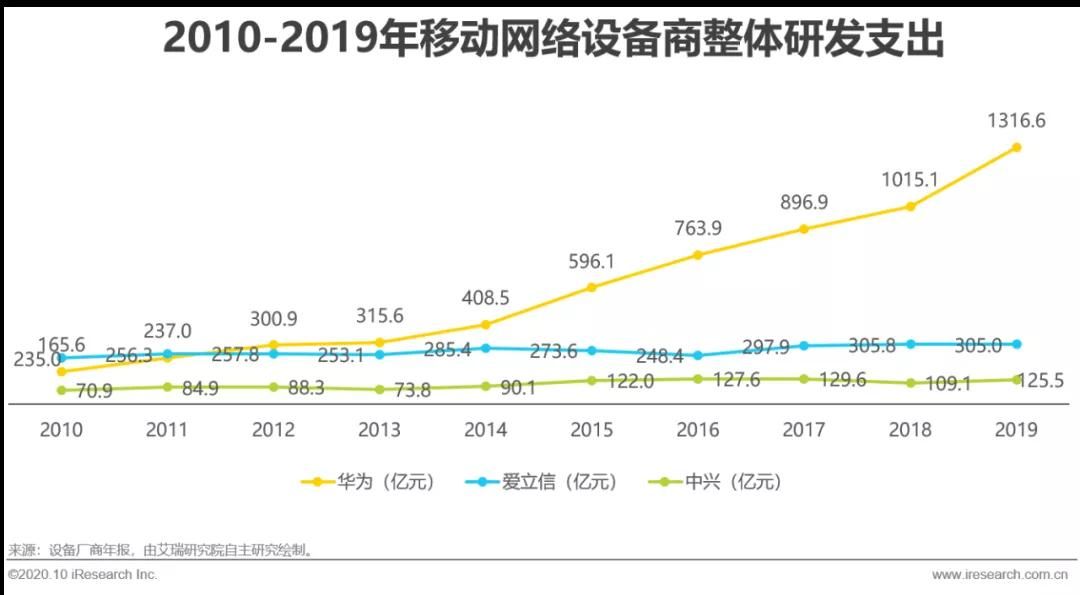
Promoting more mature technology is the primary task of mobile network development. The continuous R&D investment of operators and equipment manufacturers is the guarantee for the continuous evolution of mobile network technology. Compared with 2G/3G/4G, 5G for the first time extends human-centered communication to communication centered on people and things. 5G’s ability to connect everything brings unlimited imagination to the development of the industry. Countries' high expectations for 5G have led to commercial use of the standard before it is mature. Although my country has begun large-scale deployment of base stations, it is mainly based on R15 deployment, which can meet the application of eMBB. To accelerate 5G infrastructure construction, in addition to accelerating base station construction, it is also necessary to accelerate the development of 5G technology to build high-quality 5G networks and empower the development of industry applications. Judging from the overall R&D expenditures of mobile network main equipment manufacturers in the past ten years, the overall R&D expenditures have shown an upward trend, but Ericsson and ZTE have tended to be stable in the past two years. Currently, 5G industry applications are still in the early stages of development and require continuous development of standards, products and solutions. Therefore, equipment manufacturers and operators should continue to increase investment in research and development to promote the continuous development of 5G technology.
5G network cost
User-oriented, precise deployment and maintenance optimization in stages to improve base station utilization
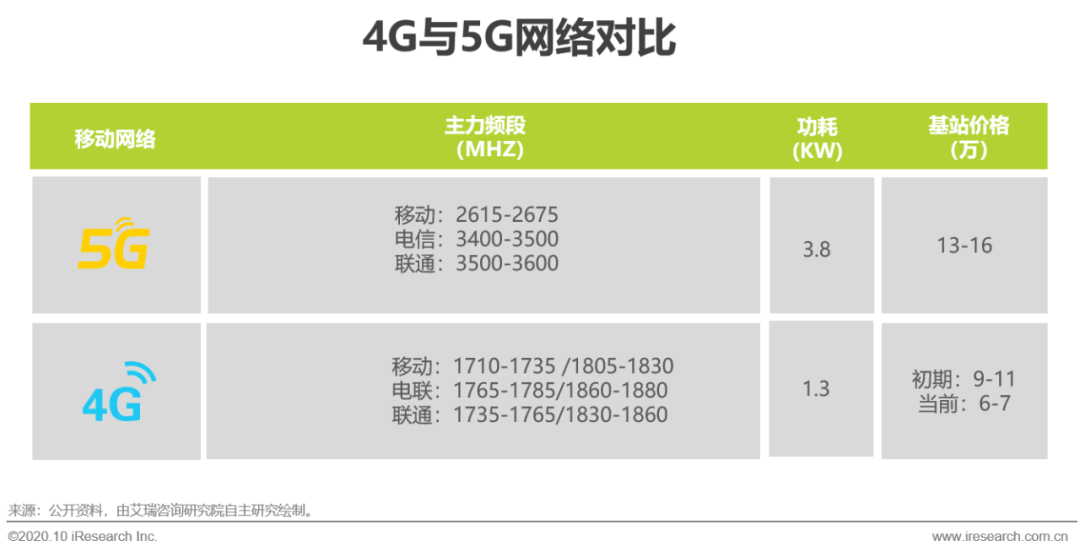
Compared with 4G, 5G network costs are higher, reflected in high construction costs and high operating costs. The high construction cost is mainly caused by the large number of sites to be built and the high price of a single base station. The high operating costs are mainly caused by the large number of base stations and high energy consumption of a single station. Continuously reducing 5G network costs has become the top priority for the entire 5G industry chain. In terms of network construction, China Telecommunications Union adopts a co-construction and sharing approach, and China Mobile is actively seeking cooperation with China Radio and Television to achieve the purpose of reducing costs. In terms of operating costs, the government actively coordinates to reduce electricity prices, equipment manufacturers reduce base station power consumption from a hardware perspective, towers actively promote power supply conversion to direct power supply, and operators intelligently shut down 5GAAU channels.
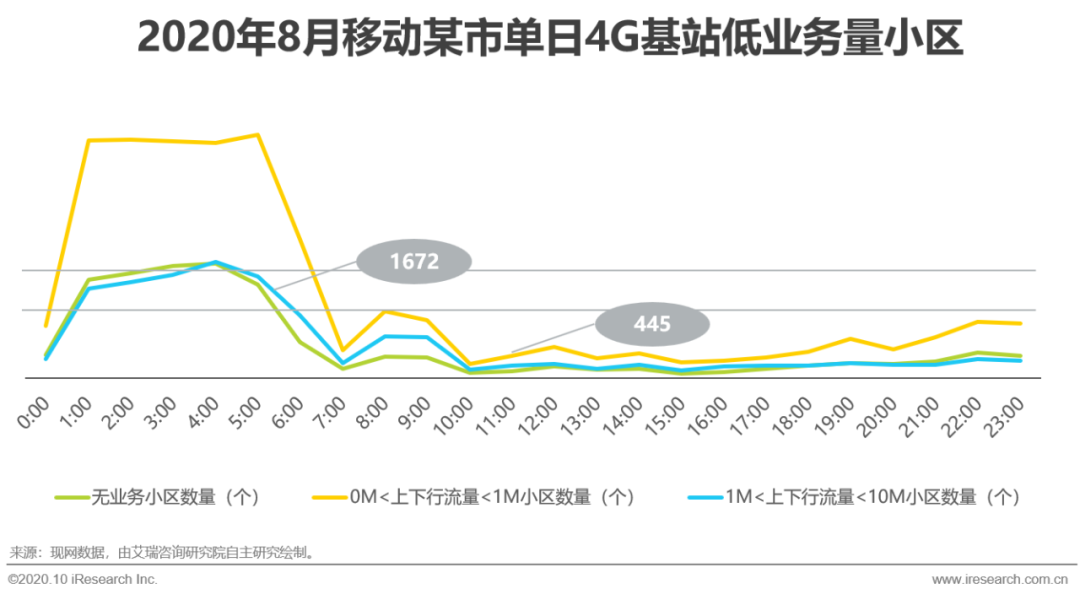
Judging from the operation of 4G networks, in addition to continuing to adhere to the above-mentioned cost reduction measures, operators also need to improve the utilization rate of 5G base stations to reduce costs and improve investment benefits. Take the operation of China Mobile's base station in a certain city on a single day in August 2020 as an example. There are cells with no business 24 hours a day, and the number of cells with less than 1M uplink and downlink traffic during the day is between 200 and 1,000. Assuming that this situation will also occur in the city's future 5G networks, a simple calculation is based on the no-load power of the 5G base station of 2.3KW and the power transfer of 1.3 yuan/kWh. The electricity bill for an hour of a single no-load station is about 3 yuan. Then the electricity bill for a community with no business in the city for a day is about 11,000 yuan, and the electricity bill for a community below 1M is about 28,000 yuan.
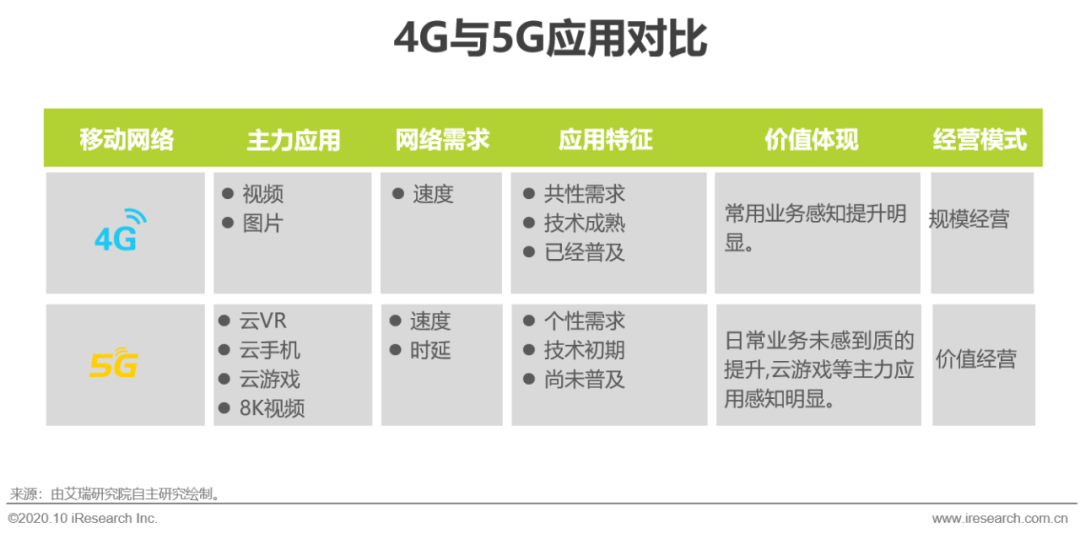
Under the collaborative networking of 4G and 5G, 4G can meet the daily business needs of C-end users. The current value of 5G is reflected in applications such as 8K video, cloud VR, and cloud games. In addition to users who are willing to "try new things" and are not price-sensitive, fans of cloud games, cloud VR and 8K high-definition videos who are more aware of the value of 5G are more willing to switch to 5G packages. In the planning stage, planning principles should be further refined, mobile users' willingness to upgrade to 5G should be fully considered, and accurate deployment should be carried out in stages to avoid long-term low business of 5G base stations. In the maintenance and optimization stage, indicators such as coverage, connection rate, and call drop rate should not be used as assessment criteria. User complaints should no longer be used as the only link between the network department and users. A real-time feedback channel between the two should be established to fully consider user opinions. Overall, in addition to continuing to take measures to reduce costs, operators also need to be user-oriented, carry out precise deployment and maintenance optimization in stages, and improve base station utilization.
5G network application-C-end application
Operators should adopt value management, accelerate multi-dimensional billing, and cooperate with applications to promote
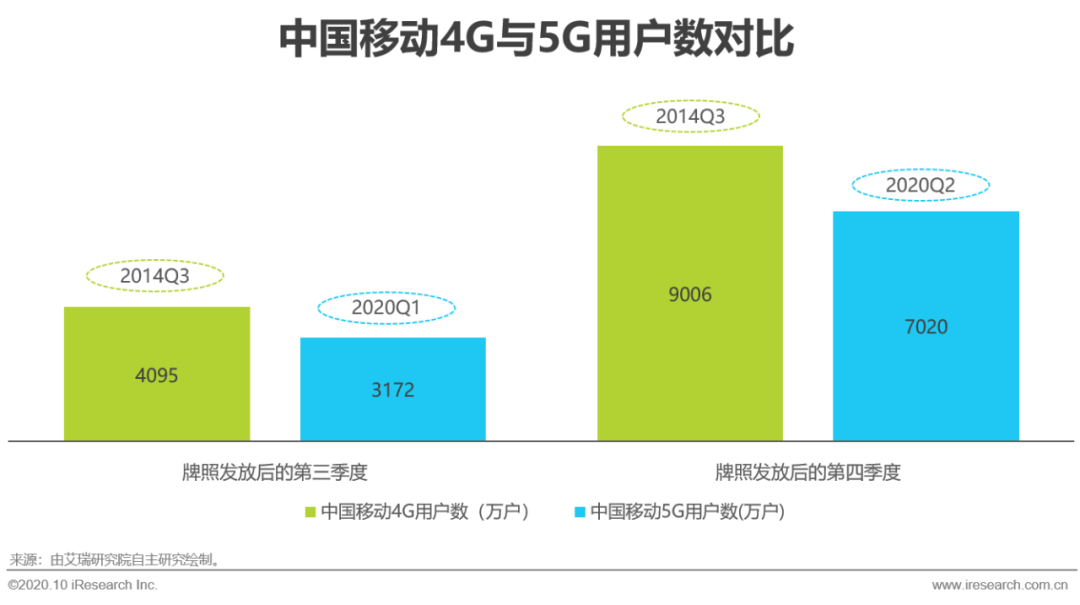
Application is the continuous driving force for the development of 5G new infrastructure. Compared with 4G, the development speed of 5G users is slower. Taking the analysis of China Mobile, which is in the leading position in both 4G and 5G users, in the fourth quarter after the issuance of 5G licenses, the number of 5G users reached 70.2 million, but in the fourth quarter after the issuance of 4G licenses, the number of 4G users reached 90.06 million. As far as mobile video is concerned, the 3G era has begun to develop. It is a basic and common demand, but the 3G network performance cannot support its good experience. The faster speed of 4G network can bring a clearer and smoother video experience. User perception has been significantly improved, and there is a strong willingness to upgrade to 4G. Therefore, the operators formulated packages of different levels based on traffic volume, classified high-end, middle-end and low-end users based on current phone charges, and promoted the packages from high to low, achieving good results.
However, cloud mobile phones, cloud games, cloud VR and 8K high-definition video are in the early stages of development, and the technology needs to be further matured. At present, they do not all have common needs. Moreover, each application has different network performance requirements. One public network cannot meet the ultimate experience of each application. Network slicing is required to create virtual networks with different performances. Therefore, 5G networks require more flexible pricing methods. Although operators have proposed "multi-dimensional" pricing, they still use 4G scale operations to strive for breakthroughs among mid-to-high-end users. For most users, 4G can satisfy their daily business experience, while 5G cannot bring about a qualitative improvement to existing services, and the package costs are high, making them less willing to upgrade to 5G. Operators should adopt value management, accelerate the implementation of multi-dimensional billing, cooperate with third-party platforms, and accurately push it to users who can better perceive the value of 5G. For example, operators can cooperate with cloud games and cloud VR platforms to recommend telecom packages on the cloud VR game platform that are more suitable for the game.
5G network application-B-end application
Industry applications will be implemented in stages to accelerate ICT integration and promote early application scale promotion.
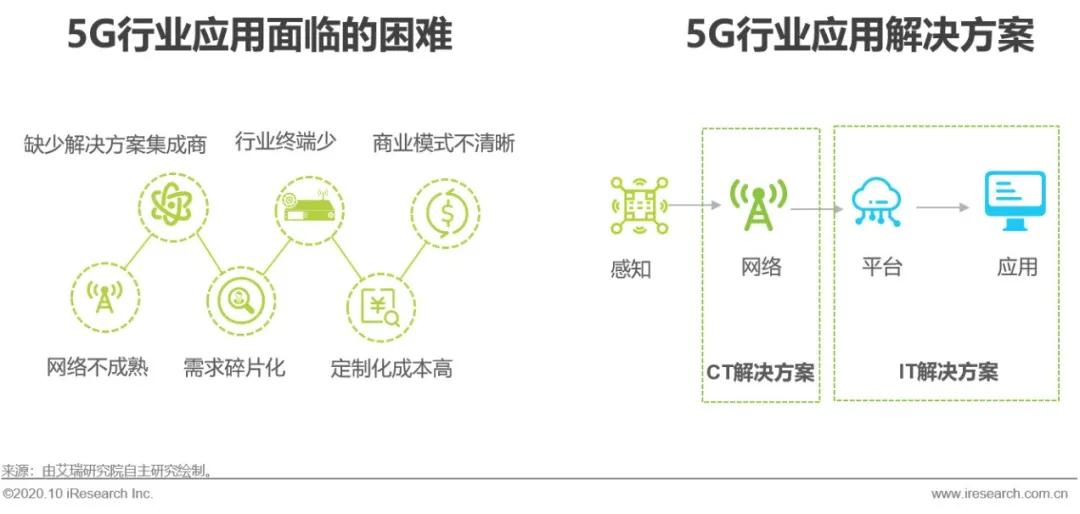
For the first time, industry applications have become a key application scenario for wireless cellular network services, and will also become the driving force for the continued growth of communications operators' revenue. In the past two years, operators and equipment manufacturers have actively sought to integrate 5G with the industry and realize the value of 5G in industry applications. However, the diversity and complexity of industry applications determine that the integration of 5G and industry is a long process. Some application scenarios still have technical bottlenecks other than networks, which also determines that 5G industry applications need to be implemented in stages. The development of 5G industry applications has problems such as immature networks, lack of solution integrators, fragmented demand, high customization costs, few industry terminals, and unclear business models. Continued efforts from all parties are still needed. Currently, 5G-focused solutions for application scenarios such as smart medical care, smart factories, smart energy, and Internet of Vehicles are mainly composed of IT solutions and CT solutions. 5G is a major component of CT solutions. IT solutions require a full understanding of application scenarios and are an accelerator for the integration of 5G and industry applications. Overall, 5G industry applications need to be implemented in stages according to technology maturity. Early applications that are already commercially available need to accelerate the integration of IT solutions and CT solutions to promote their large-scale promotion.
Operators use private networks to provide customized networks and services
Operators need to accelerate the maturity of 5G virtual private networks and promote the development of 5G industry applications
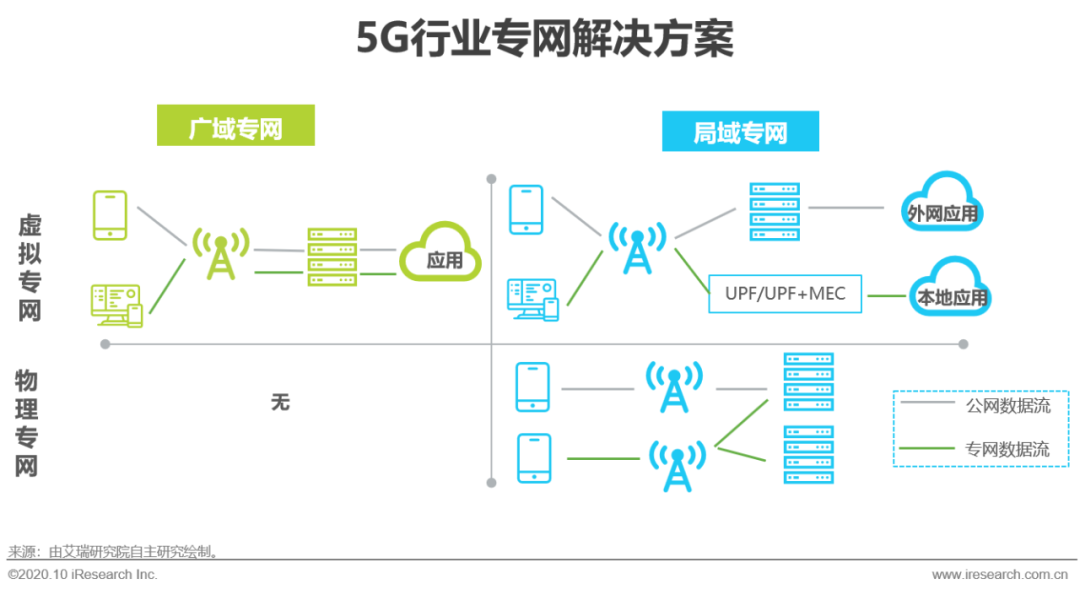
Operators want to use 5G industry private networks to provide users with customized networks and services. From the perspective of resource isolation, industry private networks are divided into virtual private networks and physical private networks. Virtual private networks are mainly implemented through network slicing and core network sinking. Physical private networks are implemented using dedicated frequency bands and dedicated base stations, independent or shared core networks. According to the scope of network services, industry private networks can be divided into wide area private networks and local area private networks. The wide area private network is a slicing service based on the operator's end-to-end public network resources. It is mainly targeted at application scenarios with dispersed business and wide coverage, including transportation, electric power, Internet of Vehicles, and very large enterprises operating across domains. The local area private network includes two solutions: local virtual private network and local physical private network. It is suitable for businesses limited to specific geographical areas. Based on the 5G network in the specific area, the business is closed-loop to ensure that the core business of the industry does not leave the park. The main application scenarios include park/factory-type enterprises such as manufacturing, steel, petrochemicals, ports, education, and medical care.
At present, network slicing technology is not yet mature, and it will take some time for virtual private networks to be commercially available. Although the local area physical private network has good performance, the cost is high. Overall, the development of private networks in the 5G industry will take time. Operators need to accelerate the maturity of 5G virtual private networks and promote the development of 5G industry applications.
4
Analysis of important sectors of 5G new infrastructure
5G new infrastructure industry chain
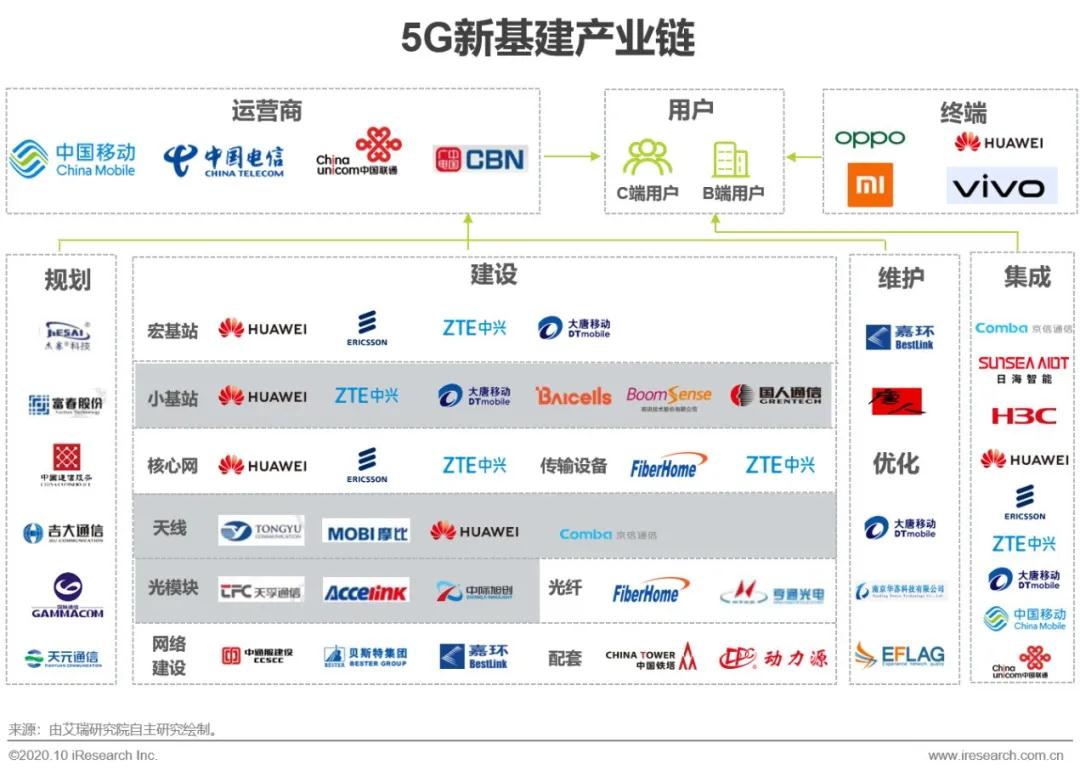
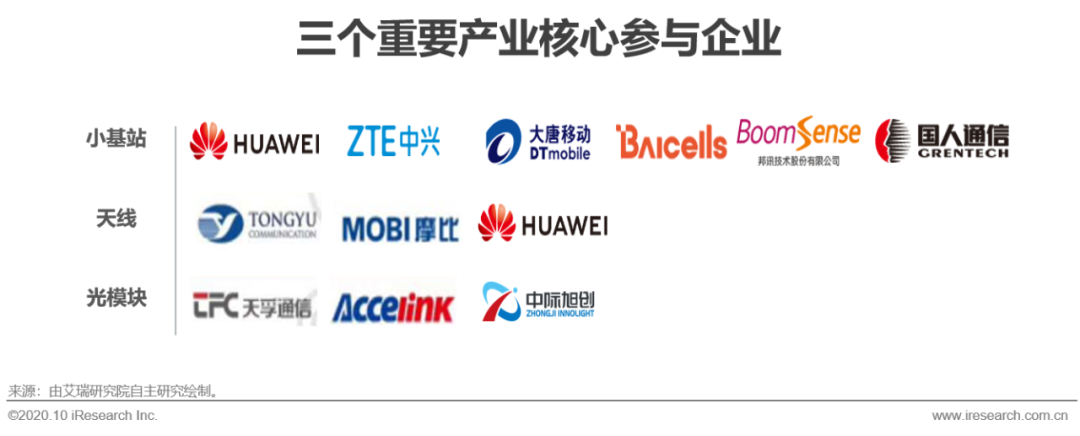
In addition to the main equipment, supporting equipment such as micro stations, antennas and optical modules are worthy of attention.
Optical modules are the basic building blocks of 5G networks
5G brings new challenges to the optical module industry, and domestic optical module manufacturers develop upstream chips
Optical modules are the basic building blocks of 5G network physical layer equipment and are used in wireless and transmission equipment. Compared with 4G, the large bandwidth of 5G requires higher speeds for optical modules. Various fronthaul solutions require different types of optical module support. The evolution from CPRI to eCPRI places more stringent requirements on the high-temperature resistance of fronthaul optical modules, bringing new challenges to the optical module industry. Although domestic optical module manufacturers have squeezed into the first echelon of the global optical module market, domestic development in the core chip link of optical modules is weak and they mainly rely on imports, especially high-speed optical modules for 5G network construction. At present, domestic optical module manufacturers such as Optoelectronics and HiSilicon have begun to develop upstream chips for optical modules, but there is still a large gap between their overall capabilities and foreign countries. In the context of domestic substitution, it is believed that the number of domestic optical module manufacturers developing upstream chips will gradually increase.
Small base stations will become an important component of 5G networks
The "status" of 5G small base stations has been improved. It is necessary to accelerate product maturity and wait for opportunities to come.
The main coverage frequency band of 4G is 1.8GHZ-2.3GHZ, while the main coverage frequency band of 5G is 2.6GHZ-3.5GHZ. While the high frequency of 5G leads to an increase in the number of base stations, it also makes indoor coverage more difficult. Small base stations are small in size and flexible in deployment, which can solve the pain points of outdoor site selection and indoor coverage, and will become an indispensable component in 5G network construction. In order to meet the needs of various 5G application scenarios, the network architecture of 5G small base stations is simpler, performance indicators such as the number of cells, power consumption and number of users have been greatly improved, and it also supports cloud deployment and becomes more open. Currently, 5G networks are in the stage of large-scale construction to achieve basic coverage. Taking advantage of this period, small base station manufacturers need to accelerate the maturity of their products and wait for the arrival of deep coverage requirements.
The antenna is the entrance and exit of the 5G network
5G antennas and radio frequencies are tightly coupled, increasing dependence on base station equipment manufacturers
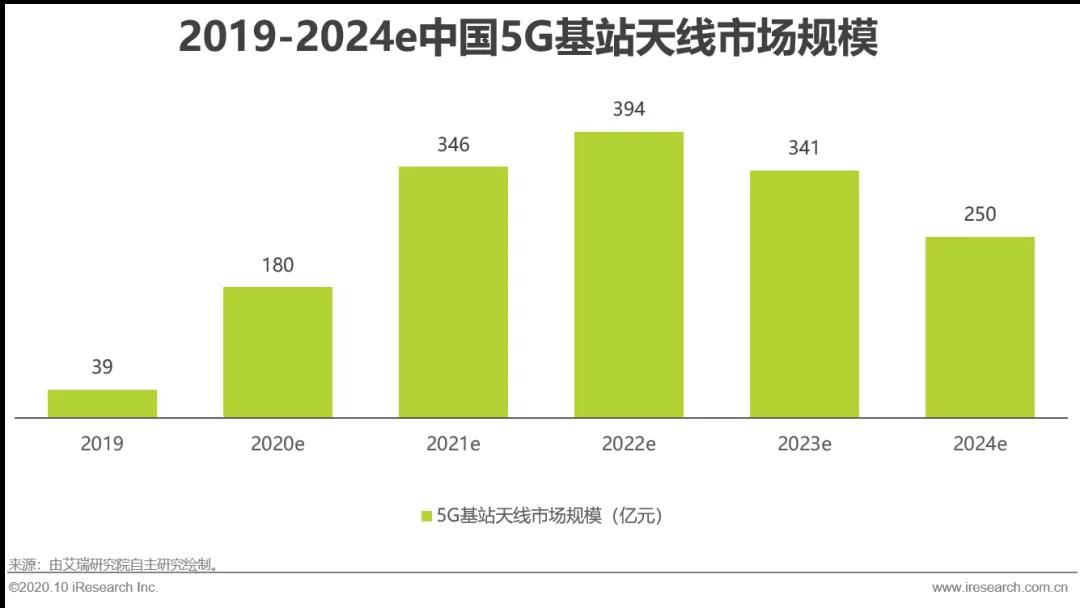
According to coverage application scenarios, mobile cellular network antennas are divided into base station antennas and indoor distributed antennas. The former is used for outdoor coverage, and the latter is used for indoor coverage. The use of MassiveMIMO technology has had a greater impact on 5G antennas. From the perspective of outdoor coverage, the base station antenna has evolved from 4G’s 8T8R to 5G’s 64T64R. In order to solve the connection problem between radio frequency and antenna, RRU and antenna are merged, and 5G changes from the original three-level architecture of BBU+RRU+antenna to the two-level architecture of BBU+AAU. From the perspective of indoor coverage, the new indoor distribution system will replace the traditional DAS indoor distribution system and become the main solution. The antenna form has also evolved from the original single-channel passive antenna to the radio frequency unit pRRU with built-in antenna. Although there are currently loose coupling solutions in which the radio frequency is fixed behind the antenna, overall, tight coupling between the antenna and radio frequency is the mainstream solution in the 5G era. In addition to Huawei's antenna production capabilities, equipment manufacturers such as ZTE, Ericsson and CITIC (Datang Mobile) all need to enter into strategic cooperation with antenna manufacturers to package antennas and radio frequencies to operators. Therefore, the market share of antennas depends on the share of equipment manufacturers to a certain extent, and the dependence on equipment manufacturers has increased.
The time window for local governments to promote the implementation of 5G industry
Single-point breakthrough in the industrial chain and development opportunities for integrators
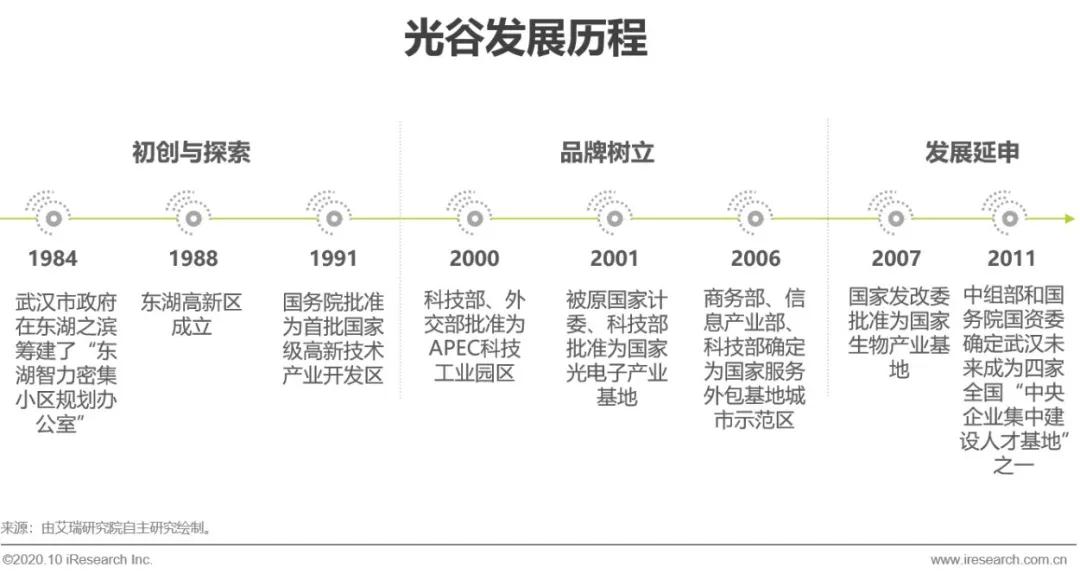
In the current environment in China, 5G new infrastructure is an important industry that can effectively drive the economy. Compared with traditional communication infrastructure, 5G requires more construction and more equipment, so it will inevitably trigger a new round of investment boom. As mentioned above, optical modules, small base stations and antennas are sectors with opportunities in the existing 5G industry. However, the three of them are different. Optical modules have already formed an industrial cluster in China. Wuhan Optics Valley was approved by the State Council as one of the first batch of national high-tech zones in 1991. In 2001, it was approved by the former State Planning Commission and the Ministry of Science and Technology as a national optoelectronics industry base. As for small base stations and antennas, although they need to increase their production capacity, there is no cluster-like trend yet and they require certain operations. The implementation of these three existing industries can promote the development of the 5G industry in a certain region, and after implementation, it can also increase the region's attractiveness to other industries.
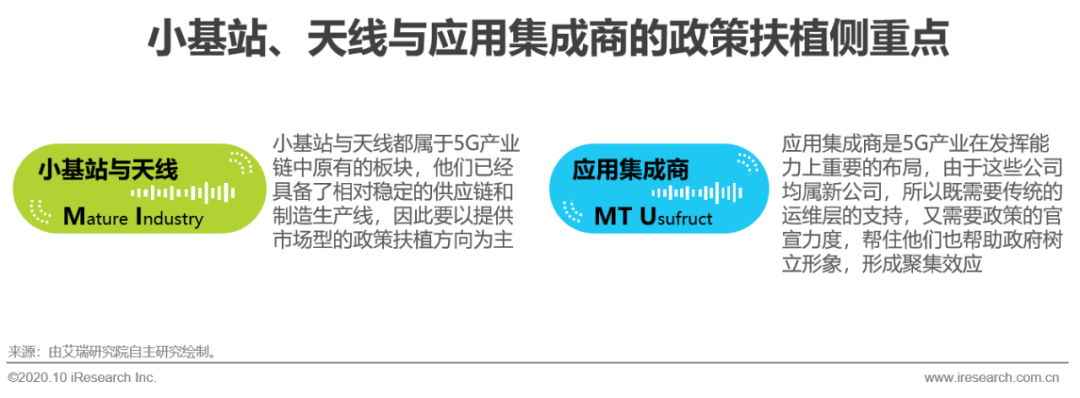
In addition, the development of integrators is a sector that has a lot of room for imagination in the future application and implementation of 5G industry. At present, operators are very aggressive in promoting 5G. They can take the lead in finding suppliers to conduct pilot projects without considering the investment-return ratio. In the later stage, operators will only charge network service fees. Therefore, if the demand for digitalization of enterprises increases in the future, these companies cannot be the only ones doing it. On the one hand, there is the issue of industry barriers, which cannot be covered. On the other hand, small businesses may not do everything. From the demand level, for an integrated solution, the network is the foundation, and IT technology is required at the upper level. For users, it is impossible to find several companies to complete it by themselves. Now operators, equipment vendors, and the original H3C integrators are all working on integrated solutions, but they are only proficient in CT solutions and lack the foundation and foundation of IT. A big difference between 5G and 4G is that its ultimate goal is to drive the development of the B-side industry, so for 5G, it is bound to lead the common progress of a series of communication technologies including cellular network technology. In the process of driving the development of the B-side industry, communication connection capabilities are actually similar to many basic capabilities in enterprise services. Integrators need to use them to form many solutions for different industries. This part of enterprise service capabilities will be the largest value-added opportunity for the real economy driven by 5G, in addition to investment in 5G new infrastructure.
Integration direction around application scenarios
Solutions for B-end industrial applications are the focus of development
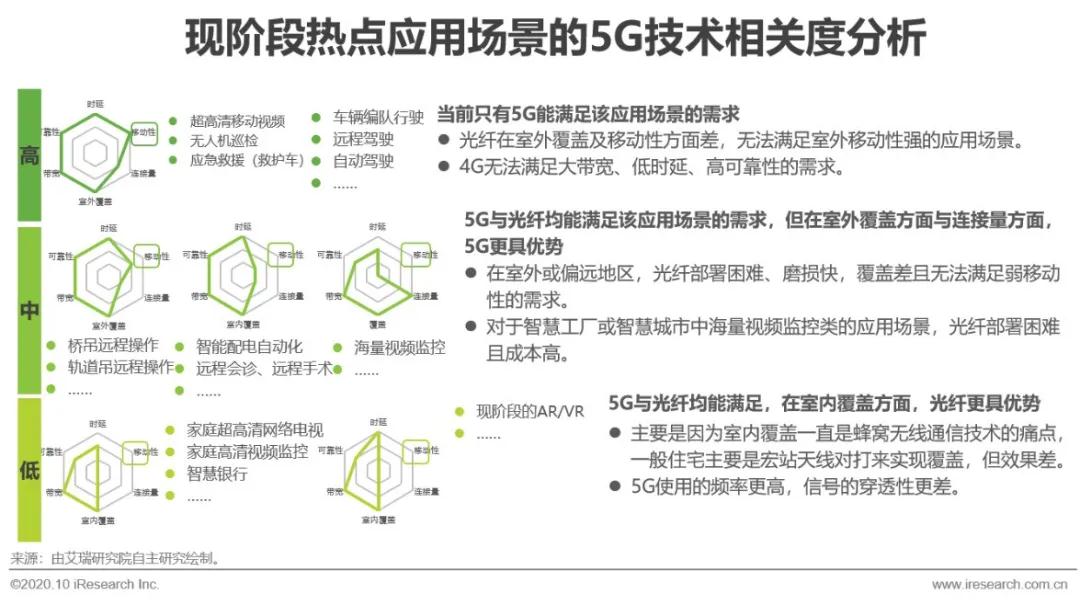
ITU-R defines three major application scenarios for 5G: eMBB, uRLLC and mMTC. eMBB, or enhanced mobile broadband, mainly refers to mobile Internet high-traffic consumer applications such as 4K/8K high-definition video, AR/VR, and 3D holography. uRLLC, which stands for ultra-high reliability and low latency, mainly refers to industrial applications that have extremely high requirements on reliability and latency, such as industrial manufacturing, telemedicine, and autonomous driving. mMTC, or massive machine type communications, mainly refers to application scenarios based on massive sensors such as smart homes, smart cities, and large-area environmental monitoring.
The star effect of 5G has attracted a large number of consumer-level and industry-level application scenarios related to it. However, whether these application scenarios are real 5G applications requires analyzing the relevance of 5G technology based on the needs of the application scenarios. Comparative analysis is conducted from the six dimensions of bandwidth, delay, reliability, mobility, connection volume and coverage. Compared with 4G, 5G has the advantages of large bandwidth, low delay and high reliability. Compared with optical fiber, the advantage of 5G is strong mobility and large connection volume. The disadvantage is poor indoor environment coverage. Therefore, when 5G is implemented in local industries and provides solutions for industrial environments, it is essentially the synthesis of a series of communication and IT technologies.
Wuhan·China Optics Valley
The industrial extension and city brand value-added effect brought about by the agglomeration of high-tech industries
Among the existing examples, Wuhan’s East Lake High-tech Zone is the most representative of the 5G new infrastructure industry, and it is called the “China Optics Valley.” It is the world's largest optical fiber and cable R&D base, the country's largest optical device R&D and production base, and the country's largest laser industry base. Optics Valley optical fiber and cable accounts for 66% of the national market and 25% of the international market, ranking first in the world in sales. The leading companies in the optical fiber field, China Information Technology and YOFC; the leading optical module companies Guangxun Technology, Huagong Technology, and HiSilicon are all concentrated in Wuhan. This dual concentration of production capacity and companies has greatly increased the regional brand value of East Lake High-tech Zone. Furthermore, in addition to the optical industry itself, with the help of the mutual promotion effect of high-tech industries, Optics Valley also gathers several major industries such as biomedicine, energy conservation and environmental protection, high-end equipment manufacturing, and modern service industries, which has greatly established Wuhan's image as a city in the national high-tech field. It has obvious effects on attracting talents and boosting the economy.
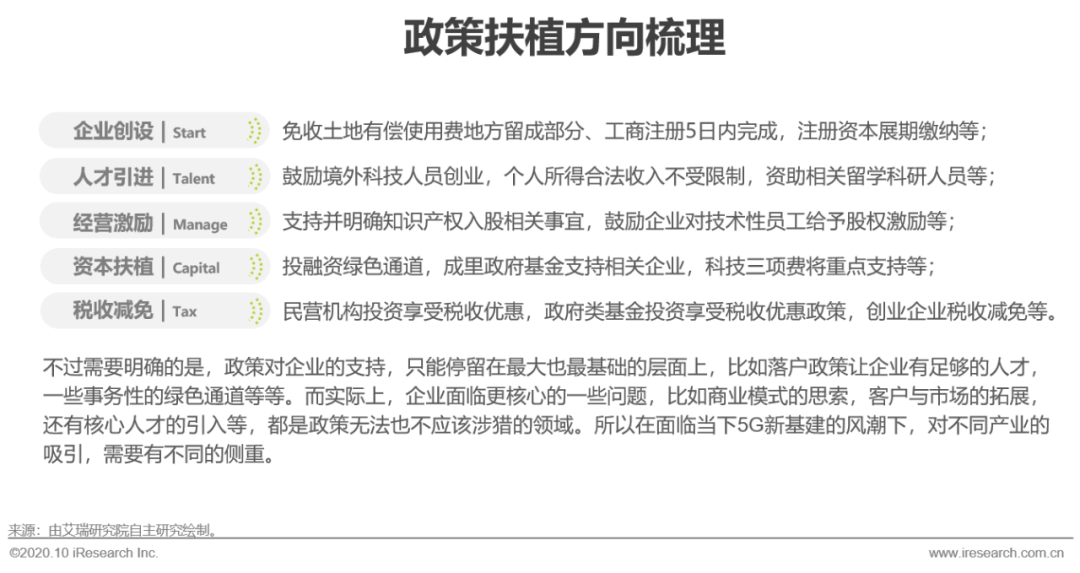
Preferential policies and support to ensure the most basic survival and operation of enterprises
In 2001, Wuhan East Lake High-tech Zone was officially dubbed the "Optics Valley of China". In 2000, the Wuhan government launched 14 clear and quantifiable preferential policies for the Optics Valley. To sort it out, it mainly includes the following aspects:
This article is reproduced from "iResearch", supports the protection of intellectual property rights, please indicate the original source and author when reprinting. If there is any infringement, please contact us to delete it.
Related Recommendations