






















Service Hotline
News

News
Sub-6GHz network is fully rolled out, why does China still develop 5G millimeter wave?
2021-12-28
602
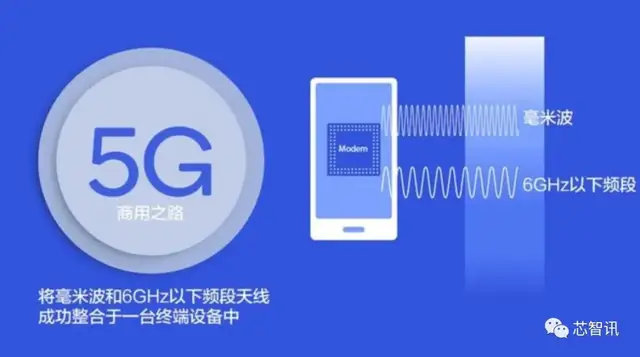
The global 5G network frequency bands are mainly divided into Sub-6GHz frequency band and millimeter wave (mmWave) frequency band. The 5G millimeter wave network and the Sub-6GHz network are not in an antagonistic relationship where "you can only choose one of the two", but a complementary relationship where "you can have your cake and eat it too." Each country's choice of which technical route to take first is more based on its own national conditions. After China's 5G Sub-6GHz network construction matures, the construction of 5G millimeter wave networks has also been put on the agenda.
In March 2020, the Ministry of Industry and Information Technology issued the "Notice on Promoting the Accelerated Development of 5G". The notice clearly mentioned that "the frequency use plan for some 5G millimeter wave bands will be released in a timely manner, and millimeter wave equipment and performance testing will be organized to prepare for the commercial use of 5G millimeter wave technology." On April 30, 2021, the Ministry of Industry and Information Technology released the "5G Application "Sail" Action Plan (2021-2023)" Draft for Comments (hereinafter referred to as the "Draft"). The Draft proposes that by 2023, the penetration rate of 5G individual users in my country will exceed 40%, and the number of users will exceed 560 million. At the same time, the opinion draft proposes that "the 5G millimeter wave frequency plan will be released in a timely manner and a bidding system for 5G millimeter wave frequency licenses will be explored." This also means that after the 5G Sub-6GHz network is fully rolled out in China, the construction of 5G millimeter wave in China is about to start. In addition, Tian Yulong, chief engineer of the Ministry of Industry and Information Technology, emphasized at a press conference of the State Council Information Office in March when talking about promoting high-quality development of the information and communications industry that "5G network construction will be promoted in an orderly manner and the layout of 6G will be accelerated."
5G millimeter wave and Sub-6GHz are complementary
Millimeter waves refer to electromagnetic waves with wavelengths from 1mm to 10mm and frequencies from 30GHz to 300GHz. In the field of mobile communications, electromagnetic waves between 24GHz and 100GHz are usually called millimeter waves.
The 2019 World Radiocommunication Conference (WRC-19) of the International Telecommunication Union (ITU) has determined that the millimeter wave frequency bands between 24GHz and 86GHz will be used for International Mobile Communications (IMT). Among them, the 24.25-27.5GHz, 37-43.5GHz and 66-71GHz frequency bands are the globally integrated IMT frequency bands.
Compared with the 5G system of Sub-6GHz (frequency band below 6GHz), 5G millimeter wave communication has ultra-large bandwidth ranging from 24GHz to 100GHz, which gives it unique advantages such as higher speed, lower latency and flexible and elastic air interface configuration. It can effectively meet the needs of future wireless communication for system capacity, transmission rate and differentiated applications.
For example, in terms of transmission rate, Ookla’s latest analysis based on a large amount of measured data from its Speedtest application shows that the 5G millimeter wave frequency band can reach 16 times that of the Sub-6GHz frequency band.
Secondly, 5G uses the two dimensions of subcarriers and time slots to transmit data. Millimeter waves have the characteristics of high bandwidth, large subcarrier intervals, and small corresponding time slots. This also makes the 5G millimeter wave delay only about 25% of the Sub-6GHz frequency band. Similarly, because millimeter waves have larger available bandwidth and higher transmission rates, they can also provide greater capacity to meet a wider range of terminal access.
In addition, the higher downlink rate of 5G millimeter wave can support dense spatial multiplexing while reducing interference, which can better solve the congestion problem of a large number of users accessing the Internet at the same time in the same area. It is especially suitable for applications in densely populated scenarios such as stations, airports, and stadiums.
In related industry application fields, such as ultra-high-definition video live broadcast, security monitoring, telemedicine and some industrial applications, where there are high requirements for upload speed and low latency, 5G millimeter wave large uplink and lower latency characteristics can better meet these needs.
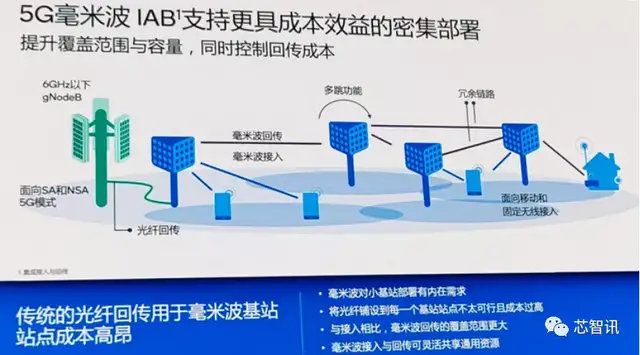
It should be pointed out in particular that the 5G millimeter wave network can realize self-backhaul without resorting to the connection between the optical fiber network and the core network. 5G networks based on Sub-6GHz still need to rely on traditional optical fiber backhaul solutions, that is, each 5G base station needs to be connected to the core network through optical fiber, which also increases deployment costs. 5G millimeter wave IAB (Integrated Access and Backhaul) technology can support 5G millimeter wave base stations to use other 5G millimeter wave base stations as relay nodes, and ultimately backhaul to the core network in the form of wireless transmission through multi-hop functions, which will greatly save deployment costs. This also enables 5G millimeter wave base stations to support more cost-effective and dense deployment.
In addition, millimeter wave technology can also be used in 5G vehicle-to-everything (V2X) to provide positioning services that far exceed the accuracy of GPS and LTE (accuracy can reach sub-meter level).
Ma Hongbing, general manager of China Unicom's Technology Innovation Department, said: "By combining 5G millimeter wave with MEC and AI technologies, millimeter wave can provide customized private network services for target customers, and can be widely used in scenarios such as smart factories, smart parks, and smart terminals."
Although millimeter waves have advantages in speed and delay compared to the Sub-6GHz frequency band, they also have limitations. For example, signals are easy to attenuate, have poor penetration, and are easily blocked. Although there are currently beamforming, beam tracking and other technologies that can solve these problems well. However, the Sub-6GHz frequency band still has greater advantages in terms of coverage and deployment cost.
All in all, 5G millimeter wave network and Sub-6GHz network deployment are not competing or replacing each other, but complementing each other. Use Sub-6GHz to achieve wide coverage of 5G, and use millimeter wave systems to achieve coverage in indoor venues (sports events, concerts, large conferences), transportation hubs (subway stations, high-speed rail stations) and office areas, as well as outdoor hotspot coverage, wireless broadband access, etc. Coordinated deployment of millimeter waves and Sub-6GHz can achieve an organic combination of large capacity and wide coverage.
Preliminary preparations for China's 5G millimeter wave deployment have already begun and are progressing smoothly
If the Sub-6GHz network solves the 5G coverage problem, then the 5G millimeter wave network can maximize the advantages of 5G, thereby releasing greater value.
Meng Pu, chairman of Qualcomm China, also said: "To achieve the original design goals of 5G, all spectrum resources need to be utilized. The mid- and low-frequency bands of Sub-6GHz can achieve a balance of coverage, capacity and performance, while the high-frequency millimeter waves above 24GHz can support the ultimate 5G performance and capacity, bringing next-generation wireless connection experience to many scenarios and industries, and ultra-reliable and low-latency mobile communications to vertical fields such as the industrial Internet."
According to the "5G Millimeter Wave Technology White Paper" released by the GSMA in September last year, it is predicted that 5G millimeter wave will contribute US$565 billion to global GDP by 2035. Among them, the economic benefits directly brought by the use of 5G millimeter wave frequency bands in China will reach approximately US$104 billion before 2034.
Currently, the United States, Japan, Europe and Southeast Asia have all launched 5G millimeter wave deployments. According to data released by the GSA in March this year, more than 150 operators around the world are currently investing in 5G millimeter wave technology.

According to the 5G millimeter wave test plan of the China IMT-2020 (5G) Promotion Group, millimeter wave testing has begun in 2019 to verify the key technologies and system characteristics of 5G millimeter wave. Starting in 2020, the functions, performance and interoperability of millimeter wave base stations and terminals will be further verified, and high and low frequency collaborative networking verification will be carried out. At the same time, the China IMT-2020 (5G) Promotion Group also carried out typical scenario verification in a timely manner.
In October 2019, under the organization of the IMT-2020 (5G) Promotion Group, ZTE and Qualcomm achieved China's first smartphone-based 5G millimeter wave interoperability test (IoDT). Two months after the new millimeter wave MIMO OTA test method was clarified in the 3GPP Rel-16 version released in early July 2020, at the end of September, under the organization of the IMT-2020 (5G) Promotion Group, Qualcomm took the lead in completing the millimeter wave performance test based on the 3GPP Rel-16 MIMO OTA test method at the MTNet laboratory of the Academy of Information and Communications Technology. At this point, Qualcomm has become the first chip manufacturer in China to participate in and pass all ten 26GHz 5G millimeter wave radio frequency tests.
While millimeter wave testing work is progressing in an orderly manner, the characteristics of chip products are also constantly optimized to meet China's millimeter wave deployment needs. On May 19, 2021, Qualcomm announced that it would launch upgraded features and functions specifically for the Snapdragon X65, the world's first 10Gbps 5G modem and radio frequency system released in February: it supports millimeter wave 200MHz bandwidth and millimeter wave SA mode, thereby meeting the key requirements for China's millimeter wave network deployment.
In view of the industry application scenarios where millimeter waves will show their talents, upstream and downstream manufacturers in China's millimeter wave industry are making efforts. On May 21, 2021, under the technical guidance of the IMT-2020 (5G) Promotion Group and China Unicom, ZTE, China Unicom, Qualcomm and TVU Networks successfully completed the world's first 5G millimeter wave 8K video backhaul service demonstration based on the large uplink frame structure on the 26GHz (n258) frequency band in a laboratory environment.
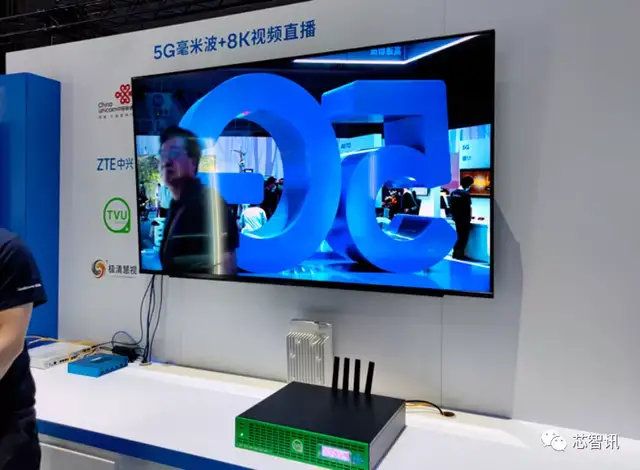
In this demonstration, ZTE provided a 5G millimeter wave base station. TVU Networks' 5G multi-network aggregation router provided a 5G millimeter wave connection through a CPE-type test terminal equipped with Qualcomm Snapdragon X55 5G modem and RF system and Qualcomm QTM527 millimeter wave antenna module. The real-time collected 8K video content was stably returned through the 5G millimeter wave uplink, and was finally successfully received at the receiving end for playback.
According to the 5G millimeter wave test plan of the IMT-2020 (5G) Promotion Group, the millimeter wave large uplink frame structure will be promoted in 2021 to support differentiated application scenarios. The real-time backhaul of ultra-high-definition video, especially 8K video, places very high requirements on the uplink bandwidth of the mobile network. The DSUUU frame structure used in this demonstration triples the peak uplink rate of existing millimeter wave technology by allocating more time slots to the uplink. The demonstration verified the super uplink capabilities of 5G millimeter wave, which is of great significance for meeting the large uplink bandwidth requirements of many 5G industry applications in the future.
It is worth mentioning that during the 2021 MWC Shanghai exhibition, the 5G millimeter wave exhibition area, hosted by China Unicom and GSMA and supported by Qualcomm, comprehensively displayed 5G millimeter wave applications and terminals supported by 39 industry-leading companies. The multi-vendor 5G millimeter wave terminals on display cover modules, mobile phones, CPE, PCs, AR (augmented reality) and XR (extended reality) equipment, live broadcast backpacks, robots and other rich categories.
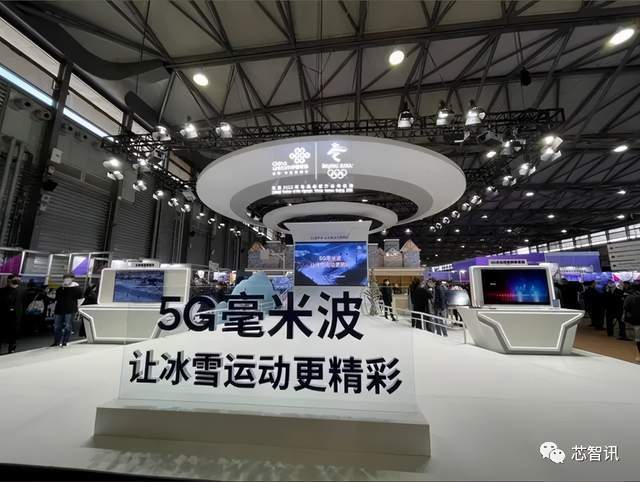
The diverse application scenarios supported by 5G millimeter wave on display include: athlete competitive experience, 5G mixed reality smart snow resort, 8K video transmission, 5G full-view event service and free-view event live broadcast, 5G millimeter wave panoramic experience, etc. The 5G multi-view live broadcast solution based on millimeter waves directly captures the outdoor field of the Zhangjiakou International Cross-Country Ski Center. UAVs, head-mounted cameras, and professional photography cameras communicate with the base station through wireless networks, and the athletes' heroic postures on the National Cross-Country Ski Center are broadcast back in real time from multiple angles, achieving multi-angle live broadcast of the field and providing a variety of viewing experiences for actual spectators. China Unicom is currently the only official communications service partner of the 2022 Beijing Winter Olympics. The maturity of 5G millimeter wave related terminals and applications will help provide better 5G services using millimeter wave technology at the 2022 Beijing Winter Olympics.
5G millimeter wave technology continues to evolve and may become an important component of 6G
Millimeter wave technology is still evolving. For example, the integrated access and backhaul (IAB) technology mentioned above; there is also broadband positioning technology that can support precise terminal positioning; extended spectrum support: supports frequency bands above 52.6GHz and license-free spectrum for licensed auxiliary and independent operation; enhanced beam management: through Full beam optimization and multi-antenna panel beam support improve latency, robustness and performance; dual connection optimization: reduce terminal initial access latency and improve coverage when connecting multiple nodes; power saving features: improve power consumption by maximizing terminal dormancy to support faster link feedback.
The continued evolution of 5G millimeter wave related technologies will bring new opportunities in terms of functionality, efficiency, spectrum and deployment. In addition, 5G millimeter wave technology is also expected to become an important component of the next generation 6G technology.
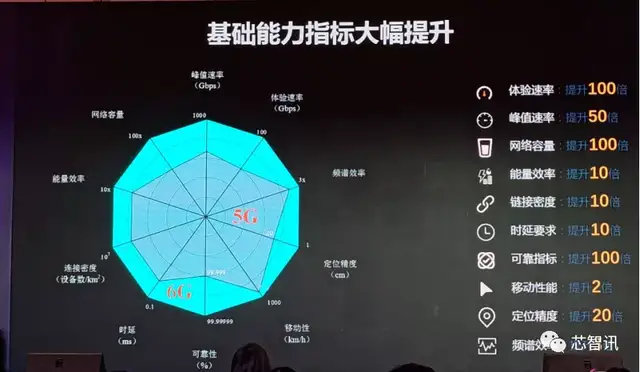
According to the 6G white paper "Next Generation Hyper-Connected Experience" released by Samsung last year, the peak rate of 6G will reach 1000Gbps and the delay will be as low as 100us. It may be completed and commercialized as early as 2028, and large-scale commercialization may be achieved around 2030. Regarding these key indicators and time points, other communication manufacturers have basically the same views.
Samsung also proposed candidate technologies that may be used in the 6G standard, such as the THz terahertz frequency band, new antenna technology to enhance high-frequency signal coverage, advanced duplex technology, the development of network topology and spectrum sharing to improve network utilization and enhance the application of AI.
The white paper "6G: Unbounded, with AI" released by UNISOC believes that 6G core technologies will be diversified, and terahertz communications, visible light communications, advanced modulation and decoding, and satellite-ground collaborative transmission may become 6G core technologies.
Qualcomm emphasized the innovation of related technologies, such as AI/ML data-driven design, full-duplex, higher-frequency millimeter wave, enhanced positioning, terahertz band, intelligent interface, green network, radio frequency sensing, new topology, extreme decoupling, cloud neural network structure search, ultra-secure communication, new sharing paradigm, etc.
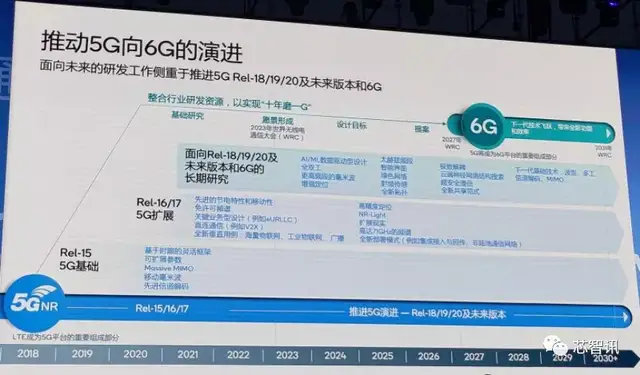
It can be seen that many manufacturers believe that terahertz communication technology will be one of the key technologies for 6G communications. The terahertz frequency band usually refers to the frequency band from 300GHz to 10,000GHz, and the electromagnetic waves around 300GHz can also be regarded as millimeter waves in the higher frequency band. Only by mastering millimeter wave communication technology can we have the opportunity to make breakthroughs in terahertz communication technology.
In mid-2020, Yang Tao, Vice President of Huawei's China Carrier Business Department, also publicly revealed that Huawei is already participating in 6G-related pre-research work. The 6G that has been pre-researched mainly uses millimeter wave bands and is in the stage of scenario mining and technology search.
It is worth mentioning that at the end of 2019, the Equipment Technology Laboratory of Japan's NTT Group developed a 6G ultra-high-speed chip made of indium phosphide (InP) compound semiconductor, and conducted high-speed wireless transmission experiments in the 300GHz frequency band. When using 16QAM modulation, it can reach a wireless transmission rate of up to 100Gbps. If a combination of spatial multiplexing technologies such as MIMO and OAM is used, it is expected to achieve large-capacity wireless transmission exceeding 400Gpbs, which is already close to the 6G peak rate requirement.
In addition, 6G will realize an integrated high-speed communication network in the air, sky, earth and sea, and the millimeter wave frequency band will also be the first choice for inter-satellite links, user links for satellite downward coverage, and feed links from satellites to ground stations.
This content comes from the Internet/ Core Intelligence, this website only provides reprinting. The views, stance, technology, etc. of this article have nothing to do with this website. If there is any infringement, please contact us to delete it!
Related Recommendations