






















Service Hotline
Tech Applications

Tech Applications

Why SMB Connectors Are Easy to Spec Wrong — A Complete Technical Guide
2026-09-23
1864
The SMB connector holds a narrow but busy position in radio-frequency hardware. It is the interface selected when board area, assembly speed and stack height matter more than frequency reach. Radio modules, set-top boxes, cameras and navigation receivers all depend on it, and most of those products buy the same SMB connector from two or three sources at once. Wide adoption plus shared supply is why engineering and purchasing need one common reference. This article sets out what the part is and where it came from, then covers the defining features, the numbers that decide fit, the roles it fills, the applications, and how suppliers are qualified.
What Is an SMB Connector?
SMB stands for SubMiniature version B, a compact coaxial interface built for paths where a threaded coupling would be too slow and too tall. An SMB connector joins a cable or a circuit board to its mating half by push-on friction, so the operator closes it with axial force and needs no tooling whatsoever. The family is fixed by the international standard IEC 61169-10, which sets the interface sizes each maker must copy so that parts from separate factories fit together.
Holding force comes from spring pressure between metal rings rather than from thread engagement. The usable frequency ceiling of an SMB connector therefore sits below what a fine-threaded interface can sustain. The SMB connector is specified for board-to-cable and module links in the low gigahertz band, where a fast, repeatable joint is worth more than extra margin. Two impedance systems exist across the wider family, and that one fact causes more buying errors than everything else combined.
The Development History of the SMB Connector
Coaxial links came out of radar hardware during the war. The first fine-threaded designs were made for lab benches, not for products built in large numbers. As communications gear spread through the 1960s and 1970s, factories needed smaller joints they could fit fast to crowded boards. The subminiature series, and the SMB connector inside it, grew directly from that pressure.
The SMB connector took the same logic one step further, keeping miniature coaxial geometry while abandoning the thread completely and surrendering some pull-out strength and some frequency margin in return for speed and a far shorter stack. Later standardisation gathered those sizes into a single document so that rival plants could build parts that mate. That is why a buyer today can compare makers on paperwork, consistency and delivery rather than on shape, and an engineer can likewise plan a second source without redrawing the board.
Characteristics of an SMB Connector
Four characteristics explain most decisions taken around an SMB connector, and each one places an obligation somewhere else in the product.
Push-on coupling. Mating and unmating run along one axis, which removes torque tooling from the process but also stops the joint pulling itself square.
Short stack. Board-mount versions of the SMB connector stand only a few millimetres over the laminate, allowing housings that a threaded jack and its wrench space would rule out.
Flange and legs. A square flange with grounding legs gives the part one seating plane and resists the twist made when a cable head lands off-centre.
Reversed gender. The board-side jack in this family often carries the centre pin rather than the socket, which surprises engineers coming from other series.
Because an SMB connector has no thread, alignment has to be finished before contact, so the housing cutout and the cable approach both need planning. The compact profile that makes an SMB connector useful also limits what can sit behind it. Catching that trade early avoids the expensive discovery that the board is right while the shell is not.
Parameters of an SMB Connector: What to Confirm Before Purchase
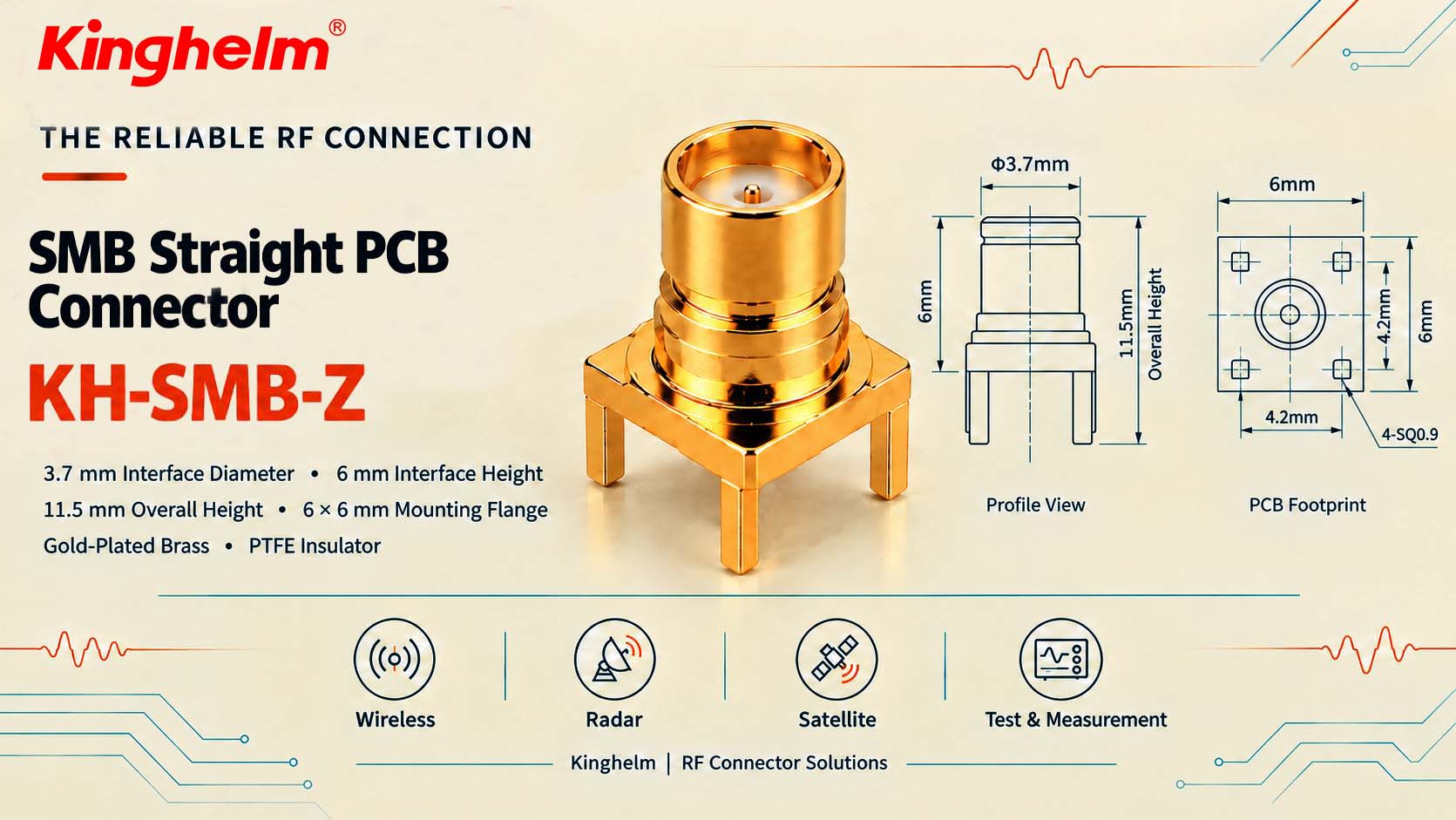
Mechanical parameters appear on the published drawing and can be compared line by line between sources. For the Kinghelm KH-SMB-Z board jack these are fixed values: a 3.7 mm interface diameter, a 0.9 mm centre contact, 11.5 mm overall length, an interface 6 mm above the seating plane, a 6.0 mm square flange, and four 0.9 mm square legs on a 4.2 x 4.2 mm pattern. The housing is gold-plated brass, the insulator is PTFE, the inner conductor is gold-plated HPb59-1 brass, general tolerances follow IT12, and the materials meet RoHS.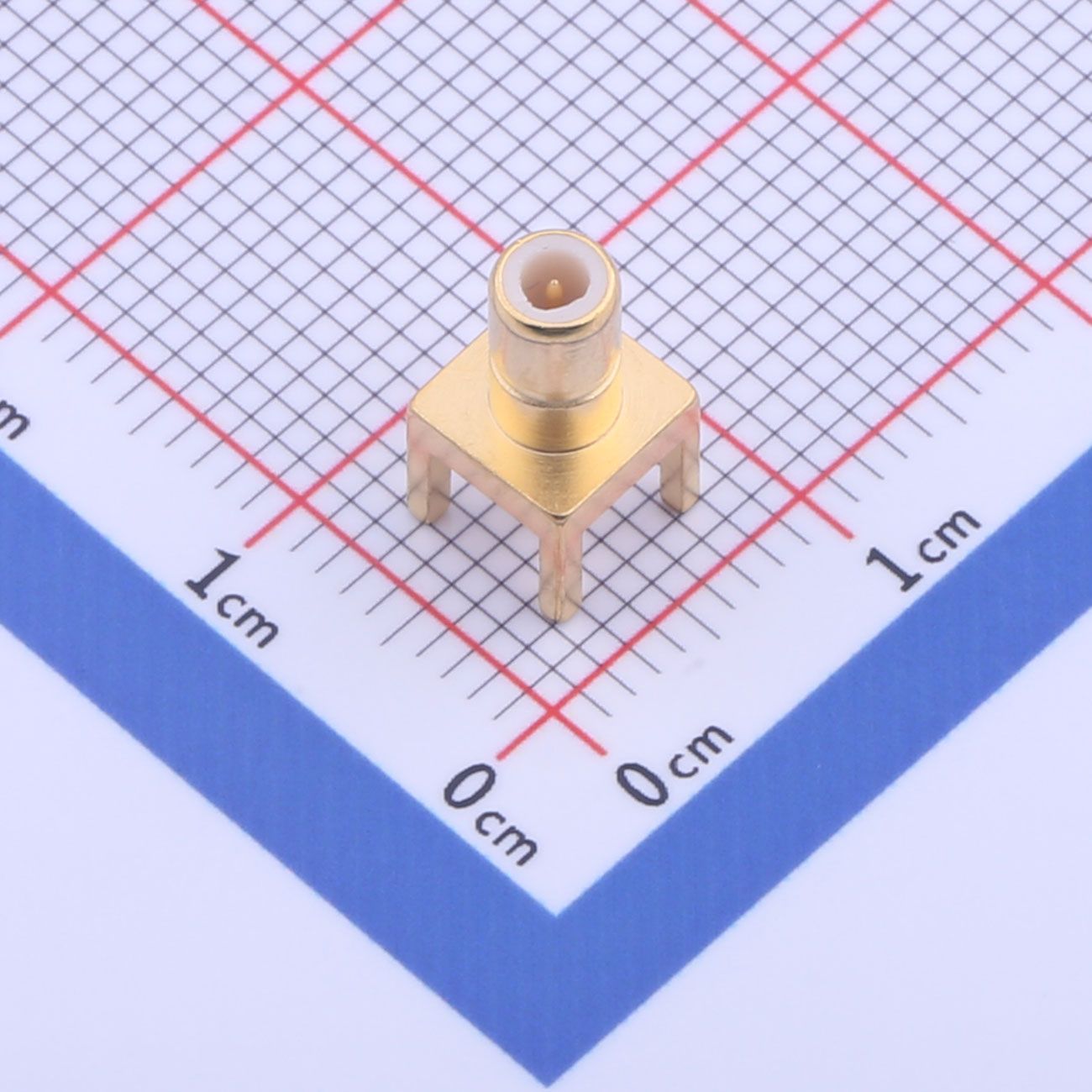
Electrical numbers behave differently, and this is where a buying file most often goes thin. Characteristic impedance, frequency range, insertion loss, voltage rating, insulation resistance, cycle life and working temperature decide whether an SMB connector suits a design. None of them can be read from a mechanical drawing or judged by how the face looks. Ask for a datasheet tied to one SMB connector part number rather than a brochure covering a whole series. The impedance question matters most, because two systems share a similar outside shape and can join by hand while reflecting signal back to the source.
Roles of the SMB Connector in a Complete Assembly
Inside a finished product the SMB connector does several jobs at once, and treating it as a pass-through is what brings units back. The first duty of an SMB connector is electrical, holding a controlled coaxial path from track to cable so that energy propagates instead of reflecting. Its second duty is mechanical, because the legs that close the shield bond also anchor the part against every insert and pull the product meets in service.
A third duty is organisational rather than physical, because a fixed interface lets a team divide work between board layout, housing design and cable build without arguing about shape at each handover. A standard SMB connector also lets purchasing approve an alternative source without reopening the mechanical design. Where those lines stay informal, the SMB connector becomes the place unresolved disagreements collect.
Applications of SMB Connectors
The applications listed below follow directly from the characteristics described above. Wireless modules and IoT gateways use the interface for antenna and test links on crowded boards built in volume. Set-top boxes and video equipment have used small coaxial joints for distribution work for decades. Industrial cameras rely on them where a compact blind-mateable link speeds the line, and test instruments use the series for fixture connections that hands cycle many times a day.
Car infotainment and telematics boards are a growing share, since a push-on joint removes a torque step from an already automated process. Navigation receivers and in-car antenna feeds follow the same reasoning when they specify an SMB connector. What binds these applications together is not frequency performance but repetition, since the SMB connector is specified where ten thousand ordinary builds matter more than one record-setting one.
Manufacturers of SMB Connector Products and How to Qualify One
Known international suppliers and many specialist Asian factories both build to this fixed interface, which is why the SMB connector is so often dual-sourced. A search for SMB connector supply will show the large component groups that wrote much of the coaxial catalogue, next to focused plants whose whole trade is board-mount RF parts and matching cable sets. Comparing them on the interface alone tells you nothing, because the interface is exactly what they all share.
Qualification achieves considerably more when it is directed at the genuine differences, so ask for a datasheet on one part number rather than a sheet for a family. Confirm which impedance system the part belongs to, and how that determination was checked and documented. Establish whether RoHS statements, material certificates and batch records can truly be produced on request, and how long delivery holds once an order lands. Then look at the detail that sets switching cost: leg pattern, flange size and centre pin shape against what already runs in production. Those three decide whether a change is a form to file or a board to redo.
Kinghelm KH-SMB-Z as a Board-Mount SMB Connector
The KH-SMB-Z is Kinghelm's vertical board-mount jack with a centre-pin face, meant for designs that want a tool-free joint rather than a threaded one. Its square flange and four legs give the build one seating plane and one direction. That is the practical difference between a part that survives years of unplugging and one that slowly works its own joints loose. Full SMB connector sizes, materials and tolerance class appear above, and further documents are available on request.
Related reading from this site: the SMB cable assembly guide covers cable-side choice and build, while the article on SMA to SMB adapters shows how these faces meet other families. For board-level fitting detail, including leg shape, shell clearance and rework practice, see the SMB board-mount jack installation guide.
Conclusion
An SMB connector is easy to specify and easy to specify wrongly, because a fixed interface hides the choices that matter most. The mechanical drawing is public and comparable, but the electrical proof has to be asked for, part by part. Treat impedance as a question rather than an assumption; treat leg and flange geometry as switching cost rather than minor detail; and treat SMB connector paperwork as a genuine supplier capability rather than an administrative formality. Teams that apply those three rules will find the SMB connector is one of the more forgiving parts on a board. Teams that skip them will find it is the cheapest item on the assembly and the dearest line on the returns sheet.
Related Recommendations