






















Service Hotline
News

News

What Is the Difference Between Tactile Switches and Push Button Switches? Clearing Up Confusion
2026-10-10
245
A buyer sends a photo of a round button on a control panel and asks for a quote on a "push button switch." The supplier replies with a 6 × 6 mm tactile switch designed for PCB mounting. The part does not match the requirement, leaving the buyer with a quote they cannot use. A second inquiry becomes necessary, adding time to the sourcing process.
The problem is not necessarily how the products look, but how the terminology is interpreted. "Push button switch" describes a method of operation, while "tactile switch" identifies a type of switch designed to provide tactile feedback. Although tactile switches can fall within the broad functional meaning of push button switches, manufacturers and distributors may list them as separate product categories. This difference in terminology can lead to sourcing errors when a buyer specifies only "push button switch" without clarifying the mounting style or application.
Many BOMs, datasheets, and product pages list these terms side by side. That is where misunderstandings can begin. The buyer may need a panel-mount button assembly, while the supplier interprets the same description as a small PCB tactile switch.
What Is a Tactile Switch, and When Do Engineers Choose One?
On a circuit board, a tactile switch usually serves one main purpose: to signal to a processor that a button has been pressed. In a normally open (NO) tactile switch, the contacts close when the actuator is pressed. In a momentary version, the contacts return to their normal open state when the actuator is released. The tactile feedback helps users recognize that the switch has been actuated.
PCB tactile switches come in SMT and through-hole versions. Most are small enough to sit beside other components, with a low cap or actuator. Because they switch logic-level signals, they are rarely asked to carry a motor, a lamp, or a mains load.
Typical places you will find them include remote controls, keyboards, wearables, appliance front panels, communication equipment, and instrument interfaces. For construction details and type breakdowns, see our guide to tactile switch types and specifications.
What Does "Push Button Switch" Actually Mean?
"Push button switch" is the wider term. Anything you operate by pressing a button fits under it, tactile switches included. In a sourcing conversation, though, the phrase usually points to the larger panel button: the one mounted through a hole in the enclosure and used to start, stop, or reset equipment.
Those two uses of the same phrase are why quotes go wrong. A BOM line that only says "push button switch" can be filled by a 6 mm tact switch or a 22 mm panel button. Both are push buttons. Only one will fit the board or the panel.
Panel buttons also raise questions that a tact switch never raises: is the action momentary or latching, what load does the contact carry, what cutout does the panel need, is there a lamp, and does the front need sealing? Those are not upgrades of a tact switch. They are a different product family.
For the wider classification picture, read our article on how switching devices are classified.
Where Do Tactile Switches and Panel Push Buttons Really Differ?
The comparison only becomes useful when both sides are concrete. Below, the left column is the PCB tact switch most engineers mean. The right column is the panel or industrial button most buyers mean when they use the short phrase.
| What to Check | Tactile Switch | Panel Push Button |
|---|---|---|
| Main role | Signal input on a PCB | Operator control on equipment |
| Typical application | Low-level signal input, reset and user-interface functions | Equipment control, such as start, stop and reset |
| Operation | Commonly momentary | Momentary or latching |
| Mounting | PCB, SMT or through-hole | Panel cutout; some PCB versions exist |
| Actuator and space | Compact, low travel | Larger cap, longer travel, behind-panel depth |
| Operating feel | Distinct click feedback | Click, smooth, detent, or illuminated |
| Confirm in datasheet | Footprint, pinout, height, force, life | Cutout, rating, contact form, cap, sealing |
There are multiple variants of push button switches. The confusion can happen not only between panel-mount push buttons and tactile switches, but also between latching PCB push switches and momentary tactile switches.Two rows cause most of the trouble. Current rating is not a family rule. You can find panel buttons rated for a few milliamps and tactile switches rated for low-level signals, but the numbers come from the specific part, not the label. 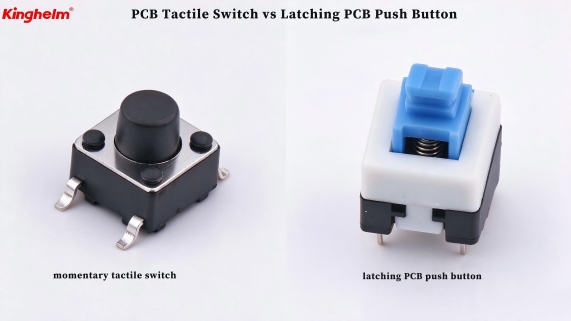
Operation is the same story: momentary and latching both exist in the panel family, while the small PCB versions are usually momentary. Mounting style is one of the most useful ways to distinguish these products in a sourcing inquiry, although it is not an absolute rule. Typical PCB tactile switches are soldered directly to circuit boards, while industrial panel push buttons are usually secured through a cutout in the enclosure. However, PCB-mounted push buttons and larger tactile switches also exist. Always confirm the mounting method, dimensions, terminal arrangement, and mechanical drawing before selecting a replacement.
What Should Buyers Check Before Ordering?
The fastest way to avoid the mix-up is to make the BOM line more specific. These are the fields we ask for before quoting:
- Function: press-and-hold (momentary) or press-to-latch?
- Mounting: PCB pads or panel cutout? Include the drawing.
- Load: what voltage and current will the contacts switch?
- Actuator: cap height and shape, plus the space around it.
- Environment: dust, moisture, cleaning, or temperature limits?
- Life: how many operations, and under what test condition?
Photos help, but they do not replace a drawing. A button that looks right from the front can have the wrong pin spacing, actuator height, or terminal type. If the part is going into an existing product, compare the sample against the current drawing before you approve it.
If a tactile switch has already failed in the field, our troubleshooting guide for tactile switches covers the common causes.
Conclusion
"Push button switch" is a broad functional term describing a switch operated by pressing. A tactile switch is designed to provide tactile feedback and is commonly used as a compact PCB input component. Panel push buttons serve similar pressing functions but are typically selected for equipment control and panel mounting.
For accurate sourcing, the BOM, drawing, and quotation should clearly specify the mounting method, operating function, electrical rating, and relevant dimensions. Clear specifications help prevent mismatches and reduce unnecessary back-and-forth during procurement.
Need a sample or a specification check? Contact Kinghelm.
Related Recommendations