






















Service Hotline
News

News

Radio and Television will build 400,000 5G base stations to achieve nationwide 5G coverage next year
2021-12-28
1136
It was revealed thatChina Radio and Television 5G is expected to build 400,000 5G base stations in 2021, the relevant parties actually gave a plan of 450,000 to 500,000.
400,000 radio and television 700MHz base stations can cover more than 90% of the administrative villages in the country. Therefore, if progress goes well,By the end of next year, it is possible that 700MHz will achieve full network coverage of 5G for radio and television.

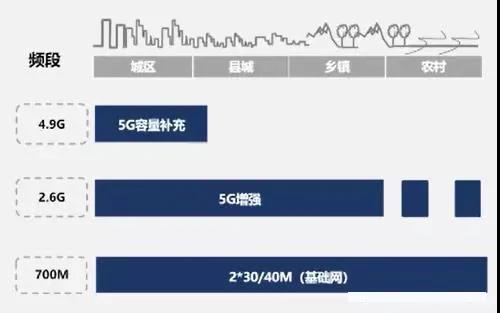
Regarding the radio and television 5G construction plan, Liang Jing, director of the 5G working group of Hunan Cable Network (Group) Co., Ltd., pointed out,In the future, 5G radio and television canUse 700MHz as the base network, 2.6GHz to enhance network capabilities, and 4.9GHz as capacity supplement.Mainly reflected in:
1. Adhere to 700MHz as the basic base network.
The value of the 700MHz network is maximized. Based on its low latency, it can comprehensively deploy IoT applications and create an optimal 5G voice basic network, which can fully meet the needs of edge 720P video services and VoNR in the initial stage.
2. Mobile 2.6GHz enhances network capabilities.
Through 700MHz+2.6GHz downlink CA, 5G network user experience can be fully ensured in heavy traffic services or congestion scenarios, and 700M+2.6G uplink SUL can make up for the lack of 2.6GHz uplink capability, thereby achieving a win-win experience.
3. Capacity supplementation is achieved through 4.9GHz.
In high-hotspot areas and special government and enterprise private network application scenarios, the 4.9GHz network can be used to achieve network expansion within the region.
In the 700MHz network deployment that attracts public attention, radio and television can refer to China Mobile’s 900MHz and China Telecom’s 800MHz network deployment experience.Thin network coverage will be achieved in the early stages, and network coverage will be gradually improved in the later stages.
Compared with 900MHz, the coverage radius of 700MHz has increased by 20% to 30%, the coverage area has increased by 44% to 70%, and the number of sites required has decreased by 30% to 40%. With reference to Telecom's 800MHz construction, a total of 460,000 base stations were completed through two phases of four-year construction, basically achieving nationwide coverage.
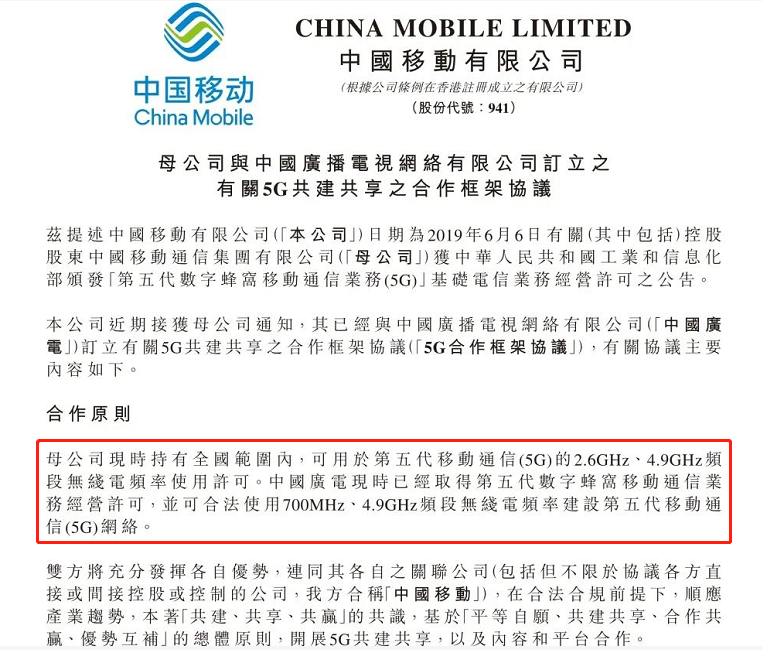
In May of this year, China Radio and Television and China Mobile officially announced the co-construction and sharing of 700M. China Mobile and China Radio and Television will invest in the construction of 700MHz 5G wireless network at a ratio of 1:1. China Mobile will open all of its 2.6GHz frequency band 5G network to China Radio and Television for a fee and provide international business transfer services.
China Radio and Television’s 700MHz+2.6GHz can prioritize network deployment in industry application scenarios, if 700MHz is used as the main carrier and 2.6GHz as the auxiliary carrier, the downlink rate can be expanded to 2.1Gbps, thereby solving the problem of insufficient 700MHz downlink rate; in addition, it also extends the 2.6GHz uplink coverage edge.
Under 1:3 networking conditions between 700MHz and 2.6GHz in urban areas, the uplink edge rate is increased by 130% compared to pure 2.6GHz networking, which is 30%+ ahead of the uplink and downlink edge rates of the China Telecommunications Union. Since the theoretical peak of 700MHz uplink is 175Mbps,With the improvement of 700MHz and 2.6GHz networking, the uplink increased to 390Mbps, which increased by 123%.
In the future networking user retention strategy, in the early stages of 700MHz construction, due to poor network coverage and low terminal penetration, we can follow the mobile strategy to be consistent with mobile user experience, quickly form network capabilities, and then develop users.
When 700MHz matures, users can give priority to staying in 2.6GHz to ensure network quality and improve user experience; when the 2.6GHz network capacity and network coverage are insufficient, switch to the 700MHz network to fully supplement.
Since the high priority of 700MHz will cause the mid- and near-point 700MHz users to stay on 700MHz, which will cause network congestion. To ensure network quality, priority can be given to staying on 2.6GHz. The user experience of 700MHz in the far reaches of the community is much higher than that of 2.6GHz. When the capacity or coverage is insufficient, it can be switched to 700MHz.
This article is reproduced from "5G通信 ", supports the protection of intellectual property rights, please indicate the original source and author when reprinting. If there is any infringement, please contact us to delete it.
Related Recommendations