






















Service Hotline
News

News
GaN Solutions: Small Packages Meet Large Radar Challenges
2021-12-28
652
GaN Solutions: Small Packages Meet Large Radar Challenges
X-band (8 GHz to 12 GHz) radar is a key piece of equipment suitable for commercial navigation. Aviation is a major use of X-band radar equipment, and the equipment is also deployed in a wide range of applications, including drones, maritime vessel traffic control, weather monitoring, monitoring of bird activity near airports, and anti-icing remote sensing.
According to a report by market research firm Strategy Analytics, X-band radar is the largest radar market segment. Sales of radars in this band were close to $6.3 billion in 2018, and corresponding spending is expected to grow at a compound annual growth rate of 3.4%, reaching $8.7 billion in 2028.
But not just any X-band radar has significant growth opportunities. Active electronically scanned array (AESA) systems are increasingly popular for research and development. The system is mainly used on large airborne platforms, but is also used in land and maritime market segments.

AESA Challenge
AESA systems use active arrays, each with hundreds or even thousands of antennas. Each antenna has its own phase and gain controls. The interference or superposition of individual wavefronts of antenna elements generates plane waves, effectively producing a beam of radio waves traveling in a specific direction. AESA radar systems electronically steer the beam by shifting the phase of the antenna elements.
Antenna elements are typically spaced half a wavelength apart to reduce exposure in the near field. AESA radars also often need to spread signals over a wide range of high frequencies. Such frequency agility allows the radar to quickly search for targets in the sector. This also makes them harder to detect among background noise. This allows ships and aircraft to emit high-powered radar signals while remaining stealthy and provides greater immunity to interference.
These requirements present several challenges for engineers: Each antenna element must be small and lightweight enough to accommodate the tiny wavelength spacing, while keeping the overall system size and weight manageable for use in the air and at sea. However, depending on the application, the radar system must be powerful enough to output anywhere from a few hundred watts to as much as 100 kW. Therefore, radar systems require efficient heat dissipation capabilities, which increases size and weight.
Among many of these use cases, it is necessary toSize, weight, power and cost (SWaP-C)Evaluate the system. Replacing just a few components in the system won't have much of an impact on these considerations. Therefore, technologies that enable AESA radar systems must demonstrate significant advantages in SWaP-C improvements.

Enabling technology: GaN
The technology that can help radar designers overcome many challenges such as power, heat dissipation, weight and size, and cost-effectiveness is gallium nitride (GaN). This material has high electron mobility. And compared to silicon, GaN-based devices have low gate charge and low output capacitance, and can produce higher gains at higher frequencies more efficiently.
GaN has a wide energy bandgap and a very high critical breakdown electric field, which will bring excellent high-temperature reliability, outstanding robustness at high supply voltages, and excellent power density.
Using silicon carbide (SiC) as the substrate of GaN can achieve lower thermal expansion, lower lattice mismatch, and excellent thermal conductivity, thereby fully utilizing the characteristics of GaN. The thermal conductivity of 4H-semi-insulating polytype SiC is 430 W/mK, while the thermal conductivity of silicon is as low as 146 W/mK. This enables very high power densities while dissipating heat efficiently, avoiding extreme channel temperatures that would render the device inoperable.
Therefore, the gallium nitride on silicon carbide (GaN-on-SiC) amplifier in AESA radar can achieve higher performance and equivalent output power in a smaller volume while saving heat dissipation requirements. But to realize the improved benefits of SWaP-C, more needs to be done in terms of device technology.

Encapsulation is key
Further development of phased arrays, such as AESA radar systems, will require size reduction and tighter integration of components.
One such technology is monolithic microwave integrated circuit (MMIC), which enables complete functional modules of multiple components to be fabricated in a single device, thereby increasing circuit density. MMICs also have additional advantages, including reduced component mismatch, reduced signal latency (due to the shorter distance between components on MMICs), and reduced overall bill of materials (BoM) cost.
The MMIC is available in a Quad Flat No-Lead (QFN) package, which offers further cost and size reduction benefits. Because the QFN package uses short bond wires, which help reduce lead inductance, its exposed copper die pad provides excellent thermal performance.
The Wolfspeed CMPA901A020S device is available in a 6 mm QFN package. It is a 20W GaN-on-SiC high-power amplifier that can operate in the 9 GHz to 10 GHz frequency range and is suitable for pulse radar applications such as marine weather radar. The amplifier's three-stage gain provides greater than 30 dB of large-signal gain and greater than 50% efficiency, enabling lower system DC power requirements and enabling simplified system thermal management solutions.
Wolfspeed CMPA9396025S is another GaN MMIC that can integrate many technologies to maximize SWaP-C improvements. Designed for 9.3-GHz to 9.6-GHz operation, this tertiary device is available in a 6 × 6 mm QFN package.Power is 25 W at 100-µs pulse width, 10% duty cycle.
The Wolfspeed CMPA801B030 series of MMIC amplifiers, operating in the 7.9-GHz to 11-GHz frequency range, enables wider bandwidth and higher power in the X-band. Its typical output value is up to 40 W, its large-signal gain is greater than 20 dB, and its power-added efficiency reaches 40%. The product family is manufactured in 7 × 7 mm plastic overmolded QFN and is available in both bare die and 10-pin metal/ceramic mounting flanged packages, resulting in enhanced electrical and thermal performance.
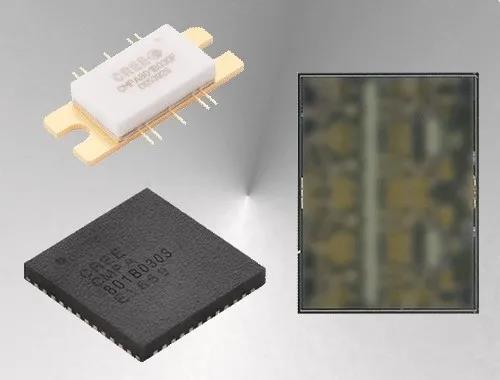
▲ Wolfspeed CMPA801B030 is available in bare die and highly compact packages, maximizing SWaP-C improvements
Note: The ECCN of all devices listed above is 3A001.b.2
Empowering radar technology changes
Strategy Analytics believes that the above-mentioned GaN devices will help promote the faster adoption of AESA radars in a rapidly increasing variety of platforms, and that GaN spending on radar systems will rise from US$171.8 million in 2018 to US$734.1 million in 2028.
This content comes from the Internet/CREE. This website only provides reprinting. The views, stance, technology, etc. of this article have nothing to do with this website. If there is any infringement, please contact us to delete it!
Related Recommendations