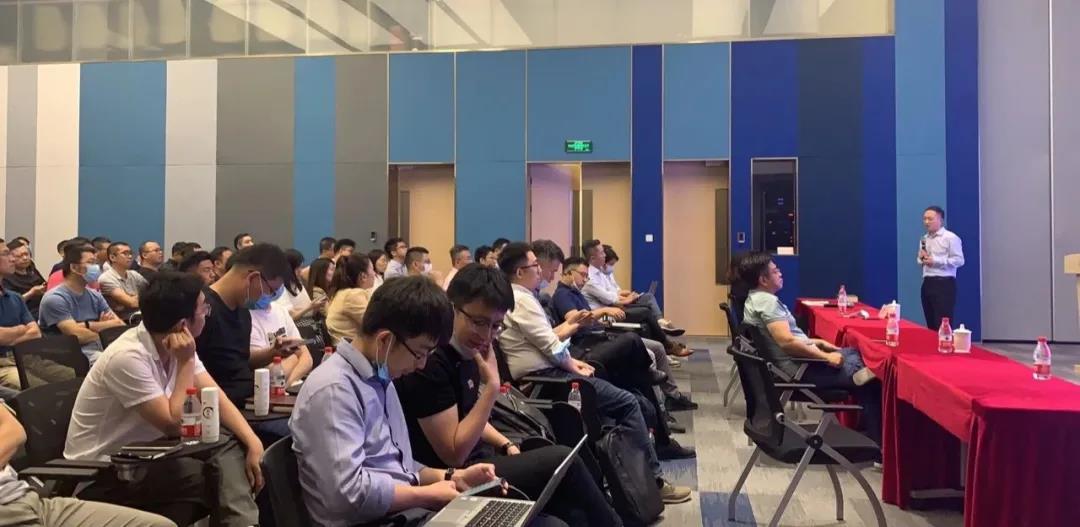
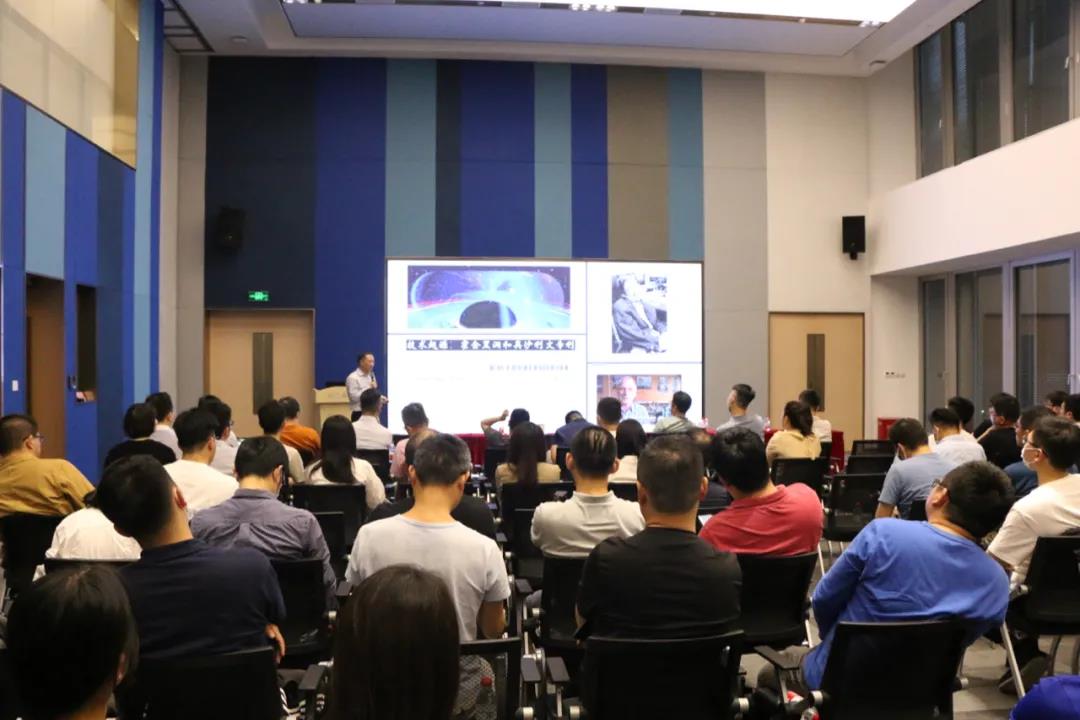
| Can 5G replace Wi-Fi 6?Le 9 juin 2021 au soir, le sixième salon industriel « Chip Everyone Says/I Say IC », organisé par Zhangjiang Hi-Tech et Xinmo Research, s'est tenu à Zhangjiang Science City. Zhang Pengfei, président-directeur général de Broadcom Integration, y a prononcé un discours remarquable sur le thème « Repenser l'Internet des objets : parlons du Wi-Fi 6 ». Le salon a réuni des cadres moyens et supérieurs d'entreprises de renom telles que Huawei, Huahong Grace, Unisoc, Pingtouge et Intel.During the on-site communication session, Zhang Pengfei had a heated discussion with the audience on industry hot spots, industry opportunities, corporate strategies and other issues. Zhang Pengfei, président-directeur général de Broadcom IntegrationMr. Zhang Pengfei is the chairman and CEO of Broadcom Integration and has more than 20 years of experience in the semiconductor industry. Mr. Zhang Pengfei studied in the Department of Electronic Engineering at Tsinghua University with his bachelor's, master's and doctoral degrees. In 1994, he went to the United States to engage in postdoctoral research at the University of California, Los Angeles (UCLA). He once co-founded Resonext Communications, an integrated circuit design company in the United States with his partners, which was later successfully acquired by RF Micro Devices, a listed company in the United States. In 2005, after Zhang Pengfei returned to China, he established Broadcom Integration in Shanghai Zhangjiang High-Tech Park, focusing on the R&D and sales of wireless communication integrated circuit chips. It provides low-power, high-performance wireless radio frequency and microprocessor SOC chips to domestic and foreign customers, including many world-renowned brands, and provides complete solutions for intelligent transportation and the Internet of Things. In April 2019, Broadcom Integration was listed on the A-share main board.Voici le contenu du discours remarquable de M. Zhang Pengfei, compilé par Xinmo Research.Zhang Pengfei :
Everyone is familiar with Wi-Fi, and everyone has at least one device that uses Wi-Fi. In the past two years, with the launch of Wi-Fi 6 technology, many terminal products have been upgraded to Wi-Fi 6, and Wi-Fi 6 has also attracted media and news attention. Today, I want to talk to you about Wi-Fi 6 and what new technology upgrades, new application scenarios and new investment opportunities it has.Je développerai les points suivants :1. The origin of Wi-Fi technology; 2. Five major application bottlenecks of Wi-Fi 5; 3. Nine major technological upgrades of Wi-Fi 6; 4. Comparing Wi-Fi 6 and 5G; 5. Design challenges of Wi-Fi 6 chips; 6. The rise of the Wi-Fi industry; 7. Wi-Fi market size forecast; 8. Broadcom integrated Wi-Fi products.
L'origine de la technologie Wi-Fi
The electronic information industry has developed for more than 50 years and has created many products that have changed the world. Computers and mobile phones are the two most representative products. The very important supporting technology behind this is transmission and connection.We use more than one wireless transmission protocol every day, and every mobile phone contains at least three protocols: cellular network, Wi-Fi and Bluetooth. There are three important dimensions for measuring wireless transmission technology: distance, bandwidth and battery life. From a technical perspective, there is no way to achieve the ultimate in these three dimensions, and even if it is done, the cost will be very high. This is why there are three wireless transmission protocols in mobile phones. Cellular networks choose to optimize distance, Wi-Fi chooses to optimize bandwidth, and Bluetooth chooses low power consumption.Since 1999, WLAN has had a Wi-Fi wireless communication protocol standard. And after a long period of development, before Wi-Fi 6, it experienced five generations of technological development, and the main theme was to increase the amount of data transmitted per unit time. For example, the third-generation Wi-Fi 802.11a and 802.11g protocols can transmit emails; the fourth-generation Wi-Fi protocol allows devices to surf the Internet freely, and the fifth-generation Wi-Fi protocol 802.11ac allows devices to play videos smoothly. With the upgrade of technology, more and more users are using Wi-Fi, and Wi-Fi has begun to succeed in industry and business. User bottlenecks have also emerged.
Cinq principaux goulots d'étranglement des applications Wi-Fi 5
Commençons par examiner un scénario d'application Wi-Fi typique. Dans un environnement de bureau, on trouve un point d'accès (AP), qui peut être un routeur, un hotspot ou une passerelle. De nombreux appareils du bureau se connectent à Internet via ces points d'accès. Un point d'accès et tous les appareils qui y sont connectés forment un groupe de stations de base (BSS). Les appareils connectés au point d'accès sont appelés stations (STA). Au sein d'un BSS se trouve un point d'accès. Toutes les STA qui accèdent au point d'accès à un instant donné doivent se disputer le canal de transmission sans fil pour se connecter à Internet. Deux BSS adjacents forment un groupe de stations de base (OBSS).After understanding this, we can figure out what technical bottlenecks exist in Wi-Fi technology before the arrival of Wi-Fi 6.(1) La coexistence de plusieurs appareils entraîne de graves congestionsAvec la généralisation du Wi-Fi, de plus en plus de stations (STA) sont connectées à un point d'accès (AP) au sein d'un réseau de stations de base (BSS), ce qui réduit la probabilité d'accès de chaque STA à l'AP. En pratique, au sein d'un BSS, si l'utilisation d'un canal atteint 75 %, il est saturé. L'ajout d'une STA supplémentaire entraîne alors une latence importante. Les stations de base externes (OBSS) continuent de s'interférer entre elles.(2) La proportion de données à trame courte est trop élevéeLorsqu'un point d'accès (AP) transmet des données à une station (STA), il doit les encapsuler et les envoyer. Ce processus engendre une surcharge de gestion et de contrôle afin d'établir des connexions de données efficaces et sécurisées. Plus le volume de données valides est important, plus l'utilisation du support de transmission est élevée. En général, le Wi-Fi sert à envoyer des messages courts, et le volume de données utiles est faible. Seul l'envoi de données 4K et 8K génère un volume important de données valides. Dans ce cas, l'utilisation du support sans fil lors de l'assemblage des paquets est extrêmement faible.(3) Grave pénurie de ressources spectralesNous utilisons principalement la bande de fréquence 2.4 GHz. Même avec une bande passante minimale de 20 MHz, seuls trois canaux sont disponibles. Avec une bande passante de 40 MHz, un seul canal peut être sélectionné dans la bande 2.4 GHz. Du point de vue des ressources fréquentielles, l'utilisation de la bande 2.4 GHz est très difficile. Par exemple, si le protocole 802.11ap utilise une bande passante de 160 MHz, seuls deux canaux peuvent être utilisés, même dans la bande 5 GHz. La congestion est souvent due à un nombre insuffisant de canaux.(4) Faible consommation d'énergieThere are more and more users of the Internet of Things, and a very important requirement for the application of the Internet of Things is to reduce power consumption. In the Wi-Fi industry, low power consumption is still not paid enough attention. Today’s electronic devices can have their batteries replaced once a year. It's been done very well. When the Internet of Things era arrives, assuming there are 100 such devices at home, two batteries will have to be replaced every week, which will put a lot of pressure on users. Therefore, delaying battery life is a very important challenge.(5) Longue distance en extérieurWi-Fi is an indoor transmission protocol, why use it outdoors? Now with the arrival of the Internet of Things, the demand for outdoor scenes has increased. For example, for security monitoring and leisure and entertainment facilities, we need more reliable outdoor transmission protocols.These are all difficulties and challenges in efficiency that arise in Wi-Fi application scenarios due to the rapid development of the industry before the arrival of Wi-Fi6. This is also the industrial technical background for IEEE to launch Wi-Fi 6 from the perspective of wireless standard formulation.
Wi-Fi 6 nine major technical upgrades
Qu’a apporté le Wi-Fi 6 ? En résumé, le Wi-Fi 6 comporte neuf améliorations techniques majeures.(1) Technologie de modulation d'ordre supérieur 1024QAM.Le Wi-Fi 6 utilise une technologie de modulation 1024QAM haut de gamme, ce qui augmente le débit de transmission de données maximal de 25 % par rapport au Wi-Fi 5.Wi-Fi 5 uses 256QAM modulation technology, and the single symbol data density is 8. Wi-Fi 6 uses 1024QAM vector modulation, and the single symbol data density reaches 10.(2) Les données de sous-porteuse ont été multipliées par 4Wi-Fi uses multi-carrier technology. The number of sub-carriers in Wi-Fi 5 is 256. Wi-Fi 6 has increased by 4 times, and the number of sub-carriers has reached 1024. The increase of subcarriers has two benefits, one is to improve spectrum utilization, and the other is to improve transmission time utilization.Subcarriers are grouped into RU groups of different sizes and allocated to each STA in RU units. Using OFDMA technology, different information data can be packed into the same packet to avoid spectrum waste caused by short packets. It also reduces competition between STAs and reduces latency.The Wi-Fi 5 standard already supports downlink multi-user concurrency; Wi-Fi 6 adds uplink multi-user concurrency. There are many requirements: channel matrix measurements, clock management, power control. Both MU-MIMO technology and OFDMA technology solve the problem of multi-device transmission. OFDMA technology solves it through frequency reuse, while MU-MIMO technology solves it through spatial multiplexing.La technologie de coloration BSS s'appuie sur le protocole 802.11ah. Par exemple, la transmission de données est comparable à un repas dans une salle à manger. Chaque table représente une BSS. Avec le Wi-Fi 5, la communication est impossible tant qu'une personne parle dans la salle, tandis qu'avec le Wi-Fi 6, elle est possible tant que la personne à table ne parle pas. Grâce à cette méthode, 64 BSS différentes peuvent coexister.(6)TWT( temps d'attente cible)Le moyen le plus efficace de réduire la consommation d'énergie est de mettre les appareils inactifs en veille. Le Wi-Fi 6, dédié aux applications de l'Internet des objets, permet aux stations (STA) de se mettre en veille en toute sécurité tout en restant hors ligne. Le point d'accès (AP) et la STA négocient la période de réveil et échangent régulièrement des informations afin d'allonger la période de diffusion du point d'accès et d'améliorer ses capacités de contrôle. En d'autres termes, le Wi-Fi 6 réduit le nombre d'appareils concurrents et la consommation d'énergie en optimisant leur gestion et leur contrôle.(7) Prend en charge les bandes de fréquences 2.4 GHz et 6 GHzAfin de pallier la pénurie de ressources spectrales, le Wi-Fi 6 prend en charge les bandes de fréquences 2.4 GHz et 6 GHz. La bande 2.4 GHz a été ajoutée en raison de sa faible perte de transmission et de sa connexion fiable. La bande de fréquences 6 GHz est exclusive au Wi-Fi 6, triplant ainsi les ressources spectrales (canaux 59, 29, 14 et 7 inclus). Aucun autre appareil, même parmi les versions précédentes, n'utilise la bande de fréquences 6 GHz ; la compatibilité n'est donc pas requise, ce qui améliore encore l'efficacité du système.Le Wi-Fi 6 propose des produits exclusifs 20 MHz conçus sur mesure pour répondre aux exigences spécifiques de faible consommation, de faible coût et de faible débit des applications de l'Internet des objets (IoT). Les terminaux Wi-Fi 6 IoT nécessitent une bande passante de seulement 20 MHz, ce qui simplifie le système et le rend adapté à l'éclairage, au divertissement, à la télécommande, aux objets connectés, à la santé, au secteur médical et à d'autres applications.(9) Niveau de sécurité WPA 3The encryption security level of Wi-Fi 6 has been upgraded from WPA 2 to WPA 3, with an encryption word of 192b, which can resist "dictionary" attacks. To protect the security of data before it is cracked, the security level in company, home, and enterprise scenarios is higher than that of cellular networks.
Comparaison entre le Wi-Fi 6 et la 5G
Every time the cellular network is upgraded, someone will come out and say that Wi-Fi is no longer needed. This statement was very popular with 4G-LTE. Now that cellular networks have developed to 5G, will they replace Wi-Fi? I think it's unlikely. Let’s first take a look at the technical comparison between Wi-Fi 6 and 5G.Comparé à la 5G, le Wi-Fi 6 offre une meilleure capacité et une latence réduite ; son coût de couverture par unité de surface est également inférieur ; l’architecture en couches du réseau 5G facilite l’accès au Wi-Fi ; les améliorations de sécurité simplifient la gestion et le contrôle des données, et leur sécurité est renforcée ; la compatibilité ascendante des équipements permet des mises à niveau progressives du réseau ; l’unification mondiale des bandes de fréquences et des protocoles favorise la généralisation du Wi-Fi 6 par rapport à la 5G ; l’ajout de la bande de fréquence 6 GHz renforce la compétitivité de la 5G à ondes millimétriques ; les habitudes d’utilisation du Wi-Fi peuvent se maintenir, favorisant ainsi la coexistence ; les densités d’utilisateurs en intérieur et en extérieur se complètent et s’influencent mutuellement. Par conséquent, la 5G et le Wi-Fi continueront de coexister.
Défis de conception des puces Wi-Fi 6
The many technical upgrades of Wi-Fi 6 place high demands on chip design and pose great challenges. It mainly includes several items: receiver, transmitter, baseband circuit and clock synchronization. In the field of baseband circuits, the industry has begun to use higher process 12nm and 14nm. Clock transmission power control was not available in Wi-Fi system clocks in the past, and the design of these is very difficult.Many companies have now designed Wi-Fi 6 chips, most of which are American companies. The first one to make it was Quantenna. They made Wi-Fi 6 chips in 2016. Now this company has been acquired by ON Semiconductor. It is worth noting that the Wi-Fi 6 standard was formulated in 2019 and will not be introduced to the industry until 2020. Why do their chips come out earlier than the standard? The most important reason is that these companies are the makers who participate in the formulation of standards, so standards are very important to the development of our industry. We are stuck too much in the standard process.
L'essor de l'industrie du Wi-Fi
The development of the Wi-Fi industry is not easy. Today, the scale of the Wi-Fi industry has reached 3.3 trillion US dollars, with 37.5 billion Wi-Fi chips. On average, each person has two devices using Wi-Fi technology.In the application market, the router and gateway market is now close to 500 million units and is still maintaining strong growth. Products with annual shipments of over 200 million include TVs, smart speakers, home appliances, lighting and surveillance cameras. Products with annual shipments of over 100 million include watches and smart switches. Since 2017, the Wi-Fi chip market has grown by 1 billion units per year.
Wi-Fi market size forecast
Si l'on considère uniquement le marché du Wi-Fi 6, la croissance est manifeste. Tout d'abord, le déploiement rapide de la 5G a accéléré la conversion des appareils Wi-Fi vers le Wi-Fi 6. Ensuite, la politique nationale de « doublement du débit » est favorable à ce marché. Troisièmement, la multiplication des objets connectés (IoT) exige le Wi-Fi 6 pour améliorer l'expérience utilisateur. Enfin, on prévoit que plus de la moitié des appareils Wi-Fi utiliseront le Wi-Fi 6 en 2025.Wi-Fi 6 is a special opportunity for China’s semiconductor industry. Looking back at history, every time node of technological upgrading is a good time to enter the industry. The emergence of new applications is also a good time for innovation. AIOT and Industry 4.0 have brought new application markets. For China, we have a complete industrial chain. At the same time, national policies are vigorously promoting the safety of the industrial chain. There are many related benefits in terms of investment and policies. It is a good time for the development of the semiconductor industry.
Produits Wi-Fi intégrés Broadcom
Enfin, présentons la situation de l'intégration de Broadcom au sein de notre entreprise.Broadcom Integrated, fondée en 2005, est spécialisée dans le secteur des transmissions sans fil. Cotée sur le marché principal des actions A en 2019, son offre de produits se concentre principalement sur deux axes : d’une part, les solutions domotiques complètes, notamment les puces Bluetooth et Wi-Fi pour l’Internet des objets (IoT) ; d’autre part, les puces intelligentes haut débit, dont elle est le principal fournisseur de puces ETC internationales et d’une gamme complète de puces pour l’automobile.En termes de produits, Broadcom Integration propose actuellement deux produits phares : la puce de processeur audio intelligent double cœur multimode Wi-Fi/BT/FM BK7271, dotée de nombreuses ressources de traitement audio et vidéo, notamment un réseau de microphones, une réduction active du bruit, un réveil par mot-clé d’intelligence artificielle et d’autres technologies uniques ; et la puce MCU IoT Wi-Fi 6 BK7236, compatible avec le protocole Wi-Fi 6, adaptée à la plupart des applications IoT et certifiée par la Wi-Fi 6 Alliance.The "I Say IC" industry salon is a regular and innovative concept exchange platform jointly created by Zhangjiang Hi-Tech and Xinmo Research. In the future, the platform will carry out regular salons focusing on hot issues in industrial development and strive to create the most influential IC industry wisdom, innovation and communication platform.
Ce contenu provient d'Internet/Core researchCe site web propose uniquement la reproduction de cet article. Les opinions, les positions, les technologies, etc. présentées dans cet article n'engagent en rien ce site. En cas d'infraction aux droits d'auteur, veuillez nous contacter afin que nous le supprimions.